Meltdown in the courts: Greenwich boys triumph!
/
Riverside-reared Ben and Pete Van Leeuwen (and their business partner Laura O’Neill) have come out on top of this trade dress dispute.
The July 16 ruling gives Van Leeuwen founders Ben Van Leeuwen, Pete Van Leeuwen, and Laura O’Neill a sweeping victory in a five-year fight over packaging that helped them grow from a Brooklyn ice cream truck into a national brand.
Ben Van Leeuwen testified that the founders were “shocked” when an employee showed them Rebel’s pints, but initially hesitated to sue because the company had little capital and had never brought a lawsuit.
Ice cream maker Rebel Creamery files for bankruptcy after being ordered to pay $23.8M in packaging battle
Ice cream maker Rebel Creamery has filed for bankruptcy after losing a packaging battle with rival Van Leeuwen — and being ordered to shell out $23.8 million.
The Utah-based Rebel, which sells its low-carb Rebel Ice Cream at major retailers including Walmart, Target and Kroger, filed for Chapter 11 protection Friday in the US Bankruptcy Court for the District of Utah, The Street reported.
The company listed between $10 million and $50 million in assets and the same amount in debts, according to its bankruptcy filing.
The move comes less than a month after Rebel was ordered to turn over $23.785 million in profits to Van Leeuwen, after US District Judge Eric Komitee found that the business intentionally copied the New York ice cream company‘s packaging.
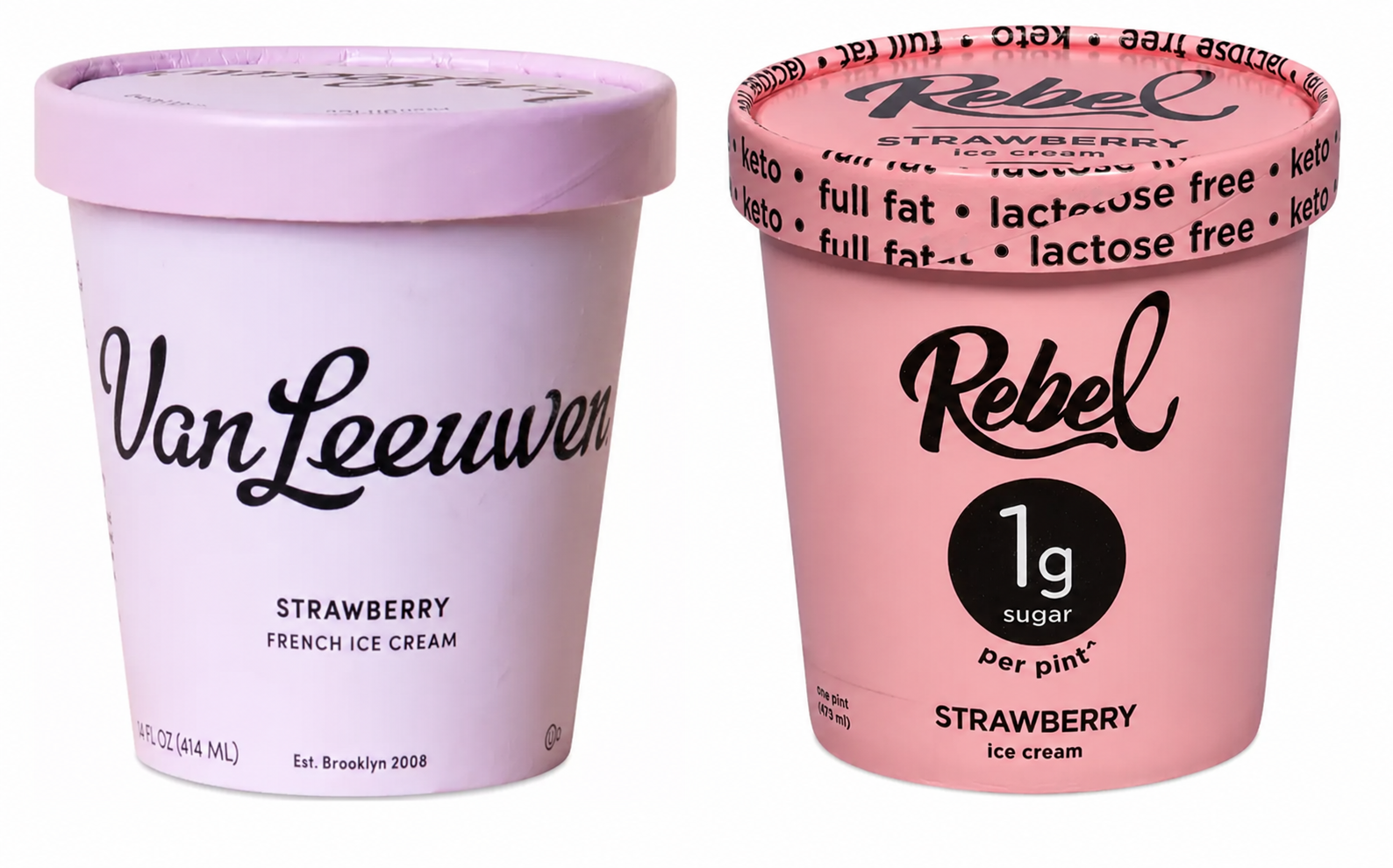
Van Leeuwen’s design features pastel-colored, monochrome pints with matching lids, black script lettering and a minimalist look.
Komitee ordered Rebel to stop selling the infringing packaging and redesign its pints.
“The evidence at trial left no doubt that Rebel infringed and diluted Van Leeuwen’s trade dress and did so intentionally,” Komitee wrote, according to the outlet.
Trademark rights violation ruling
In his order, Komitee ruled that that Rebel Creamery intentionally copied Van Leeuwen’s branding and ordered the defendant to redesign its ice cream packaging, which consists of cardboard monochromatic pints with matching monochromatic lids, use of a pastel color palette, black script typeface lettering with an exaggerated capital letter, and an overall minimalistic design aesthetic, according to court documents on Justia.
The court found that there was evidence of actual confusion in the marketplace between Van Leeuwen and Rebel, according to the order.
“The evidence at trial left no doubt that Rebel infringed and diluted Van Leeuwen’s trade dress and did so intentionally,” Komitee wrote in his order. “As a result, Rebel will be enjoined from selling the infringing products and required to redesign its packaging to avoid any further infringement.”
“Rebel will also be required to disgorge its profits from selling infringing pints,” Komitee wrote.
Judge awards plaintiff $23.8 million
“Van Leeuwen is entitled to $23.785 million of Rebel’s profits from selling infringing ice cream pints,” according to the order. “The Clerk of the Court is respectfully directed to enter judgment for plaintiff and to close the case.”
Van Leeuwen was founded in 2008 and redesigned its packaging in 2014 and again to its current design in August 2016, according to Komitee’s order. Van Leeuwen’s annual growth rate more than doubled from 35.8% between 2014 and 2016 to 91.6% between 2017 and 2018.
Rebel Creamery was founded in September 2017, over a year after Van Leeuwen’s latest redesign of its packaging. Rebel’s packaging began appearing in grocery stores in August 2018 and was discovered by a Van Leeuwen employee in late 2018 or early 2019, according to court papers.
Van Leeuwen filed lawsuit in 2021
Van Leeuwen filed its lawsuit against Rebel Creamery in April 2021, seeking injunctive relief requiring Rebel to repackage its products and account for and pay for the profits from its infringement, to which Komitee ruled in favor of Van Leeuwen.
(And while we’re talking about Van Leeuwens don’t forget FWIW’s sole advertiser, Peter and Ben’s Dad Louis, who when he isn’t building fine houses, will cart you around in his luxury Lincoln SUV)

INC has more details on the packaging dispute:
…. The decision offers a costly warning for founders: Trademark law can protect the overall appearance of packaging even when its individual elements are common—and companies should preserve records showing how their designs were created.
Van Leeuwen sued Rebel in 2021, alleging that the Utah-based, low-sugar ice cream company copied four features of its dairy pints: monochromatic cartons with matching lids, pastel colors, oversized black script, and minimalist layouts.
Van Leeuwen introduced the design in 2016 after hiring Pentagram to prepare the brand for national wholesale distribution. The design firm researched competing brands and presented seven concepts before the founders chose the final look.
Natasha Jen, the Pentagram partner who led the project and testified in the case, tells Inc. that the firm retained its briefs, presentations, design files, rejected concepts, and successive rounds.
“Founders may think documentation is bureaucratic, but it is really a record of authorship and decision making,” Jen says. “Save what was presented. Save what was rejected. The process is part of the evidence.”
Elisha Barron, Van Leeuwen’s trial attorney, said the company believes its sales growth after the redesign and the press attention the packaging received also helped establish that the design was protectable.
The missing design trail
Rebel’s paper trail was thinner. The Archibalds testified that they created their packaging in Adobe Illustrator but produced no sketches, mockups, or earlier versions—only the completed design.
A Wegmans buyer warned Austin Archibald before Rebel’s first retail launch that the cartons resembled Van Leeuwen’s, according to the ruling. Rebel made no changes.
Judge Eric Komitee found that the similarities extended to the lettering, text placement, matching lids, and sparse layouts. The probability that Rebel independently arrived at all those choices was “infinitesimal,” he wrote, calling the founders’ account “clearly fabricated.”
When the original looks like the copycat
The court also found a risk of “reverse confusion”—Rebel’s expansion into major retailers could lead shoppers and buyers to believe Van Leeuwen was the imitator. A Publix buyer reportedly raised concerns about confusion before declining to stock Van Leeuwen.
A survey commissioned by Van Leeuwen found a 34.3 percent net-confusion rate. Mark Keegan, the consumer-research consultant retained by Van Leeuwen, says roughly one-third of surveyed ice cream shoppers associated Van Leeuwen with Rebel because of the packaging similarities.
The ruling doesn’t give Van Leeuwen ownership of pastel colors, cursive lettering, or minimalist design individually. It protects the overall combination and commercial impression of the packaging …. “Many courts will be hesitant to protect something they think is truly a contemporary aesthetic,” Rebecca Tushnet, a Harvard Law School trademark professor, tells Inc.
Tushnet says courts differ over what constitutes bad faith. Some treat deliberate copying as sufficient, while others look for an intent to cause confusion. In this case, she says, the Wegmans warning may have mattered.
“Juries and judges can be hostile to copycats, so the warning may have loomed large,” Tushnet says.
A $23.8-million warning
…. For founders, the lesson begins long before litigation: retain drafts, document design decisions, and investigate warnings from retailers. Van Leeuwen arrived in court with a record of how its identity was created. Rebel arrived with the finished pint.