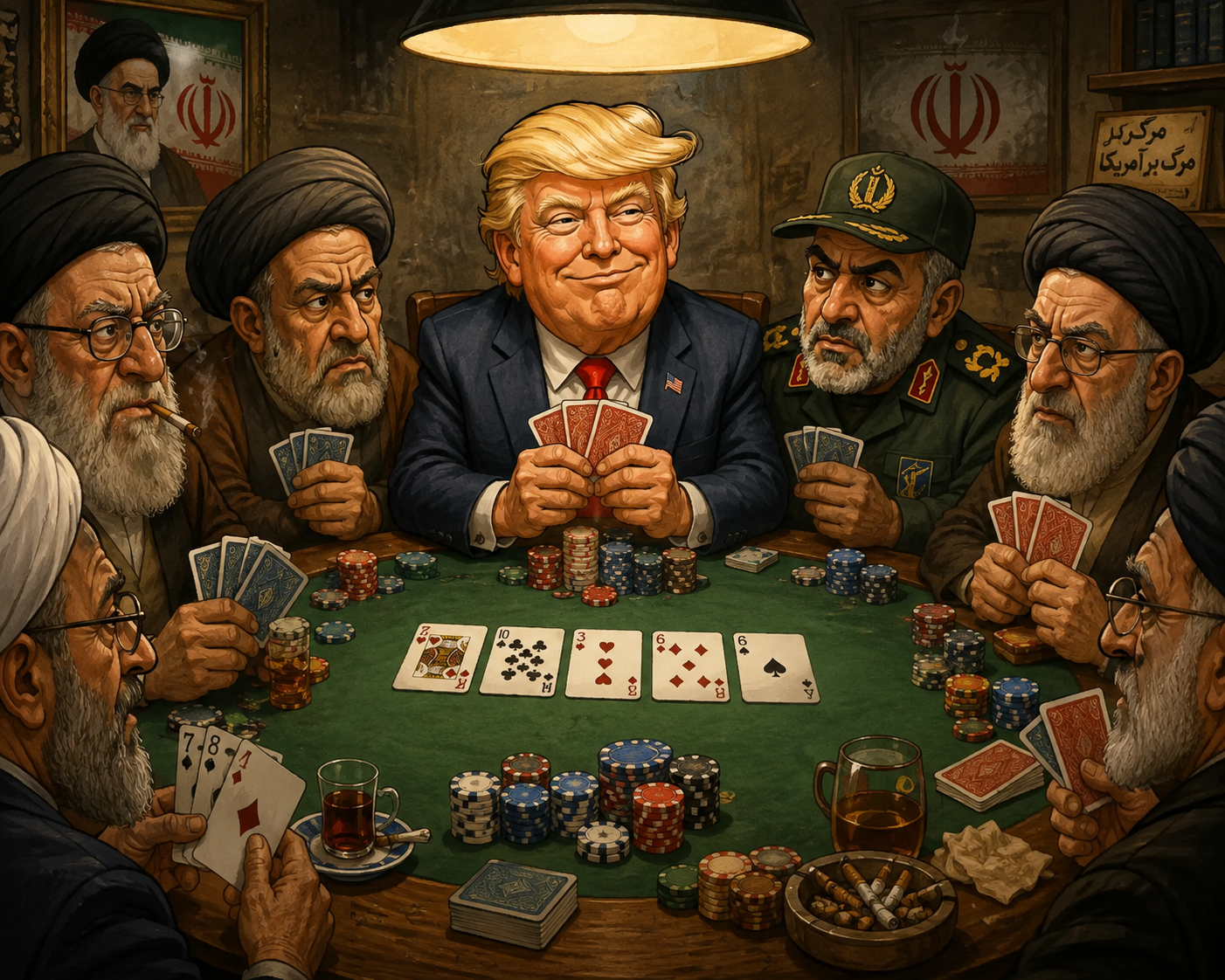
If after five months at the poker table you don’t know who the chump is—you’re the chump
/Trump Cancels Iran Attack After ‘Perimeters’ of Deal Reached; Hormuz to Open, Nuclear Threat Set to Be Ended.
“And if they break their word again, ooooh, boy am I going to unleash Hell on them, and this time I really, really mean it!”
And Hamas has agreed to peacefully disarm, embrace the jews, and peace wiill descend upon the middke East — O Joy!
UPDATE: What didn’t Trump and his advisors understand about Iran and, most importantly, Mahdism?
Iran is not a western country; it’s not even a typical Middle Eastern country, most of which are responsive to a credible threat by an overpowering enemy that they’ll be destroyed if they don’t surrender. The radical Shiaas running Iran merely say, “bring it on, Paradise and our virgins await.” If Trump understood this — the Israelis certainly do — he would never have promised a victory in 2 weeks, or one month, or three months, or “now we’ve got ‘em where we want ‘em.” If there’s an answer to how we get out of this mess short of the total destruction of the country, with all the global havoc that would wreak, I don’t know what it is, but starting a war we weren’t prepared to finish was just damn stupid.
A (very) lengthy essay on this subject was published May 3, 2022 in the Near Eastern Journal. I’ll just include a few of its conclusions and leave out the discussion of the history of the Mahdism — the belief that the Mahdi will return to earth in a final apocalypse and bring peace and justice to the world and won’t that be fun? — and how the IRGC, which has now taken control of the country, holds to the most extreme version of Mahdism and actively seeks to bring that return about now, rather than wait.
Iran’s Revolutionary Guard and the Rising Cult of Mahdism: Missiles and Militias for the Apocalypse
As the U.S. administration seriously considers whether to remove the IRGC as an FTO, understanding its nature, development, and ideology could not be more important to making an informed decision. Much is to be understood about the IRGC’s system of beliefs to differentiate it from a conventional armed force. However, one fundamental aspect of its ideology that until now has been overlooked is the doctrine of Mahdism. There are signs today that the preparations for the return of the 12th divinely ordained Shi’a imam are becoming of pivotal importance to the IRGC’s lens on the world. The rise of a militaristic Mahdist cult among the senior ranks of the IRGC is now not inconceivable and the repercussions far-reaching.
…..
While all of these pillars of the IRGC’s belief system have been assessed to varying degrees, one fundamental value of its ideology that makes up a significant aspect of its indoctrination has yet to be explored: the concept of Mahdism. Mahdism in the IRGC remains a complete blind spot for Western policymakers and experts, and yet its implications could have major consequences
What is Mahdism?
As a Shi’a Islamist force the IRGC’s worldview hinges on Mahdism: the return of the 12th divinely ordained Shi’a imam, Muhammad al-Mahdi (or the Hidden Imam), whom Shi’a Muslims believe was withdrawn into a miraculous state of occultation (hiddenness) by God in 874 CE. …..
….
Iran’s Islamic Revolution: Preparing for Mahdi’s Return
The 1979 Islamic Revolution in Iran led by Ayatollah Khomeini would fundamentally change the Shi’a political doctrine and Mahdism …. Rather than silently waiting for the 12th Imam’s return, Khomeini argued, the 12th Imam was waiting for Shi’a Muslims to prepare the ground for his arrival. ….
Ahmadinejad: The “Government of Mahdi”
The election of the hardliner Ahmadinejad as president in 2005 turbocharged Mahdism across the Islamic Republic. Ahmadinejad — a member of the Basij — was obsessed with the doctrine of Mahdism and finding ways to speed up the return of the 12th Imam. This is perhaps unsurprising given the fact that his spiritual leader was none other than Mesbah-Yazdi. As the new president declared, “We have a mission — to turn Iran into the country of the Hidden Imam.”
…. After the Islamic Revolution, maddahs became a central component of the ideological radicalization of IRGC and Basij members, and were instrumental in preparing Iranian soldiers — often volunteers — to launch “martyrdom-seeking,” human-wave attacks during the Iran-Iraq War (1980-88). Whereas the traditional Shi’a clerical establishment devotes more attention to Imam Ali and Imam Hussain, the maddah culture and class are fixated on Mahdism and praise for the Hidden Imam. The apocalyptic and revolutionary environment is fundamental to heyati and maddah culture. ….
While the doctrine of Mahdism has always been a part of the IRGC’s system of beliefs and indoctrination, it began to flourish under Ahmadinejad, in particular from the post-2009 unrest period onwards.
Mahdism and the Eradication of Israel
Mahdism has also become an increasing focus in IRGC indoctrination and has come to underpin other pillars of its ideology. It is being used to explain the Guard’s system of beliefs, in which the world is seen as divided between good (jebeh-e hagh) and evil (jebeh-e batel). As Saeedi has asserted, the current era represents the final period of history ahead of the reappearance of the 12th Imam, with the world being divided between the “will of the essence of transcendence” and “the arrogant powers.”
The IRGC is increasingly understanding and communicating its official policy of eradicating Israel and Zionism through the doctrine of Mahdism. While the destruction of Israel has been the IRGC’s working objective since its inception, like other Islamist groups this hostility was borne out of viewing the Jewish state an illegitimate, oppressive, and usurping entity for the West to achieve its supposed colonial goals across the Muslim world. More recently, however, the existence of Israel is being viewed and understood as the “greatest barrier” to the reappearance of the 12th Imam. According to the doctrine of Mahdism, part of preparing for the reappearance of the 12th Imam is removing all obstacles and barriers to his return.
Indeed, the ideological belief that the eradication of Israel is a necessary step for the reappearance of the 12th Imam is increasingly being mainstreamed in the IRGC.
The IRGC’s “War Footing” to Prepare to Aid Mahdi’s Army
A decade on from Saeedi’s 2012 speech, in March 2022, Hojatoleslam Haji-Sadeghi, Khamenei’s new representative to the IRGC, reaffirmed the IRGC’s role in facilitating the reappearance of Imam Mahdi. In a speech to IRGC members, Haji-Sadeghi declared, “The IRGC’s last responsibility is to prepare the world for the emergence of Imam of the Age.”
Just weeks after Haji-Sadgehi’s speech, on March 2022, the IRGC released a publication on the militaristic concept of Mahdism, entitled “Waiting means that we must prepare ourselves for soldiering in the army of Imam of the Age.” The IRGC has redefined waiting for the reappearance of Imam of the Age as being about proactively preparing to aid Mahdi establish the rule of justice throughout the world (entezar-e faraj). Based on Khamenei’s statements on the “duty of those waiting,” this is not about “sitting down and mourning” — a cultural custom in Shi’a Islam — but about being on a “war footing” (amadeh baash). The IRGC must “prepare for the army of Imam of the Age, which wants to fight all the centers of power and international corruption.” According to this doctrine, however, this does not mean “because the Imam of the Age will come and fill the world with justice, we have no duty today.” Rather the IRGC is mandated as having a “duty today to move in that direction and prepare for Mahdi’s emergence.” This is presented as fighting “oppression, injustice, discrimination, and coercion everywhere in the world.”
In practical terms, “not accepting and rejecting” the liberal international rule-based order — what is described as the “current situation that rules humanity based on ignorance/barbarism (jahiliyyah)” is presented as one of the actionable measures to pave the way for the reappearance of Mahdi. Against this backdrop, the IRGC’s actions — from regional destabilization to disrupting the international system and its militia network — are being understood and communicated as part of the plan to prepare for the return of Mahdi. Likewise, the Guard’s permanent conflict with America is increasingly being tied to preparing for Mahdi’s emergence, with the U.S. viewed as a barbaric force the “Imam of the Age will come to fight against.” Indeed, in a speech in February 2022 where Khamenei lent his support for Vladimir Putin’s invasion of Ukraine, the supreme leader asserted that Islam was in a permanent war with the age of barbarism/ignorance (jahiliyyah) and that the modern form of this was the “American mafia regime.”
Based on Islamic hadiths and historic Shi’a narrations, the militaristic doctrine of Mahdism also calls on Shi’a populations to take up arms in preparation for the end times. As another publication on “IRGC and Mahdism” asserts, “Since the foundation of [the Islamic Republic] is bound to the Lord of the Age (Imam Mahdi) in order to truly connect with the Lord of the Age, various tasks have been assigned to us” not least “regarding the military readiness of the Shi’as.” In this light, the IRGC’s involvement in the Middle East — including its weapons proliferation, ballistic missile program, and support for arming, financing, and training Shi’a militias — is consistent with Mahdist doctrine to pave the way and remove the barriers to the reappearance of Mahdi. Until now, most Western observers have viewed all of the IRGC’s activities through the lens of national-interest, but its involvement in the Middle East is more consistent with the Mahdist doctrine.
Conclusion
As the U.S. administration assesses whether to delist the IRGC as an FTO, the nature of the Guard reveals that it is not a conventional state armed force and should not be treated as such. The IRGC is an ideological organization that shares key characteristics with other designated Islamist organizations, including its quest for an expansionist Islamic state, a global Islamic order, forceful imposition of sharia law (Shi’a interpretation), militaristic concept of jihad, and anti-American and anti-Semitic ideology.
The finding of this research paper reveals three visible trends in the IRGC. The first relates to indoctrination becoming an increasing focal point in the Guard. Khamenei and his hardline circle have sought to nurture a more radical IRGC generation by dedicating more time to ideological indoctrination of its members. The promotion system within the ranks of the IRGC also favors ideological conviction over technical expertise, ensuring the most zealous members rise up within the chain of command. The second trend relates to the increasing priority given to Mahdism within the IRGC’s ideology. From the post-2009 period onwards, the doctrine of Mahdism has become one of the main prisms through which the IRGC and affiliated hardline clerics would understand the world around them and the IRGC’s actions, as well as communicate that understanding. In turn, there has been greater emphasis on viewing the IRGC as the military vehicle to prepare the foundations for the reappearance of the 12th Imam, with policy objectives such as hostility toward the U.S. and the eradication of Israel being understood through this prism. This is consistent with the goal of Khamenei and his hardline allies, such as Ayatollah Alamalhouda, the supreme leader’s representative to Khorasan and President Ebrahim Raisi’s father-in-law, to transform the concept of Mahdism from a set of feelings into an “ideological belief.” The third and final trend relates to the IRGC’s younger generations becoming more radical and extreme. In this regard, efforts by Khamenei and the Guard’s Ideological-Political Organization to nurture a more radical generation among the IRGC has paid, and is paying, dividends.
Against this backdrop, the rise of devout followers of the militaristic doctrine of Mahdism among the senior ranks of the IRGC is not inconceivable and should not be ruled out. [Four years later, that’s been accomplished] . While there is hope that the IRGC’s senior leadership will act pragmatically, internal structures within the Guard — including its indoctrination and promotion system — certainly open up the possibility that devoted Mahdists could occupy senior leadership positions. Such a scenario could have far-reaching consequences as it would bring the three pillars of the IRGC’s foreign policy — militias, ballistic missiles, and the nuclear program — under their control. Even if a small number of devout Mahdists occupy senior positions in the Guard, it is possible that they may seek to facilitate and speed up the return of Mahdi. This would have major implications for some of the policies that are being understood through the prism of Mahdism, such as Israel’s existence being the “greatest barrier” to the reappearance of the 12th Imam.
At present [2022] the doctrine of Mahdism in the IRGC remains a complete blind spot for Western policymakers, yet it could have major implications for the Islamic Republic’s militia network, ballistic missile program, and even its nuclear program. Of course, no one knows for sure if devout adherents of the ideology will attain senior command positions in the IRGC. The objective of this paper, however, is simply to point out that it would be unwise not to prepare for this scenario given the huge implications it would have for U.S. and global security.
Four years on, the author’s warning has come true, and we were not, are not prepared.