Cry me a river
/
Saw this headline and thought, uh-oh, Ned’s got a new plan for wasting our money, but, whew!
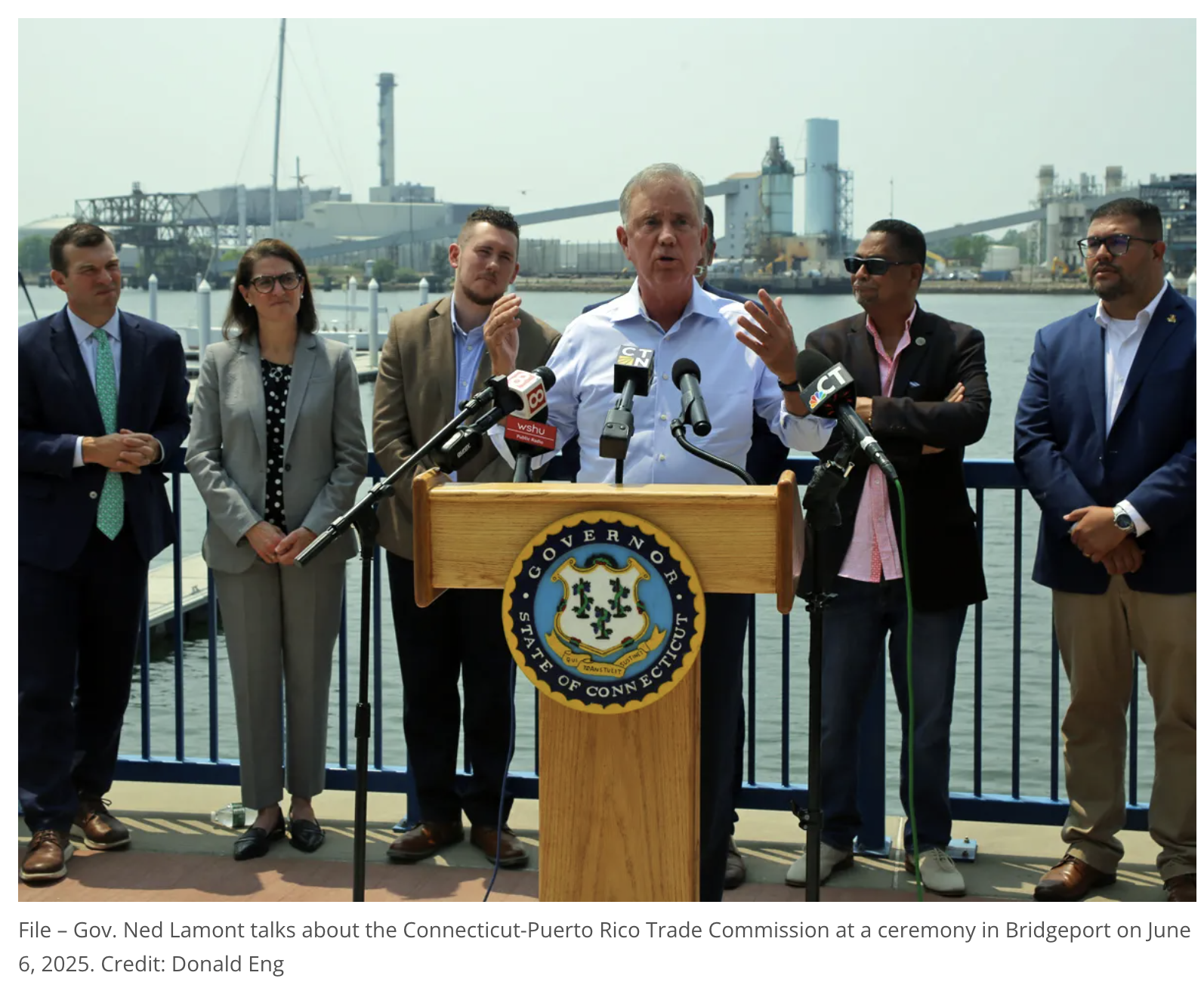
Lamont: Connecticut stands ready to aid Puerto Rico in its water crisis
HARTFORD — The state government in Connecticut stands ready to answer any request from Puerto Rico for assistance during the island's ongoing water crisis, Gov. Ned Lamont said Wednesday.
"We're ready to provide support when requested," he said.
Lamont told reporters in Hartford that state and Puerto Rican officials have been in contact but Puerto Rico Gov. Jenniffer González-Colón has yet to ask Connecticut for help.
"We've had some outreach," he said.
"Look, we're standing by. We've got water companies ready to step in when asked and help with infrastructure," he said. "The Connecticut National Guard is ready to step up as needed when asked."
Fortunately, it turns out that it’s merely a public relations ploy and shouldn’t cost us anything:
"This is basically a message to people of Puerto Rico, [said State Rep. Christopher Rosario, D-Bridgeport] 'Connecticut, estamos presente.' We're ready. We're here to help in whatever way we can," he said.
To that end, the Aquarion Water Authority has agreed provide a $1,500 contribution to a nonprofit organization that the Connecticut-Puerto Rico Trade Commission recommends to assist Puerto Rico get through its ongoing water crisis, said George Logan, the director of community relations for the nonprofit, quasi-public corporation.
Problem solved! Except that it’s not the (lack of) humidity failing Puerto Rico, it’s the stupidity.
(Readers should feel free to skip the rest of this post; I just write these things because I get bored in the morning and like to do deep dives into subjects that interest me. Executive Summary: Puerto Rico’s a mess, and always has been, because it’s nothing but a steaming pile of corruption and incompetence). Now go on with your day.)
Back on August 26th Greenwich Times’s parent company ran a weepy AP article on the drought, devoting paragraph after paragraph on the island’s troubles and finally, after blaming global warming, finally admits the heart of the problem in these four throw-away sentences:
Dry conditions aside, Puerto Rico is also struggling with a lack of water blamed on crumbling infrastructure.
Thousands of Puerto Ricans were already experiencing water shortages and changes in pressure for up to a year.
The lack of water unrelated to the drought prompted San Juan Mayor Miguel Romero to sue the island’s Water and Sewer Authority in late May, with the governor acknowledging the agency’s infrastructure has lacked investment and maintenance for decades.
Puerto Rico previously implemented water rationing measures in 2020 and in 2015, when about 400,000 utility customers received water only every third day.
This has been known for decades, yet nothing has been doen to correct it. Here’s a summary from our friends (?) at Google AI:
AI Overview
Crumbling and neglected infrastructure has severely worsened Puerto Rico's water crisis by causing massive daily water losses and leaving the system unable to cope with a historic drought. [1, 2]
Major Infrastructure Failures
Massive Water Loss: Long before the current drought, nearly 60% of all treated water produced by the Puerto Rico Aqueduct and Sewer Authority was lost before reaching homes. This loss stems from leaking water mains, broken pipes, inaccurate meters, and unauthorized use. [1]
Pipeline Ruptures: A series of major breaks in the Superaqueduct—a critical 72-inch pipeline carrying water 50 miles along the northern coast to San Juan—drastically disrupted supplies ahead of the emergency. [1]
Lack of Maintenance and Investment: Decades of deferred maintenance, government inaction, and a lack of funding for structural resilience have left the island's reservoirs and distribution networks highly fragile. [1, 2]
Public Consensus on Neglect: Most users on Reddit agree that systemic infrastructure decay and failure to modernize reservoirs are primary drivers of the crisis, far beyond just the lack of rain. [1]
One of Google’s cited sources is the Yale Climate Connections newsletter and, having perused it pages before, I can attest that its editors would far prefer to blame global warming for all the earth’s woes. Yet …
U. S. citizens in San Juan, Puerto Rico, are spending hours waiting for water trucks after water rationing went into effect amid drought on the island archipelago. Puerto Rico Gov. Jenniffer González declared a state of emergency in late July as the water in key dams dropped below levels that can support communities.
Seven of the most populous of the 78 municipalities on the island archipelago are experiencing a rotating schedule of 48 hours – or more – without water, with more than 500,000 people affected.
How did this water crisis get so bad? Read on to get up to speed.
It’s been raining in Puerto Rico, so why isn’t there enough water?
Seventy-two percent of the land area of Puerto Rico is experiencing drought, according to the U.S. Drought Monitor. But this water crisis isn’t just about a lack of rain: high temperatures, lack of dredging sedimentation in reservoirs, deteriorating infrastructure, and mismanagement have led to Puerto Rico facing one of its worst water crises since 2015.
…. As Yale Climate Connections contributor Yessenia Funes explains in her newsletter (you should subscribe!), the Indigenous inhabitants of Puerto Rico chose the island for its plentiful rainfall. But as Puerto Rican journalist Manuel Guillama Capella points out, residents are now experiencing a culmination of decades of poor maintenance of collapsing infrastructure.
“For more than three decades, the Puerto Rico Aqueduct and Sewer Authority has staggered from one crisis to the next,” he wrote in Spanish in an article published in Puerto Rico’s most-read newspaper, El Nuevo Día. “Fiscal crises, operational problems, failed privatizations, poor planning, and inefficient execution of capital improvement projects that, in theory, should provide the stability needed for the production, treatment, and supply of drinking water service required by nearly 1.3 million households and businesses across Puerto Rico.”
Has Puerto Rico experienced a water crisis before?
A 2015 drought crisis caused prolonged rationing and disrupted daily life for millions of people – and disrupted farming. Although the current situation doesn’t exactly replicate the 2015 drought in terms of duration and geographical areas affected, it shares troubling features: a sustained decline in water sources, limited recovery after isolated rainstorms, pressure on filtration plants, and prolonged service interruptions.
This year, extreme heat has made the problem worse by increasing water consumption and driving greater evaporation from reservoirs and other bodies of water.
What is the government doing about the problem? (Spoiler alert: nothing)
The 2015 drought was a warning that still hasn’t fully translated into public policy.
Even before the water crisis, approximately 65% of potable water either did not reach clients due to water leaks or went unbilled.
The González administration has faced ongoing criticism of its handling of the situation, including a lack of communication about where and when there will be water rationing. Recently, unionized employees of the Puerto Rico Aqueduct and Sewer Authority went on strike, stating that they can no longer live on $10.50/hour.
The Federal Emergency Management Agency, or FEMA, announced that it would send water trailers to Puerto Rico to assist with water distribution, ABC reported.
What about desalination as a solution?
[In] this case, desalination doesn’t seem to be a potential solution. It can be useful, but it requires high-energy consumption on an island with already failing infrastructure. Desalination also requires a lot of investment, specialized maintenance, and proper brine management.
So, there’s Puerto Rico’s water infrastructure. What about the electrical grid in this, the Democrats’ would-be 51st state? Brace yourself, Bridget.
It’s actually far worse than this (almost) sympathetic ChatGTP summary says it is, but this will do for now:
The political/financial history is arguably the key to understanding the physical condition of the grid, because PREPA's problem wasn't simply that it "ran out of money." It spent and borrowed enormous amounts of money while systematically failing to price, budget, govern, and maintain the utility like a utility.
There's also an important twist: the privatization experiment has produced some genuine operational improvements, but not the dramatic improvement in reliability that Puerto Ricans were promised. And separating the system among PREPA, LUMA, Genera, the Energy Bureau, the fiscal Oversight Board, Puerto Rico's government and federal agencies has created a new coordination problem of its own. GAO's June 2026 report is quite explicit about that.
1. How do you borrow $9 billion and still have a crumbling grid?
At first glance it seems paradoxical:
If PREPA borrowed ~$9 billion, shouldn't Puerto Rico have ended up with $9 billion worth of shiny new power plants and transmission lines?
No.
A significant part of the borrowing was effectively compensating for a utility whose revenues did not cover its true costs.
The Oversight Board's reconstruction of PREPA's finances says that for decades PREPA failed to set rates sufficient to cover operating expenses—including its pension obligations. It borrowed for fuel, didn't adequately fund its retirement system, accumulated unpaid vendor obligations, and borrowed to service existing debt. Meanwhile, maintenance was deferred.
That's an extremely dangerous financial model.
Imagine a homeowner doing this:
Income: $60,000
Actual annual expenses: $70,000
Home maintenance needed: $10,000
Solution: borrow $20,000.
Next year:
Income: still $60,000
Expenses: $70,000
Maintenance: postponed
Interest: now $2,000
Solution: borrow another $12,000.
Repeat for years.
Eventually the homeowner has enormous debt and a roof that leaks.
That is surprisingly close to what happened.
Time out to mention that this is how our own federal government has operated for decades, and will continue ti do so until it can’t — Ed]
2. Electricity prices were political
PREPA was not an ordinary investor-owned utility.
For most of its history it was simultaneously:
a power company + government agency + employer + borrowing vehicle + political institution.
That matters enormously.
Electric utilities require politically unpleasant decisions. If transformers are reaching end-of-life, you have to spend money replacing them even though customers see no immediate benefit. If fuel costs rise, rates eventually have to reflect it. If staffing isn't efficient, you have to restructure it.
Politicians have powerful incentives to postpone all three.
Puerto Rico's fiscal Oversight Board now describes PREPA as having operated with a structural financial deficit since 2004, and says PREPA went more than 30 years without comprehensively evaluating its long-term system needs.
That's extraordinary for a utility.
And the problem wasn't necessarily that Puerto Rican electricity was cheap—it famously wasn't. Fuel was extremely expensive.
Rather, money customers paid was heavily consumed by fuel and current operating expenses, while rates weren't structured around what was actually necessary to rehabilitate the physical system.
The Oversight Board describes the old budgeting logic this way: budgets essentially started with "how much money do we have?", rather than "what does this electrical system actually require to remain reliable?"
Those are profoundly different questions.
3. Then there were subsidies and politically mandated benefits
PREPA also wasn't simply charging every customer the full cost of serving them.
Puerto Rican law created various subsidies and preferential arrangements. Municipalities historically received electricity through a contribution-in-lieu-of-taxes arrangement, and other categories of customers received subsidized rates.
Congressional testimony examining PREPA's crisis specifically identified legislatively mandated subsidized service and municipal arrangements as contributors to its financial problems.
Individually, some of those policies were defensible public-policy choices.
The financial problem arises when government says:
"Electricity for X should be subsidized."
but doesn't separately appropriate enough tax money to pay the utility for that subsidy.
Then PREPA itself becomes the social-policy funding mechanism.
That cost ends up somewhere else in the system.
4. Puerto Rico made an exceptionally bad fuel bet
This was perhaps the biggest structural mistake.
Puerto Rico built much of its generating system around imported petroleum.
That was particularly painful after the oil shocks of the 1970s, and it remained painful for decades.
Oil isn't merely expensive. Its price fluctuates wildly. So PREPA had a utility whose largest operating expense could suddenly explode because of events thousands of miles away.
From 2002 through 2017 alone, PREPA spent roughly $27.7 billion purchasing fuel, predominantly oil, according to an analysis of PREPA records.
Think about that number relative to the ~$9 billion debt.
Puerto Rico wasn't necessarily borrowing $9 billion to build $9 billion of infrastructure.
It was operating a machine that continuously consumed imported fuel while simultaneously carrying debt and postponing maintenance.
That's how you can spend spectacular amounts of money and still end up with rusty generating plants.