Sure, provide relief funds as a humanitarian matter, but not as some sort of global warming "reparations".
/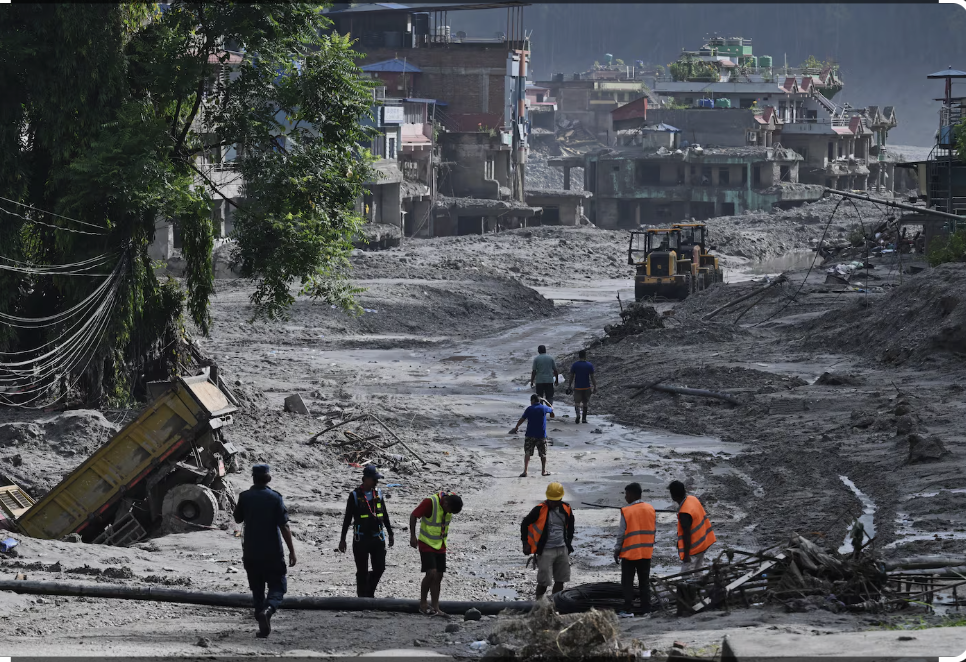
Nepal is on the boundary of the geological collision between the Indian Plate and the Eurasian Plate, a process that’s been going on for 50- 100 million years, and is pushig the Himalayas higher every day. The result is earthquakes, many of them, and despite what global warming profiteers and idiot news readers say, has nothing to do with global warming. But admitting that won’t sell ads or generate grants, so we get this instead:
ABC: Nepal flood disaster sparks concern over glacier-related events amid climate change
The type of event that’s ‘triggered by climate change’
Glacier collapses and landslides are complex can be caused by a number of factors, but climate change often plays a role, scientists say. Nepal, in the rapidly-warming Himalayan region, is home to thousands of glaciers which are melting and destabilizing as temperatures rise.
And then, from another rag:
The Guardian: Climate injustices have been laid bare in the Nepal-Tibet flood disaster
The recent glacial collapse and catastrophic floods in Nepal and Tibet are not isolated tragedies (Report, 28 August). They reflect accelerating climate disruption that disproportionately affects the countries and people that are least responsible for global emissions.
As climate change intensifies, glaciers around the world, including in the Himalayas, are melting at unprecedented rates, destabilising ecosystems and causing glacial collapse and ice-and-rock landslides, destroying settlements, villages and livelihoods in minutes. No one died when a Swiss glacier collapsed last year, owing to early-warning systems that were in place. But a lack of early-warning systems means that the disaster in Nepal and Tibet has led to hundreds of deaths and thousands missing.
Events like these are not “natural disasters”. They are due to global warming and climate injustices, and also flawed development policies, including rampant property developments on vulnerable floodplains. They call for better disaster preparedness and investment in early-warning systems. Most importantly, they require global action.
And so on –
Now for the rest of the story
Leslie Eastman, September 1: The Ghoulish Race to Turn Nepal’s Flood Victims Into a ‘Climate Crisis’ Talking Point
The political talking point ignores tens of millions of years of plate tectonics and its consequences, and completely dismisses well-established mountain-weather dynamics.
And September 4: Nepal Wants a $5 Billion Climate Handout from UN for a Himalayan Bedrock Collapse, but …
Nepal’s request should be rejected unless the U.N. would likewise fund U.S. recovery from a San Andreas earthquake or Cascadia tsunami.
As it turns out, I was right to focus heavily on the geology of the Himalayas in my earlier piece. The root cause of that landslide was weak bedrock that took the overlaying glacier with it.
Geomorphologists Kristen Cook and Dan Shugar said initial images from Nepal were obscured by clouds and dust from the debris, so they could only see that part of a glacier had broken off from Langtang Lirung peak, near the border with Tibet. In clearer images from Thursday, they said they could see that the bedrock underneath the glacier had collapsed, taking the massive chunk of ice down with it and sending boulders and ice into the valley.
“It shows the whole area without anything hidden, and we could see that, yes, it looked like there was not only this glacier that had failed, but a much larger chunk of the bedrock of the mountainside itself that had given way,” said Shugar, associate professor at the University of Calgary. “You have this big bedrock failure that took part of the glacier with it.”
Dr. Matthew M. Wielicki, Director of the US Global Change Research Program, says this information changes the story.
That distinction matters. This was fundamentally a geologic mass-failure event involving bedrock, which then mobilized ice, rock, sediment, and water downstream… not simply a glacier spontaneously collapsing because of warming.
Well, this changes the story considerably.
— Dr. Matthew M. Wielicki (@MatthewWielicki) August 31, 2026
The initial headlines called this a “glacial collapse.” Satellite analysis now indicates the major failure was a massive bedrock collapse beneath the glacier.
That distinction matters. This was fundamentally a geologic mass-failure… https://t.co/5vGx4ND8Iz pic.twitter.com/SyHWx1tP0s
Tectonic forces along colliding plate boundaries can substantially weaken rock, creating dense networks of fractures that leave slopes far more vulnerable to failure. This fact helps explain why landslides can be so frequent and destructive in active plate collision zones….like the Himalayas.
The Nepal landslide was an Earth-caused disaster.
Nepal’s request should be rejected unless the United Nations is prepared to apply the same standard consistently, such as providing the United States with climate-recovery money after a catastrophic San Andreas Fault earthquake or a Cascadia Subduction Zone rupture and tsunami.
The Earth does not need climate change to produce earthquakes, landslides, and tsunamis, and turning every natural disaster into a climate-money shakedown is neither science nor justice.
(If you can put up with the sing-songy voice of this woman who calls herself “Geo Girl”, this is actually a pretty good presentation on what’s going on over at “The Roof of the World”.)