What I said below

The new report from the Government Accountability Office — a federal auditing agency — shows that of the $3.7 trillion the federal government spent in 2015, $3.2 trillion of it didn’t require authorization by Congress that year. In other words, Congress only specifically approved 14% of what the federal government spent that year.

Over the years, Congress has passed laws that allow federal spending without any annual congressional approval. The biggest chunk is for so-called “entitlement programs” like Social Security, Medicare, Medicaid and welfare. Congress provided these programs with “permanent appropriations.” Spending levels are set automatically, based on eligibility rules and benefit amounts.

Over the years, this kind of autopilot spending authority exploded from $1.7 trillion in 1994 to $3.2 trillion by 2015. That’s an 87% increase, after adjusting for inflation.

The US population has increased by 24% since 1994, so “autopilot spending” per capita — again, mostly entitlements — has increased by nearly 66%.

Tulip bulbs, Bitcoin, the US Dollar?

mackay.jpg

Bitcoin is dead.

Erik Finman, who gained renown after becoming one of the earliest crypto millionaires, told MarketWatch in an interview that the virtual currency that made him wealthy is headed to the trash bin.

“Bitcoin is dead, it’s too fragmented, there’s tons of infighting. I just don’t think it will last.

“It may have a bull market or two left in it,” he added, “but long-term, it’s dead.”

Finman was especially downbeat about Litecoin — which has fallen 95 percent from its peak — as being on the way out.

“Litecoin has been dead for a while,” he said. “It’s like when the sun is going down and there’s that eight-minute period just before it goes dark. Litecoin is in its seventh minute.”

In the last 24 hours, bitcoin hit a new yearly low of $3,126, and some analysts believe it may fall even further — below the $3,000 level.

It’s been nearly a year since bitcoin surpassed $18,000 and appeared headed toward $20,000 — before falling back to earth.

As I understand these things, a currency’s value is based on trust of the issuer. Continental dollars didn’t amount to much (though I believe our new government did end up making good on most of them), Confederate dollars were worse, and Bitcoin was an implausible scheme from its inception. I’d say I was surprised by Wall Street’s jubilant acceptance of Bitcoin as something good to invest in, but nothing our geniuses do down in the canyons surprises me.

I’m more concerned about what happens when the hollow foundation of our own currency is exposed, but I suppose that will only happen when the entire global economy collapses, so who’ll notice?

I have mixed feelings about this, but on the whole, I think justice was done

San Francisco Planning Commission orders renegade developer to rebuild an exact replica of the house he tore down.

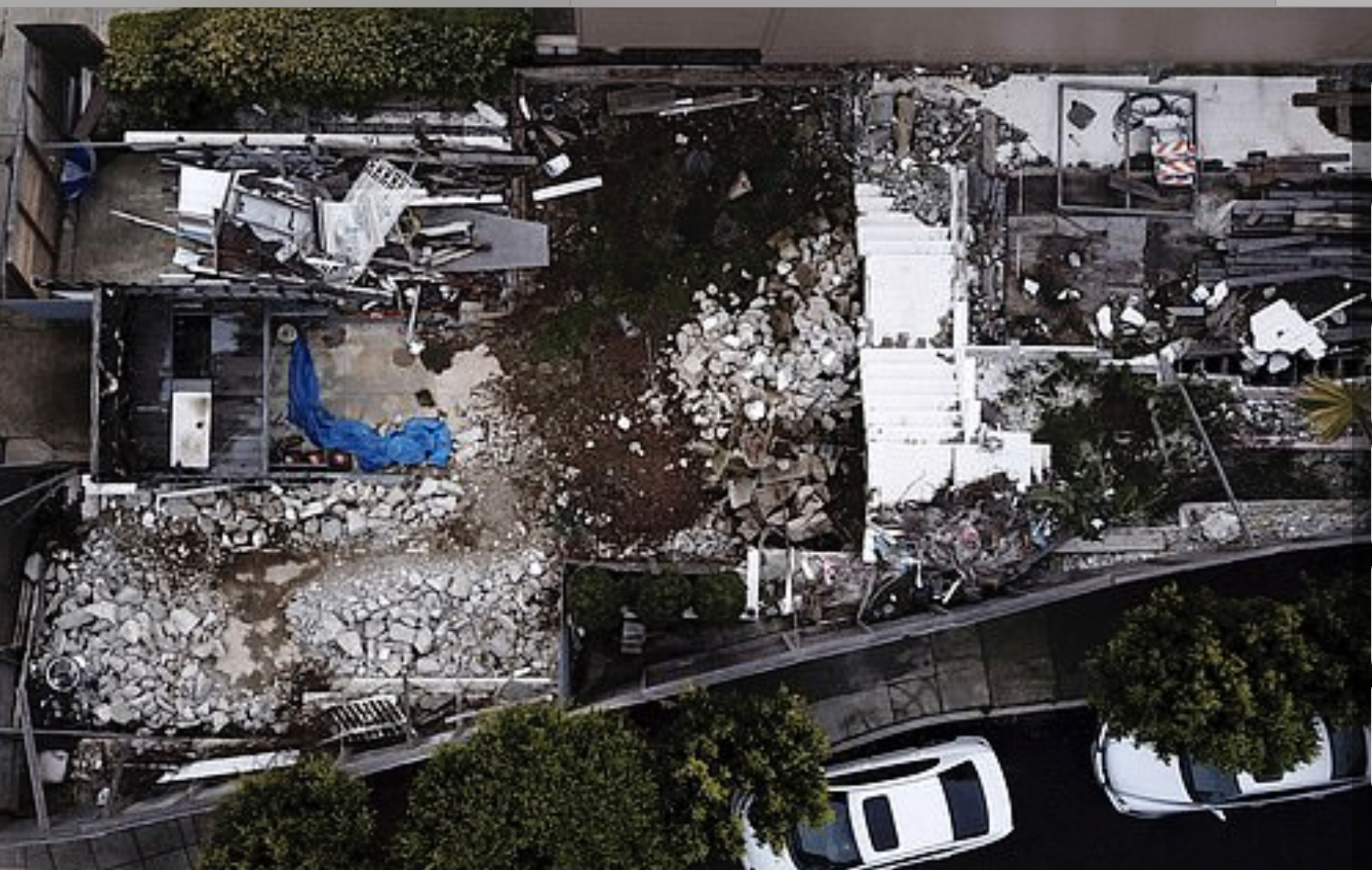
A San Francisco man has been ordered to build a replica of a landmark house he illegally demolished to make way for a mansion that would have been triple the size. 

It was an unprecedented ruling from the San Francisco Planning Commission, which wanted to send a strong message about the developer's actions. 

The Largent House, which was built in 1936, was 1,300 sq ft and featured an indoor swimming pool. It was located in San Francisco's Twin Peaks neighborhood.  

Johnston had planned to remodel the two-story home and submitted plans to the city that mostly kept the first floor intact. His permit was approved.  

But his neighbor Cheryl Traverce was shocked to find the house completely gone, save for a garage door and frame, when she returned from a vacation. 

'I went to New York for about a week and a half and came back, the house was gone,' she told KPIX. 'Totally gone. I was shocked.' 

Johnston later applied for a retroactive demolition permit and asked to build a new three-story house that would expand the size from 1,300 to nearly 4,000 sq ft.

The city believes he then wanted to flip the home for a profit. Johnston has claimed he wanted to move his family of six into the planned mansion

'We acknowledge and apologize for the fact that a small portion of the work exceeded the scope in the approved plans,' he said. 

The planning commission unanimously voted to order Johnston to build an exact replica of the design. 

They also want Johnson to include a plaque that tells the story of Neutra's original house, the demolition, and the replica. 

'The fact that it was a unanimous vote should send a message to everyone that is playing fast and loose that the game is over,' Aaron Peskin, a member of the San Francisco Board of Supervisors, told the San Francisco Chronicle

The San Francisco Planning Commission unanimously voted to order Johnston to build an exact replica of the design

'We want to preserve iconic, historic structures, but even more important, we want to protect our reservoir of more affordable housing stock.

'You want a 1,300-square-foot house to be worth what a 1,300-square-foot house is worth, rather than a mega-mansion.' 

I trend towards the libertarian, do-what-you-want-with-your-own-property side of these arguments, but here there were regulations in place, the developer pretended to be playing by them, and lied. I think he got what he deserved.

(Ironically, if he does build an exact replica, with modern electrical, plumbing and HVAC systems, windows, etc., he’ll probably still end up with the $4 million house he was aiming for.)

“We acknowledge and apologize for the fact that a small portion of the work exceeded the scope in the approved plans,' he said.”

“We acknowledge and apologize for the fact that a small portion of the work exceeded the scope in the approved plans,' he said.”


It's a wonderful life — or could have been

dope

dope

A wonderful comment found at Instapundit, and just in time for Christmas:

Someone wrote that in It’s a Wonderful Life Old Man Potter should have been the good guy. He was trying to make something of the town. George Bailey made risky loans, joked about losing money, gave a blonde a loan when she kissed him, and employed incompetent relatives. Uncle Billy literally gave money away. No wonder the S&Ls collapsed.

Oh God, please don't let this spread to refrigerators

Just … no

Just … no

“Living coral” — bright pink to us plebes — has been declared “color of the year” by some group, and interior decorators are expected to march in lockstep off the cliff.

You may scoff, but I distinctly remember when “avocado” was declared to be the next new color choice back in the mid-60s, and sure enough, within a year or so I began seeing avocado refrigerators, cabinets, bathtubs and even toilets (!) in the homes of my friends’ parents. Even today, touring homes as a realtor, I still come across artifacts from that dreadful era.

Let’s make white the new pink.

Any proper Englishman would have paid for the privilege

please sir, may i have another?

please sir, may i have another?

45-year old (American) pledges to a fraternity, complains to police that his naked bottom was spanked “200 times” (was he really counting?)

A middle-aged Brooklyn man told cops he paid a painful price for pledging a fraternity at the ripe old age of 45 — by getting whacked on the backside hundreds of times with a wooden paddle, police sources said Friday.

Tory Gates, 45, said he was drinking “heavily” inside a Bedford-Stuyvesant brownstone on Dec. 7 when the Omega Psi Phi brothers blindfolded him, whipped out a wooden paddle and told him to bend over, according to police sources.

That’s when they went more medieval than Greek on his heinie, whacking it up to 200 times with the paddle and their open hands, according to the sources.

The “Old School” meets “Animal House” booty lashing was part of a bizarre hazing ritual, Gates told cops.

He was so bruised up by the agonizing bashing that he checked himself into Mount Sinai Hospital — and called the cops on his would-be frat bros.

On Friday, the apartment where the alleged paddling went down on Marion Street was boarded up and had a chained-off gate.

A sticker with the phrase “We Black Men Care” was slapped on a door of the home.

Gates’ neighbors — who were stunned that he would go Greek so late in life — said he has two teenage kids.

“A hazing incident? Do you know how old he is?” said one neighbor, who asked not to be named.

“Maybe it’s about nostalgia or something. He’s a strong guy, physically, so I’m not sure what that is all about.”

Police said they were having trouble getting in touch with the victim Friday.


It's Saturday night, so time for another amusing (at least to me, it is) story from the past

Back in the late 80s I was an associate at a smallish law firm and, being an associate, had to take whatever shit work they assigned me, and some of that was matrimonial law, which I hated, absolutely hated. But it did produce one shining moment.

We, unfortunately, represented the husband side of a DINK — double income, no kids — couple who were splitting up. Agreement on asset division went well: each had their own financial accounts, the house would be sold, proceeds split 50/50. no argument about who got the Lazy-Boy, who got the sofa, etc., but like so many of these cases, there were some deep, angry emotions under the surface, and those eventually focused on one object: who would get the new Saab turbo convertible?

Many hearings were held on that car; so many that the legal fees must have eaten up any equity there might have been in that damned machine, but the parties were adamant, so we pressed on and finally, we persevered, and hubby won the car.

Now, our client was a demanding, arrogant, son of a bitch, and wasn’t the firm’s most popular client, especially not mine, since I had the most contact with him. So when the idiot went home with the keys to the Saab and handed them to his girlfriend, and she sped off on a test drive and promptly totaled it, and when it turned out that title and insurance were still in the wife’s name, a great cheer erupted in our office.

Tee hee.

Robocalls — 33% of all incoming? My own experience is closer to 95%

Robocalls on the rise, and people are switching to texting instead.

Like many, I’ve stopped answering calls from unknown numbers. If the caller leaves a message (rarely) I first check the duration of that message, and if it’s less than 30 seconds, I delete it.

The scammers will undoubtedly come up with a clever way to transition to text frauds but for now, if you want to contact me and you don’t think I’ve already got you on my contact list, leave a message, and make it longer than 30 seconds. Good advice when calling anyone for the first time.

People seem to be actually answering their phones less and less these days, also using them to make fewer calls when texting and social network messaging works just fine and is even quicker in many cases. Arguably helping that trend along is the fact that we don’t always know who it is on the other end of the phone when we get a call, thanks to the veritable explosion in robocalls and a myriad of scam-type phone calls.

Transaction Network Services has estimated that one-third of all calls placed in the first half of 2018 were robocalls. Also, the FTC says it gets about 400,000 complaints about robocalls every single day.

That'll learn her

Drunken teacher bites student on the ass

A former middle school teacher has pleaded guilty to biting a 14-year-old girl’s butt as the teen played water volleyball during a Fourth of July celebration in Georgia.

Jonathan William Herbert, 30, will serve 30 days in jail and four years probation under the plea deal reached on Friday, according to The Daily Mail.

Herbert allegedly did nothing to hide his actions: Multiple witnesses saw the drunken educator swim underwater and bite the girl while in a lake north of Atlanta, authorities said. The perv then tried to bribe a cop with $200 after he was nabbed.

He didn’t have any connection to the girl or her family. Herbert resigned from his teaching job on Aug. 1.

Probably just as well.

(Daily Mail article on this incident reports that Mr. Herbert is a resident of Dacula, Georgia — do you suppose they dropped an “r”? )

A year ago today the world ended, or it was supposed to

The repeal of Obama’s “Net Neutrality” rule was going to destroy the Internet — it didn’t. In fact, it’s more robust than ever.

One year after FCC Chairman Ajit Pai liberated broadband networks, doomsayers have been proven wrong.

Of all the anti-Trump hysterias of our age, perhaps the most absurd and extreme was the charge that last year’s repeal of an Obama-era regulation would break the Internet. A year later, the Internet is still working just fine and in many ways much better for U.S. consumers.

The Obama strategy was to impose on the Internet old-fashioned telephone rules to force network operators to offer cheap service to heavy Internet users like Netflix and Google. It was a lobbying coup for the tech industry—getting Washington to cut Silicon Valley’s phone bill.

When Trump-appointed reformers wisely sought to roll back this misguided rule and restore the freedom that had allowed the Internet to thrive in the first place, the reaction was intense. 

Roslyn Layton of the American Enterprise Institute writes

A year ago today, the Federal Communications Commission (FCC) repealed the harmful 2015 internet regulation dubiously titled the “Open Internet Order.” The Washington Post, The New York Times, CNET, Ars Technica, Recode, The Verge, and advocacy groups such as Free Press and Public Knowledge predictably forecasted apocalyptic consequences to the rollback of the regulation, mischaracterizing the Restoring Internet Freedom Order (RIFO) which replaced it. CNN declared “the end of the internet as we know it,” and other media outlets said the RIFO was “gutting the rules that protect the internet,” and “that the internet has no oversight.” A year later, the internet is alive and well. The media and pundits are unlikely to issue corrections, but here are some facts to remember.

When the media talks about the end of the internet, they are referring to the end of the price control that favored Silicon Valley at the expense of consumers... In 2015 the FCC claimed that its rules were underpinned by a “virtuous circle” and predicted increased investment in and deployment of networks, but the opposite happened. Chairman Ajit Pai testified in Congress that the rules depressed investment and that the RIFO reversed that trend.