Why Johnny can't — or won’t — read

I won’t put up a lot of words on this post for fear of offending limited attention spans, but I am linking to a number of articles on the subject, if you’re curious about the phenomenon.

Gen Z students unable to read a sentence, Pepperdine professor says

The Elite College Students Who Can’t Read Books

Not-so-great expectations: Students are reading fewer books in English class

In many English classrooms across America, assignments to read full-length novels are becoming less common. Some teachers focus instead on selected passages — a concession to perceptions of shorter attention spans, pressure to prepare for standardized tests and a sense that short-form content will prepare students for the modern, digital world.

The National Council of Teachers of English acknowledged the shift in a 2022 statement on media education, saying: “The time has come to decenter book reading and essay-writing as the pinnacles of English language arts education.”

Maninder Järleberg,

Why University Students Can’t Read Anymore.

Functional Illiteracy, the Canon Wars, and the Quiet Collapse of Literary Education.

Well, at least she can afford free-range eggs

I had to look her up on Wikipedia to find out who she is (turns out, she’s a pop singer, full name Billie Eilish Pirate Baird O'Connell (?) with Tourette’s syndrome, but I do so enjoy stories of Hollywood idiocy that it was worth the effort); it seems that she suffered a tourette’s attack last light, poor dear, and although her fellow Holywood idiots who also live on land that isn’t theirs cheered her wildly, others weren’t so kind.

‘Stolen land’ Grammys rant explodes in Billie Eilish’s face as critics demand she hand over her luxury homes

Lefty pop star Billie Eilish is facing calls to hand over her ritzy Los Angeles digs to a Native American tribe or illegal immigrant after she declared “No one is illegal on stolen land” at the 68th Annual Grammy Awards ceremony.

Eilish, who Forbes estimated had a net worth of $53 million in 2020, purchased a $2.3 million horse ranch in Glendale when she was just 17 years old. That home previously belonged to British singer Leona Lewis, according to Hello! Magazine.

It’s unclear what other properties she owns.

Her brother and music partner Finneas O’Connell, who stood beside Eilish as she accepted her Grammy on Sunday night, reportedly sold his beach house on the sands of Malibu for $5.66 million in 2022, the LA Times reported.

Update: He heard, he saw, he acted:

Cage-free, free-range poultry and “affordability”

from the manure pile to you

An out of state PETAphile orgnization has invaded Maine — its goal is ultimately to ban all meat, but its immediate campaign is intended to start small and force food stores to sell only “cage-free” eggs. To accomplish that, it has disguised its campaign under the false flag of “affordability”, the exact opposite of what the actual result would be. This story is pretty much a minor one, but it does illustrate how most (all?) of these 501(c)(3) organizations operate.

A group called the New England Consumer Alliance has been organizing a “What Happened to Hannaford?” campaign with ads, mailers and protests outside some stores since the fall. The group, which is run from Pennsylvania despite its name, began by focusing on Hannaford’s sale of eggs from caged hens.

Hannaford’s parent company, the Dutch firm Ahold Delhaize, had previously said it would go to all cage-free eggs by 2025. While cage-free eggs are routinely available at stores here, the company says it is now aiming to meet its pledge to sell only cage-free eggs by 2032.

The campaign is continuing to expand. Recently, it has focused on affordability at the brand that dominates Maine’s grocery landscape with 68 stores from York to Fort Kent. Hannaford has disputed many of the claims. Outside the Newport store on Friday, many shoppers said they had not heard of the campaign, though several expressed concern about affordability at the store.

The alliance recently published a “Poverty Tax Report,” claiming that Hannaford stores in lower-income areas charge more for identical baskets of groceries. Hannaford has said prices vary by location for reasons including geographic and inventory considerations but not the income level of the area.

“We do not under any circumstances take a community’s demographics into consideration when setting prices,” Ericka Dodge Katz, a spokesperson for the brand, said in a statement.

Here’s a summary of what’s going on:

AI Overview

An ongoing, aggressive "affordability" campaign is currently targeting Scarborough-based Hannaford Supermarkets in Maine, alleging that the grocery chain is charging higher prices in lower-income communities, reducing product quality, and failing to meet ethical standards.

Campaign Background and Allegations

  • Organizer: The campaign, titled "What Happened to Hannaford?", is run by the New England Consumer Alliance* (supported by the Center for Responsible Food Business), which has used billboards, red signage, and digital ads to target the company.

  • "Poverty Tax" Claim: A January 2026 report from the alliance claimed that Hannaford charges up to 25% more for identical baskets of groceries in lower-income Maine neighborhoods compared to higher-income areas.

  • Other Concerns: Beyond affordability, the campaign highlights issues regarding the company's foreign ownership (by Dutch conglomerate Ahold Delhaize), alleged cybersecurity concerns, and a delay in pledges to move to 100% cage-free eggs.

  • Scope: The campaign has been active since at least fall 2025, with a focus on areas like Greater Portland and Central Maine.

Hannaford’s Response

  • Denial of Demographic Targeting: Hannaford has disputed the claims, specifically stating that they do not take a community's demographics or income levels into consideration when setting prices.

  • Pricing Strategy: A company spokesperson explained that prices vary by location based on operational costs, competition, and logistics, rather than the income of the surrounding area.


Again, this group is actually an animal rights (sic) organization — its website is here.

The entire cage-free chicken/egg scam is just that: a feel-good, do-nothing campaign intended to make poultry more expensive and discourage its consumption.

AI summary:

"Cage-free" eggs generally come from hens in large, industrial indoor barns, not small, sunny farms. While they are not in cages, they are often crowded, and rarely go outside, with only about 1 to 1.25 square feet of floor space per bird. These environments offer, at best, floor-level perches and nesting boxes, allowing for more movement than battery cages, but often featuring high stress and poor air quality.”

Facts about Large-Scale "Cage-Free" Operations

  • Indoor Housing: "Cage-free" means the birds are not in cages, but are typically confined inside large, crowded multi-level barns, or "aviaries".

  • No Mandatory Outdoor Access: Cage-free does not guarantee access to the outdoors or sunlight. It only ensures they are not in cages.

  • Space Limitations: While better than battery cages, cage-free hens often have limited space, with estimates of roughly 1.23 sq ft per bird.

  • Disease and Stress: The high-density, indoor environment can increase the risk of disease, such as Salmonella, and stress-induced behaviors, including feather pecking.

  • Beak Trimming: To prevent injuries from pecking due to stress, many, if not all, of these chickens undergo beak trimming. 

What a Typical Large-Scale Cage-Free Farm Looks Like
A commercial, cage-free operation is usually a large warehouse-type barn. Inside, there are often multi-tier systems (aviaries) where thousands of hens live. These systems include: 

  • Litter-Covered Floors: The floor is typically covered with litter for scratching.

  • Perches and Nest Boxes: To meet basic welfare standards, there are raised perches for roosting and nesting boxes for laying eggs.

  • Automatic Systems: Conveyor belts are used for waste removal, feeding, and gathering eggs automatically.

  • High Density: Although they can move, the density is high enough that they are constantly around many other birds, which can lead to behavioral issues and fighting. 

Then we have “free-range chicken — same bullshit, just more expensive:

A free-range chicken is poultry that has been given access to the outdoors, as required by the USDA for the label's use on meat products, and yes, it typically costs more than conventionally raised chicken. 

Definition of Free-Range Chicken

The "free-range" label on chicken meat is regulated by the U.S. Department of Agriculture (USDA). The key requirement is that the birds must have been provided with continuous and unconfined access to the outdoors for a significant portion of their lives. 

Cost Comparison

Free-range chicken is generally more expensive than conventional chicken due to several factors related to the farming method. 

  • Higher Production Costs: Free-range systems typically have higher labor costs (up to 10-20 times more for range hens) and require more land and resources than conventional indoor confinement systems.

  • Increased Feed Consumption: Chickens with access to the outdoors are more active and exposed to varying temperatures, requiring them to consume more feed. They also live longer than fast-growing conventional breeds, eating for a longer period.

  • Lower Production Rate: Due to factors like potential predator loss and nutrient partitioning, free-range farms may have a lower overall production rate compared to industrial farms. 

Consumers pay a premium for free-range chicken based on the perceived benefits of improved animal welfare, enhanced flavor and texture, and potential nutritional advantages like higher omega-3 fatty acids and vitamins. For example, free-range chicken breasts can cost significantly more per pound than regular chicken breasts.

Large commercial producers can practically raise free-range chickens, but it requires significantly more land, labor, and capital, increasing costs by double or more. While possible, true free-range on a massive scale presents logistical, disease control, and efficiency challenges compared to conventional, high-density, factory-farmed confinement systems

Higher Costs Associated with Free-Range Production:

  • Increased Feed Intake: Free-range chickens require more energy to maintain body temperature and roam, often consuming more feed, especially in colder temperatures.

  • Higher Labor Costs: Managing, monitoring, and cleaning up after birds in a free-range environment requires significantly more labor—sometimes 10 to 20 times higher—than automated, confined systems.

  • Greater Land and Infrastructure Needs: Free-range systems require more space per bird, resulting in higher land costs, specialized housing, and more intensive manure management.

  • Lower Production Efficiency: Birds grow slower, and there is higher mortality risk due to predators, environmental exposure, and increased disease risk.

  • Biosecurity Challenges: Outdoor access makes it harder to control disease outbreaks, such as Avian Influenza, requiring more intensive monitoring and higher sanitation costs. 

While some large producers are transitioning to cage-free (often confused with free-range), true free-range is generally less efficient, resulting in higher retail prices for eggs and meat. 

“Affordability”

Hannaford’s price for conventional eggs vs free-range, per dozen: $1.49 vs. $2.49

Whole Foods:’

$4.99 to over $11.99 per dozen, depending on brand and specific farming practices (e.g., pasture-raised vs. organic). The store's 365 brand offers more affordable,,, "outdoor access" options, while premium brands like Vital Farms often exceed $8–$10 per dozen.

Here are specific, estimated price points for free-range/pasture-raised eggs at Whole Foods:

*Background on this group

The Center for Responsible Food Business may sound like a large organization with a comprehensive mission in the food industry. But public records indicate that this organization, founded in 2023, is really a one-man “astroturf” operation linked to animal liberation extremism. 

Dyed in the Wool, Activist Leadership

The Center for Responsible Food Business (CRFB) is run by Taylor Warren Ford. Prior to becoming President and working for the CRFB, Ford worked at the Humane League for six years. According to its tax return, CRFB only has one employee. 

CRFB’s board has two other individuals linked to animal rights extremism. Board chair Mark Middleton is currently a director for the Humane League, while secretary Clauda Lifton-Schwerner is a state policy manager at Mercy for Animals. Both groups advocate animal liberation and vegan diets, and protest restaurants and retailers that serve animal protein.  

Funding from Radical, Anti-Meat Activists

Public sources reveal that CRFB was the recipient of $500,000 from Good Ventures in 2024, a grant authorized following a recommendation from the Open Philanthropy Project. Open Philanthropy Action Fund had previously made a $120,000 seed-money donation in 2023, accounting for about 85% of CRFB’s revenue that year.

Open Philanthropy promotes its mission to drive alternatives and ultimately displace animal products from grocery stores. CRFB advances Open Philanthropy’s mission by advocating for such policies as tighter regulations on the use of antibiotics for raising livestock and making it more difficult for conventional farmers to bring their products to the market. 

According to its grant database, Open Philanthropy Project has directed $300 million to animal rights groups since 2016. This includes funding corporate harassment campaigns at the Humane League and similar organizations–which indicate that these pressure campaigns are “astroturf” and don’t represent mainstream consumers. . 

Harassment Campaigns

Aside from maintaining a blog, CRFB does not manage any active social media accounts and has no apparent online following. 

CRFB’s tactic of choice appears to be mobile billboard advertising, which it once used to try to get an adjunctant faculty member at Northwestern University fired. She was targeted due to her service on a supervisory board of a grocery company that animal activists have been targeting. 

Records also indicate that CRFB published and then removed from the internet an analysis designed to encourage the residents of Denver to pass Initiated Ordinance 309, an effort to shut down a meat packing plant. That effort failed, garnering only 35.74% of the vote.

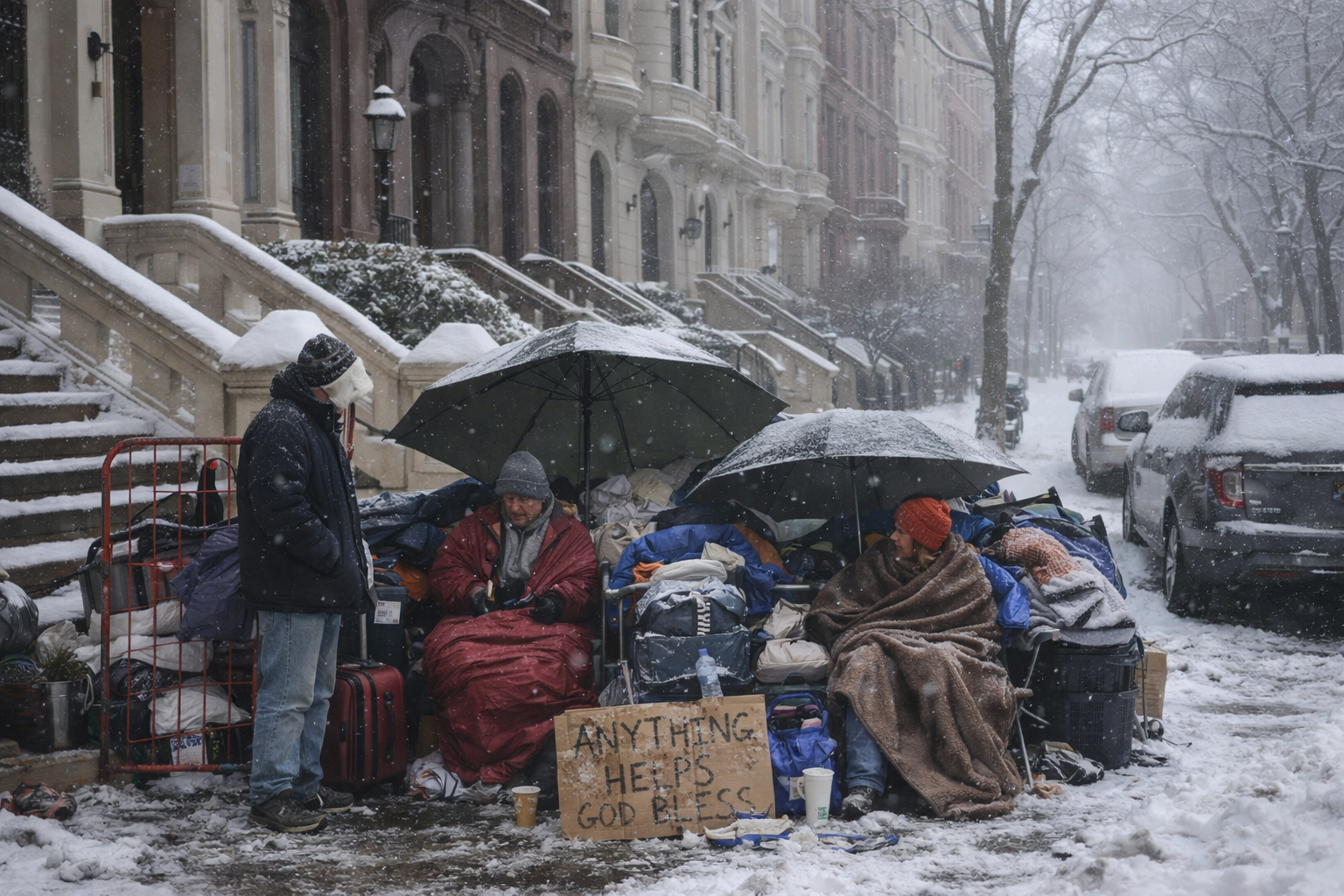
Rich New Yorkers voted for this, so they can live with it, even if the homeless can't (Updated)

won’t you be my neighbor? Oh! I guess you already are

Due to their communist mayor’s policy forbidding NYC police from forcing the homeless off the streets and into shelters, dead bodies are piling up like cordwood. Thats an effective and innovative approach to reducing their numbers, although some critics describe it as unnecessarily harsh. Meh —no port in a storm, eh? What I find particularly amusing is where some of these people are turning up and what they’re doing when they get there:

Mamdani's Cruel Homeless Policy: Frozen Corpses and Blighted Neighborhoods

        The Big Apple is about to take on a new name -- Tent City, or Filth City. Or perhaps Lepto City, after leptospirosis, a bacterial infection increasingly found in homeless encampments.

        New York's new mayor, Zohran Mamdani, is barring the New York Police Department from closing down encampments.

        Since Mamdani previewed his policy in December, new encampments are emerging in many neighborhoods. The consequences are dire both for vagrants and for the city's viability.

        Between Friday, when the city was hit with a bone-chilling winter storm, and Sunday night, eight people were found dead outdoors [13 and counting as of Saturday — Ed], suggesting they were homeless. Mamdani conceded that several of the victims were known to the city's shelter system.

        As the encampments pop up, neighborhood residents call 311, but the NYPD is now powerless. Even New York's Strongest -- the sanitation workers -- are barred from clearing the encampments. They've got orders to remove garbage and human waste but leave mattresses, clothing, makeshift cardboard huts and other items intact.

        …. Mamdani is showing a misguided brand of compassion for the homeless, and no compassion for residents and business owners. Encampments bring crime, filth and a distressing decline in street civility.

Bringing the fun back to Fun City

Even local Democrats are infuriated by Mamdani's unwillingness to clear encampments. Gale Brewer, a City Council member representing the Upper West Side, said, "You cannot have defecating, you cannot have food on the street, you cannot have all these boxes." So far, Mamdani insists you can.

        His predecessor, Eric Adams, aggressively removed encampments, saying, "We cannot tolerate these makeshift, unsafe houses on the side of highways, in trees, in front of schools, in parks. This is just not acceptable."

        But Mamdani's policy is all about the homeless, not about the rest of the public: "We are going to take an approach that understands its mission is connecting those New Yorkers to housing."

        Sorry, that's one mission, Mr. Mayor. But you are also responsible for ensuring the safety and comfort of the rest of the city's population, as well as its tourists and business visitors. Your policy is giving all of them the middle finger.

        No town or city should have to tolerate encampments. Weighing the "rights" of the homeless against the needs of communities, the U.S. Supreme Court ruled in 2024 that towns can remove encampments.

        Justice Neil Gorsuch explained that otherwise, "with encampments dotting neighborhood sidewalks, adults and children in these communities are sometimes forced to navigate around used needles, human waste, and other hazards to make their way to school, the grocery store, or work."

        That's what New Yorkers are facing now.

     Here’s an interesting statistic, Connecticut residents:

        Los Angeles Police Department crime data show that from 2018 to 2022, the homeless made up 1% of the population but 11% to 15% of all violent crime suspects.

        Nationwide, 13% of the homeless in encampments are registered sex offenders, and in some states, such as Connecticut, Massachusetts and Rhode Island, that figure is a staggering 50% or more, reports the Cicero Institute.

        Mamdani says he's doing what's right for the homeless, keeping their presence a visible eyesore, putting pressure on the city to provide them with housing.

        In truth, he's making them victims too, mere ploys in his political calculations. The life expectancy of someone living on the streets is, on average, 27 years lower than that of someone who is not. Some fall victim to crime or disease, but most die from alcohol or drug overdoses, often lying under a cardboard box or on a urine-soaked mattress.

        Adams said it best, lamenting that there is nothing compassionate or "'progressive' about leaving people to freeze in makeshift encampments. It ... dehumanizes the very people who need help."

We were warned

Of course, all this cold weather was foretold five years ago by “experts”, who blamed global warming, of course.

UPDATE: not particularly related to the lead story, but here’s more on global warming experts from 2014. 107 are listed (full list at the link) so they’ve had another 11 years to come up with more. Here are the first 30 of the original list:

The Big List of Failed Climate Predictions

The question wasn’t “what do people think is caused by global warming”, but “what was predicted by scientists and activists 25 years ago that would be a result of global warming.” Big difference.

OK. Hang on to your hat!

The original post was asking for a list of failed climate predictions, so here are 107:

FAILED CLIMATE PREDICTIONS (and some related stupid sayings)

1. “Due to global warming, the coming winters in the local regions will become milder.”

Stefan Rahmstorf, Potsdam Institute of Climate Impact Research, University of Potsdam, February 8, 2006

****

2. “Milder winters, drier summers: Climate study shows a need to adapt in Saxony Anhalt.”

Potsdam Institute for Climate Impact Research, Press Release, January 10, 2010.

****

3. “More heat waves, no snow in the winter… Climate models… over 20 times more precise than the UN IPCC global models. In no other country do we have more precise calculations of climate consequences. They should form the basis for political planning… Temperatures in the wintertime will rise the most… there will be less cold air coming to Central Europe from the east…In the Alps winters will be 2°C warmer already between 2021 and 2050.”

Max Planck Institute for Meteorology, Hamburg, September 2, 2008.

****

4. “The new Germany will be characterized by dry-hot summers and warm-wet winters.”

Wilhelm Gerstengarbe and Peter Werner, Potsdam Institute for Climate Impact Research (PIK), March 2, 2007

****

5. “Clear climate trends are seen from the computer simulations. Foremost the winter months will be warmer all over Germany. Depending of CO2 emissions, temperatures will rise by up to 4°C, in the Alps by up to 5°C.”

Max Planck Institute for Meteorology, Hamburg, 7 Dec 2009.

****

6. “In summer under certain conditions the scientists reckon with a complete melting of the Arctic sea ice. For Europe we expect an increase in drier and warmer summers. Winters on the other hand will be warmer and wetter.”

Erich Roeckner, Max Planck Institute, Hamburg, 29 Sept 2005.

****

7. “The more than ‘unusually ‘warm January weather is yet ‘another extreme event’, ‘a harbinger of the winters that are ahead of us’. … The global temperature will ‘increase every year by 0.2°C’”

Michael Müller, Socialist, State Secretary in the Federal Ministry of Environment,

Die Zeit, 15 Jan 2007

****

8. “Harsh winters likely will be more seldom and precipitation in the wintertime will be heavier everywhere. However, due to the milder temperatures, it’ll fall more often as rain than as snow.”

Online-Atlas of the Helmholtz-Gemeinschaft, 2010

9. “We’ve mostly had mild winters in which only a few cold months were scattered about, like January 2009. This winter is a cold outlier, but that doesn’t change the picture as a whole. Generally it’s going to get warmer, also in the wintertime.”

Gerhard Müller-Westermeier, German Weather Service (DWD), 26 Jan 2010

****

10. “Winters with strong frost and lots of snow like we had 20 years ago will cease to exist at our latitudes.”

Mojib Latif, Max Planck Institute for Meteorology, Hamburg, 1 April 2000

****

11. “Good bye winter. Never again snow?”

Spiegel, 1 April 2000

****

12. “In the northern part of the continent there likely will be some benefits in the form of reduced cold periods and higher agricultural yields. But the continued increase in temperatures will cancel off these benefits. In some regions up to 60% of the species could die off by 2080.”

3Sat, 26 June 2003

****

13. “Although the magnitude of the trends shows large variation among different models, Miller et al. (2006) find that none of the 14 models exhibits a trend towards a lower NAM index and higher arctic SLP.”

IPCC 2007 4AR, (quoted by Georg Hoffmann)

****

14. “Based on the rising temperature, less snow will be expected regionally. While currently 1/3 of the precipitation in the Alps falls as snow, the snow-share of precipitation by the end of the century could end up being just one sixth.”

Germanwatch, Page 7, Feb 2007

****

15. “Assuming there will be a doubling of CO2 in the atmosphere, as is projected by the year 2030. The consequences could be hotter and drier summers, and winters warmer and wetter. Such a warming will be proportionately higher at higher elevations – and especially will have a powerful impact on the glaciers of the Firn regions.”

and

“ The ski areas that reliably have snow will shift from 1200 meters to 1500 meters elevation by the year 2050; because of the climate prognoses warmer winters have to be anticipated.”

Scinexx Wissenschaft Magazin, 26 Mar 2002

****

16. “Yesterday’s snow… Because temperatures in the Alps are rising quickly, there will be more precipitation in many places. But because it will rain more often than it snows, this will be bad news for tourists. For many ski lifts this means the end of business.”

Daniela Jacob, Max Planck Institute for Meteorology, Hamburg, 8 Aug 2006

****

17. “Spring will begin in January starting in 2030.”

Die Welt, 30 Sept 2010

****

18. “Ice, snow, and frost will disappear, i.e. milder winters” … “Unusually warm winters without snow and ice are now being viewed by many as signs of climate change.”

Schleswig Holstein NABU, 10 Feb 2007

****

19. “Good bye winter… In the northern hemisphere the deviations are much greater according to NOAA calculations, in some areas up to 5°C. That has consequences says DWD meteorologist Müller-Westermeier: When the snowline rises over large areas, the bare ground is warmed up even more by sunlight. This amplifies global warming. A process that is uncontrollable – and for this reason understandably arouses old childhood fears: First the snow disappears, and then winter.”

Die Zeit, 16 Mar 2007

****

20. “Warm in the winter, dry in the summer … Long, hard winters in Germany remain rare: By 2085 large areas of the Alps and Central German Mountains will be almost free of snow. Because air temperatures in winter will rise more quickly than in summer, there will be more precipitation. ‘However, much of it will fall as rain,’ says Daniela Jacob of the Max Planck Institute for Meteorology.”

FOCUS, 24 May 2006

****

21. “Consequences and impacts for regional agriculture: Hotter summers, milder plus shorter winters (palm trees!). Agriculture: More CO2 in the air, higher temperatures, foremost in winter.”

Dr. Michael Schirmer, University of Bremen, presentation of 2 Feb 2007

****

22. “Winters: wet and mild”

Bavarian State Ministry for Agriculture, presentation 23 Aug 2007

****

23. “The climate model prognoses currently indicate that the following climate changes will occur: Increase in minimum temperatures in the winter.”

Chamber of Agriculture of Lower Saxony Date: 6 July 2009

****

24. “Both the prognoses for global climate development and the prognoses for the climatic development of the Fichtel Mountains clearly show a warming of the average temperature, whereby especially the winter months will be greatly impacted.”

Willi Seifert, University of Bayreuth, diploma thesis, p. 203, 7 July 2004

****

25. “Already in the year 2025 the conditions for winter sports in the Fichtel Mountains will develop negatively, especially with regards to ‘natural’ snow conditions and for so-called snow-making potential. A financially viable ski business operation after about the year 2025 appears under these conditions to be extremely improbable (Seifert, 2004)”.

Andreas Matzarakis, University of Freiburg Meteorological Institute, 26 July 2006

****

26. “Skiing among palm trees? … For this reason I would advise no one in the Berchtesgadener Land to invest in a ski-lift. The probability of earning money with the global warming is getting less and less.”

Hartmut Graßl, Director Emeritus,

Max Planck-Institute for Meteorology, Hamburg, page 3, 4 Mar 2006

****

27. “Climate warming leads to an increasingly higher snow line. The number of future ski resorts that can be expected to have snow is reducing. […] Climate change does not only lead to higher temperatures, but also to changes in the precipitation ratios in summer and winter. […] In the wintertime more precipitation is to be anticipated. However, it will fall more often as rain, and less often as snow, in the future.”

Hans Elsasser, Director of the Geographical Institute of the University of Zurich, 4 Mar 2006

****

28. “All climate simulations – global and regional – were carried out at the Deutschen Klimarechenzentrum [German Climate Simulation Center]. […] In the winter months the temperature rise is from 1.5°C to 2°C and stretches from Scandinavia to the Mediterranean Sea. Only in regions that are directly influenced by the Atlantic (Great Britain, Portugal, parts of Spain) will the winter temperature increase be less (Fig. 1).”

Max Planck Institute for Meteorology, Press Release, Date: December 2007/January 2013.

****

29. “By the year 2050 … temperatures will rise 1.5ºC to 2.5°C (summer) and 3°C (winter). … in the summer it will rain up to 40% less and in the winter up to 30% more.

German Federal Department of Highways, 1 Sept 2010

****

30. “We are now at the threshold of making reliable statements about the future.”

Daniela Jacob, Max Planck Institute for Meteorology, Hamburg, page 44, 10/2001

Interesting — to Riverside residents, at least — article on the history of Riverside School

It had 800 students in the baby boom years (!) 453 today; no wonder our band leader Mr. Dyksta gave individual instrument lessons in a converted second floor closet.

Update:

One thing not mentioned in the article is the debt all Riverside residents owe to architects Jay and Carolyn Haverson. Back in — the 80s? I think so — the school was going to build a new addition, and planned to use an off-the shelf “Elementary school addition, option A, B, or C” provided by the state. The Haversons, Riverside residents themselves, were so appalled by the hideous choices that they, at no charge, designed one we could use instead. It wasn’t daring or avant garde, because that wasn’t the point. What they designed was somethingthat blended into the existing building without shrieking “new! New! New!” If you’ve driven by the school any time in the past 40 years and noticed nothing new, then they succeeded; we were all spared an eyesore.

The Ladies of Greenwich Invisible defer participation in National Shutdown Day until late March; “Baby, it’s cold outside”

Yesterday’s National Shutdown Day was a flop*, so the “Indivisibles” will try again this spring, when the weather is better

'No Kings 3' demonstration planned for March 28

A group that organized two nationwide "No Kings" protests last year is planning its next large-scale national demonstration on March 28th.

The anti-Trump protest is being organized by Indivisible, a liberal grassroots group, that said demonstrations are expected across the country that day.

Reached at her Côte d'Azur winter home, Bitsy Turnbull, co-founder of the Greenwich branch of the Invisibles explained the delay: “so many of my fellow AWFLs are away for the season — the Caribbean, Spain, there are even some hardy souls slumming on Sanibel, if you can believe it — that we couldn’t possibly be back in town for yesterday’s parade. We did send our domestics, of course, but this is really a white people’s movement — ‘‘a form of group street therapy for unhappy people’, it’s been called, and the girls and I really should be there for maximum impact. So we will be there; just not right now.

“It will be perilous coming back so early”, she conceded. “Overstay the six-month residency limit by even a day, and those jackals from Connecticut Revenue will come swarming, but after all, that’s what accountants are for. Danger or not, needs must.”

*

“A smattering “of businesses in Connecticut, 16 in Vermont; and “several” in Bradenton, Florida,

Why not keep it shut for a year or two and postpone the reopening of our borders?

Senate passes federal funding compromise as Democrats score victory in DHS revolt

The Senate passed it, but not the House, so we’ll see.

The continuing short-term spending resolution — not a budget; we haven’t had one of those in years, and probably never will again —contains all the usual billions directed to individual legislators’ personal pork barrel projects, so that’s all normal and business as usual. It does not address funding and “reform” of The Department of Homeland Security and in particular, ICE and that’s the real catastrophe that the Democrats a planning: a permanent end of all deportations. “If you’re here, you can stay here; if you come, you can remain — welcome to America, and don’t forget to vote for us.”

“Among the most difficult requests is the requirement of judicial warrants, rather than administrative warrants, for ICE agents to make arrests.” “

"These are not radical demands," Schumer said on the Senate floor. "They're basic standards the American people already expect from law enforcement. I hope we can get voting quickly here in the Senate today so we can move forward on the important work of reining in ICE. The clock is ticking."

What’s going on here is this: unlike an administrative warrant, a judicial warrant requires that a federal judge, rather than an administrative hearing officer make a determination of probable cause for arrest for each and every case. Because I’m lazy, I’ll use an AI summary here: it’s accurate:

AI Overview

Yes, a criminal warrant requires a significantly higher standard of proof (probable cause) than an administrative warrant, which typically requires a lower, more flexible standard to ensure regulatory compliance

. Criminal warrants, signed by a judge, authorize searches or arrests, while administrative warrants are often issued by agencies for civil enforcement. 

Key differences between the two include:

  • Standard of Proof: Criminal warrants require probable cause to believe a specific crime was committed and evidence exists in a specific location. Administrative warrants, such as for inspections, only require a "lower standard of probable cause" or that the search meets reasonable legislative or administrative standards.

  • Issuing Authority: A neutral judge or magistrate issues criminal warrants. Administrative warrants are often issued directly by government agency officials (e.g., ICE) without prior judicial approval.

  • Purpose & Authority: Criminal warrants allow for arrests and the seizure of evidence for prosecution. Administrative warrants are used to ensure compliance with regulations and do not authorize searches of private, non-public areas without consent.

Federal dockets are already swamped, and judges are not required to review and rule on warrant applications within any specific time limit, so they won’t; they’ll let them pile up in the courtroom basement, to be reached “when I get around to them”, and even assuming a federal judge is willing to order an illegal alien to be detained — many or most of them refuse — it will be years, even decades before a case is reached. And then, of course, the army of leftist pro bono lawyers will appeal.

For now, Republicans say that they’ll never agree to this change, but given their history of caving, they likely will. Even if they don’t, the Democrats will bide their time until they regain control, possibly as soon as this November. When they do, the country will cease to have borders.