
New Old Greenwich listing
/189 Shore Road, $10.950 million. Sold for $5.750 million in 2018, and before that, $4.910 in 2007 (after beginning 505 days before in 2005 at $5.895).
Greenwich, Connecticut real estate, politics, and more.
Greenwich, Connecticut real estate, politics, and more

189 Shore Road, $10.950 million. Sold for $5.750 million in 2018, and before that, $4.910 in 2007 (after beginning 505 days before in 2005 at $5.895).

6 Reynwood Manor, $4.350 million. A four-acre building lot, essentially, with, perhaps, a salvageable pool.

victory is within our grasp!
As night fell, people across Havana lingered on doorsteps and used wood or charcoal to prepare “caldosas,” a popular soup shared among neighbors who contribute items including vegetables, chicken and meat. A group of musicians along the city’s famed seawall played into the night.
Others played dominoes by a rechargeable lightbulb.
Why maintain equipment that only perpetuates the earth’s agony?
Daily, prolonged outages have become so common in Cuba that 66-year-old Genoveva Torres was waiting for power to return at night as usual to cook dinner. She was perturbed when told about the massive blackout.
“My God, until when?” she exclaimed. “Then we won’t eat. We’ll have to eat bread again.”
State media reported that the outage was caused by a shutdown of the Antonio Guiteras thermoelectric power plant east of Havana following a leak in its boiler.

When he began his second term, President Donald Trump promised to make the federal government leaner and more efficient. One year into that promise, the numbers tell a story that few in Washington appear eager to discuss: The disappearance of nearly 400,000 federal jobs, yet daily government operations continue without obvious disruption.
A workforce reduction that large cripples most organizations; in the private sector, losing that many positions triggers emergency meetings, halts production lines, and sparks panic among executives. Washington, however, kept moving along as if someone merely cleaned a few old files out of a drawer.
The federal workforce shrank by 386,826 positions during the first year of Trump's second term. Administration leaders framed the effort as a long-overdue correction of decades of unchecked growth inside federal agencies. The work fell largely under the Department of Government Efficiency when Elon Musk served as the department's co-chair and was tasked with identifying layers of bureaucracy that had quietly multiplied over many administrations.
The numbers behind the reduction reveal how large the bureaucracy had become; roughly 317,000 federal employees left government positions during 2025. About 68,000 new workers entered federal service during the same period. Departures far outpaced hiring across nearly every major agency: Education, Housing, and Treasury experienced some of the largest workforce declines.
The Trump administration’s efforts to reduce staffing across agencies resulted in the loss of more than 317,000 federal employees governmentwide. It’s a 13.7% decrease compared with September 2024 workforce numbers, according to Office of Personnel Management data.
At the same time, 68,000 new federal employees joined the civil service during 2025, according to OPM Director Scott Kupor. Combining attrition and hiring data, the administration’s changes over 2025 resulted in a net staffing decrease of about 10.8%.
Kupor touted the results as exceeding the administration’s goals, saying that relatively few losses were due to reductions in force (RIFs) and the firing of probationary employees. Out of all employees who left their jobs in the last year, “over 92% did so voluntarily,” he said, mainly via the deferred resignation program (DRP).
“None of this is to minimize the impact of anyone losing a job, but the ‘mass firing’ headlines do not in fact tell the full story,” Kupor wrote in a Dec. 10 post on X.
The most surprising development involves what didn't happen after the reductions: Government services didn't collapse, federal agencies didn't shut down, passport offices still process applications, Social Security checks still arrive, airports still screen passengers, and daily operations continue with little visible difference for most Americans.
That outcome raises an uncomfortable question about how large the federal bureaucracy had grown before the cuts began. Eliminating hundreds of thousands of jobs without a noticeable slowdown suggests many positions had little connection to core government functions.
Government employment had expanded steadily for years. Administrative offices, policy divisions, and regulatory units multiplied inside agencies. Entire departments existed primarily to manage paperwork generated by other departments, and redundancy often became a feature of the system instead of a flaw. The reductions now underway aim to strip away those layers.
>>>>
Reduction supporters argue the numbers prove a point critics long denied: Washington expanded far beyond what the government actually required to function.
Behind the policy debate stand real people who lost steady work; many federal employees spent years building careers in public service. Most didn't design the bureaucratic maze that surrounded them; they accepted existing jobs and performed the duties assigned to them. Losing a position still means mortgage payments, groceries, health insurance, and school tuition, and suddenly it is much harder to manage.
But …
>>>>
There's a single fact that stands beyond dispute: removing nearly 400,000 positions without stopping the machinery of government exposes how deeply Washington's bureaucracy has expanded. The machine still runs, the lights still turn on each morning, and the paperwork still moves across desks.
For reform advocates, that reality confirms the belief that trimming the federal workforce didn't cripple government operations. It revealed just how much excess had accumulated inside the system over the decades.
For the rest of Washington, the result creates an uncomfortable silence.
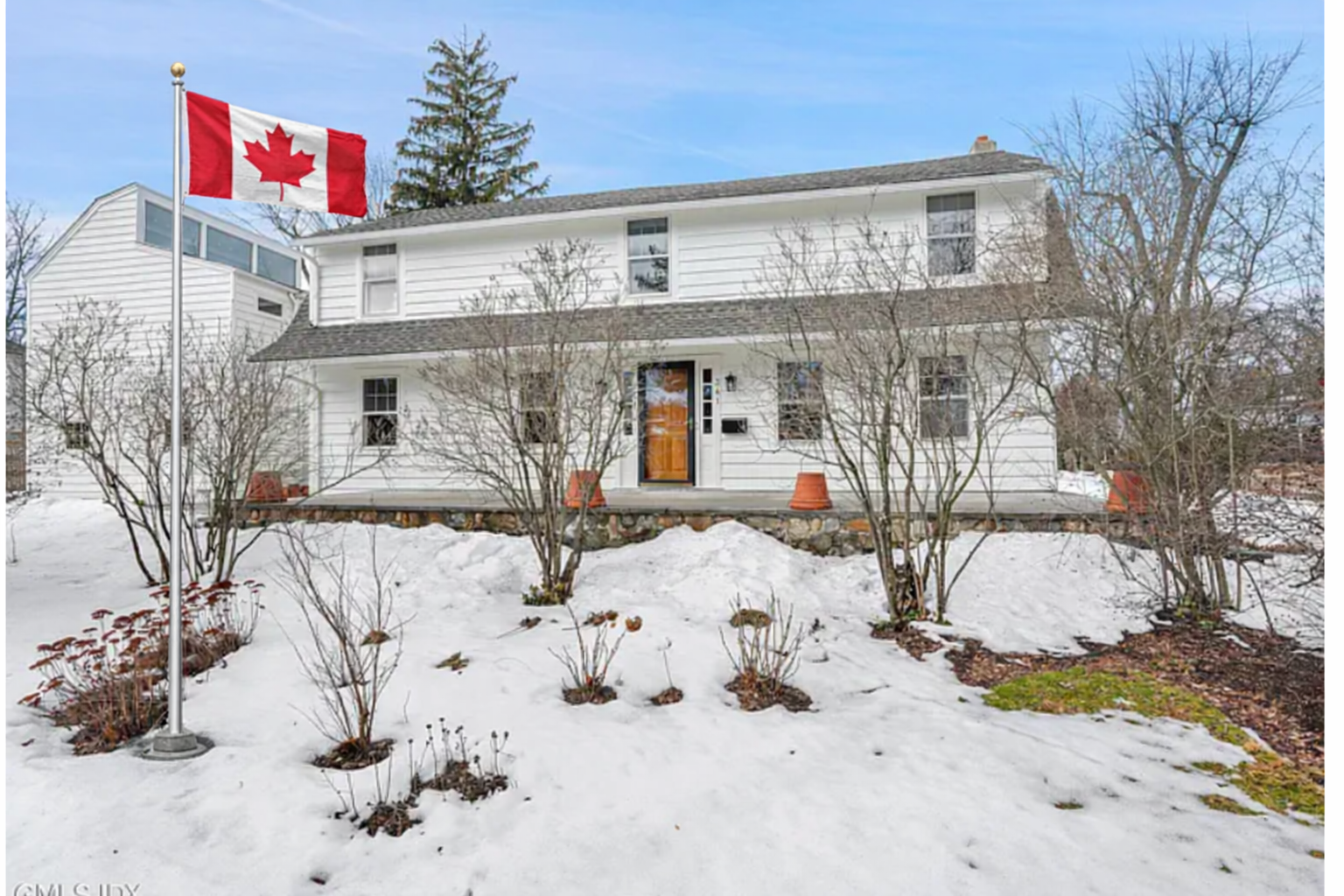
341 Sound Beach Avenue, listed last week at $2.8 million is reported pending today. The owner’s been vocal lately, expressing her terror at what Trump’s doing to our freedom, so I imagine there’ll be a quick closing to allow her escape to the north.
I mentioned last week that there wasn’t much, if anything that betrayed its original construction date of 1875, but I don’t suppose that matters, especially if this is going for land.
Update: Well, maybe not Canada; Venezuela?
…. [L]et’s revisit an old 2022 story about then-54-year-old Amir Farsoud, who was going through the process of government-sponsored suicide.
Farsoud suffers from crippling back pain and couldn’t find a new place to live when his rooming house at the time was up for sale. He couldn’t afford any place to live and barely got by on the $1,200 disability payments he received in Ontario. He wouldn’t make it on the streets, and knowing that, opted to apply for Medical Assistance in Dying (MAIDS). He fit the criteria, but his doctor knew the real reason why Farsoud was applying for MAIDS. He signed off anyway.
….Luckily, a 2024 fundraiser helped Farsoud get a new place to live and opt out of MAIDS.
In essence, the Canadian government told a poor man that death is an option and that we’re here for you since you can’t find a new home. Farsoud said that he doesn’t want to be dead.
And forced euthanasia isn’t the only thing to fear in America’s Snow Hat:
This is crazy
— Wall Street Apes (@WallStreetApes) March 2, 2026
A resident of Canada has a swollen appendix so was sent to the emergency room
She shows the wait time screen…. It’s over 15 hours to see a doctor. She says she’s already been waiting 3 hours. So that’s 18 hours
This is the Universal Healthcare system in Canada pic.twitter.com/vMOf0OjwCY
To be fair, though, if one can get over the death thing, there’s a lot for a liberal to love up on the tundra.
In Canada a hair salon was fined $500 for not having “non binary” on their booking site. It caused the person who made the complaint spiral deeper into a metal health crisis who then became unable work for a year.
— Ryan Gerritsen🇨🇦🇳🇱 (@ryangerritsen) February 19, 2026
Of course the media shared this story like this is supposed to be… pic.twitter.com/18GUnnXZ18

11 Winterset Road, new construction, $8.495 million.

1 Bramble Lane in Riverside has been listed today for $5.995 million. The owners paid $4,066,000 for it in 2017. It’s interesting to see that it sold new for $4,050,000 in 2008, so things were slow, once, and now they aren’t.


Fifty years ago today, March 4, 1976 the world’s first super computer was shipped to its first customer, the Los Alamos Laboratory. Here’s what it was, and here’s how things have changed:
AI Overview
Cray-1 supercomputer was the world’s fastest, most advanced vector processor, designed by Seymour Cray for, $8–$9 million, featuring a iconic circular design for speed. It performed roughly 80–160 million calculations per second (80-160 MFLOPS), whereas today's top supercomputers (exaflop scale) are over 10 billion times faster and a $70 Raspberry Pi is hundreds of times faster.
The 1977 Cray-1 Supercomputer
Performance: ~80-160 MFLOPS (million floating-point operations per second).
Design: Cylindrical tower to keep wire lengths under 3 feet for maximum speed, often nicknamed "the world's most expensive loveseat" due to the base bench.
Usage: Primarily used by government and research labs (like NCAR) for weather modeling, nuclear simulations, and aerospace design.
Power/Physical: Consumed over 100 kW of power, requiring massive liquid cooling.
Facebook +4
Comparison: 1977 vs. Today
Speed: The Cray-1 (1976) performed roughly 80 MFLOPS. A modern top-tier supercomputer (like Frontier) operates at over 1 Exaflop (
FLOPS), making it roughly 10-12 billion times faster.
Performance Per Dollar: A $70 Raspberry Pi 5 is estimated to be over 190 times faster than the 1970s Cray-1.
Size/Energy: The 5.5-ton, 115 kW Cray-1 has been replaced by systems with similar or better performance that fit in a palm (smartphones) or on a desk.
Memory: The Cray-1 typically had 8 megabytes of memory. A modern smartphone usually has 8-16 gigabytes of memory (1000-2000x more).
Facebook +5
Essentially, the computing power that cost nearly $9 million in 1977, required specialized cooling, and weighed as much as an automobile, is now thousands of times surpassed by the phone in your pocket.

so who doesn’t like free crab cakes?
The Baltimore mayor’s office spent more than $890,000 on lavish meals and parties — including crab feasts, catered “farewell” bashes and massive tabs at Ravens football games, according to a report Wednesday.
Mayor Brandon Scott’s administration blew taxpayer cash on over-the-top perks for staffers — including $52,589 on grub in the Mayoral Suite at Ravens and Orioles games — in a gross violation of the city’s “public funds” rules, according to baltimorebrew.com.
One of the elaborate meals was served at a $3,636 farewell “office party” for Scott’s former campaign manager Marvin James, which featured a $324 balloon arch, a $217 cake and a $2,600 catered spread with crab balls and grilled salmon in March 2025, according to the outlet.
James, however, didn’t actually leave City Hall and is still on the payroll as the mayor’s $190,000-plus-a-year senior adviser.
In total, the office spent $801,839 on meals and catering, $42,691 on floral arrangements and funeral services, and $45,646 “unreconciled” expenses between July 2022 and November 2025, according to the outlet.
The administration spent lavishly on food such as banana bread pudding, pizza, bottomless freshly popped popcorn and “a fresh fruit tray available to everyone in the mayor’s suite daily,” according to the outlet, which cited a report from Inspector General Isabel Mercedes Cumming, the city’s waste and fraud watchdog.
It also forked over more than $10,000 for flowers, which city regulations state shouldn’t be purchased “for any reason,” the report states.
The investigation found other extravagant so-called “P-Card” — aka procurement card — expenses related to birthday celebrations, baby showers and flowers “for a selected few, including executive leadership,” according to the report.
At least 336 of the “P-card” transactions violated city rules, which require a waiver to use public funds “for any social functions or activities” without the express approval of the Bureau of Purchasing, Cumming notes in the report.
“[The watchdog] found that taxpayer funds were used for floral purchases for events, employee celebrations, recognition, baby arrivals, funerals bereavement and condolence,” the report states.
When the purchasing bureau denied the mayor’s office’s request to use taxpayer money to host an annual crab feast, the mayor’s office went to finance director Michael Mocksten, who approved the event, according to the report.
The administration has been trying over the past month to restrict Cumming’s access to city financial and personnel records — which would prevent her from exposing over-the-top spending, she told the outlet.
The mayor’s chief of staff, JD Merrill, defended the food and drink spending as “legitimate expenses that support efficient and necessary operations of city government,” according to the outlet.
“The mayor’s office regularly takes on the responsibility for providing food for both its own employees and employees of other city agencies,” he said.
He brushed off the $167,455 in unapproved “P-card” transactions as the equivalent of “an estimated 0.19% of the mayor’s office budget over the time period reviewed” and said a new position is being created that’s “focused on internal fiscal oversight.”
Scott, who has been described as a progressive, has been praised for his approach to crime by New York Mayor Zohran Mamdani.
Totally unrelated, I’m sure, but Baltimore, whose schools which rank among the very lowest of performers in the country, has the 5th highest school administrative costs in the nation. “It’s not a financial problem, it’s a political problem.”


no garage at this price, of course, but the FARport allows stamford bicycle thieves easy access without disturbance to the occupants
30 Park Avenue, $4.5 million. Nothing’s changed in this house since it was built in 2011, except for its price.
2021: $3.295 ($2.995 asked)
2019: $2.850 ($2.795 asked)
2011 $2.500 ($2.945 asked)
Be notified of new posts! Sign-up here:
Want to comment without registering?