Get out of your house and off your ass — This generation of welfare dependants can’t do that, or won't?

One quarter of Connecticut’s population is on Medicaid. Soon a small percentage: 11.7% of those recipients: able-bodied adults between the ages 19-64, who are not pregnant or the primary caregivers of young children or disabled dependants, are going to be required to show that they are doing something to either give something back to their community or prepare to be a useful member of society. According to Democrats and the medical service provider industry, there’s been nothing as barbaric as this since the beginning of time; or 1935 through 2010, take your pick. In fact, this will merely return things to where they’ve been from the start.

CT health providers work to curb HUSKY losses from ‘Big Beautiful’ bill

Federal changes to Medicaid, known as HUSKY in Connecticut, take effect Jan. 1, 2027.

Connecticut officials are gearing up for sweeping changes to Medicaid, the joint federal-state program that provides insurance coverage for low-income Americans. Medicaid, known as HUSKY in Connecticut, covers around 939,000 residents, or a quarter of the state’s population.

Come January, federal policy changes to Medicaid eligibility — passed as part of House Resolution 1, also known as the “One Big Beautiful Bill” — will go into effect. Many state officials and industry leaders are warning the changes will lead to massive losses in coverage.

The state Department of Social Services, DSS, estimates that roughly 110,000 residents stand to lose their HUSKY coverage unless they can demonstrate compliance with new requirements.

Work, volunteer, or learn a skill; oh, the horror!

Under the new federal policy, beginning Jan. 1, Connecticut residents with HUSKY D — the Medicaid program for low-income adults without dependents — must meet “community engagement requirements” by proving they work at least 80 hours or earn a minimum of $580 per month. 

Enrollees can also fulfill the requirement by demonstrating at least 80 hours of monthly participation in school, community service or a qualified training program. Some people, like those already meeting work requirements for SNAP, or those enrolled in a substance treatment program, are exempt from the work requirements. 

I knew, in a general way, that it was always thus execept during the Biden term, but I asked ChatGTP for detqails:

Answer:

Yes. Your memory is basically right, with one important distinction: work requirements have a long history in American cash welfare, but until very recently they were generally not a condition of Medicaid eligibility itself. [Buts ee below, for why; spoiler alert: the entitlement programs just grew, and grew, and grew — Ed]. The new HUSKY D requirement borrows a mechanism familiar from welfare policy and applies it to health insurance.

One small update to the article you read: the provision Connecticut is implementing is part of a new federal Medicaid requirement, not simply a Connecticut policy choice. Under current federal rules, affected adults generally must satisfy an 80-hour monthly “community engagement” requirement, or earn at least 80 times the federal minimum wage—$580 at the current $7.25 rate. States generally must implement it by January 1, 2027.

The surprising part [to Chat, not to me — Ed]: this goes back well before Clinton

The lineage looks roughly like this:

1935–early 1960s: welfare was originally not supposed to put mothers to work. The original Aid to Dependent Children (ADC, later AFDC) program was conceived largely as a way of allowing poor widowed or single mothers to remain home and care for their children. There was no federal work requirement. Some states and localities nevertheless imposed their own work-related restrictions—including notorious rules requiring some mothers and older children to take seasonal agricultural work.

1962–67: the federal government begins moving toward work. Congress permitted states to establish community work-and-training programs in 1962. Then the Social Security Amendments of 1967, under Lyndon Johnson, created the Work Incentive Program (WIN). This is really the ancestor of what you're remembering. For the first time, federal AFDC policy combined incentives to take employment with requirements that certain recipients participate in employment and training.

1971–80s: the requirements became considerably tougher. This is probably the period you're remembering from the 1970s. The 1971 Talmadge amendments strengthened WIN and made participation substantially more compulsory. Mothers generally had to register for work or training unless they had a child under six (along with certain other exemptions), and refusal could result in a reduction in the family's welfare payment. Congress subsequently strengthened sanctions and job-search provisions.

So if your recollection is, "Didn't people receiving welfare already face work requirements in the 1970s?"yes, absolutely.

Reagan and the 1980s

The Reagan era pushed further toward the idea that able-bodied welfare recipients should perform work or work-related activities in return for assistance. States received greater latitude to experiment with workfare-type programs.

Then the bipartisan Family Support Act of 1988, signed by Reagan, replaced WIN with the JOBS program (Job Opportunities and Basic Skills Training). It generally required participation by mothers whose youngest child was three or older, while permitting states to lower that age to one.

That is an important point because the popular shorthand—"Clinton introduced work requirements"—is historically misleading. Clinton didn't invent them. They had been evolving for roughly three decades.

What Clinton changed in 1996

The Clinton-era reform was nevertheless a watershed.

The Personal Responsibility and Work Opportunity Reconciliation Act of 1996 (PRWORA) abolished the old federal entitlement, AFDC, and replaced it with Temporary Assistance for Needy Families (TANF). Instead of an open-ended entitlement to cash assistance for eligible families, states received block grants and had to meet federally specified work-participation targets. Recipients generally had to engage in work after a limited period on assistance, and federal cash assistance was subjected to a five-year lifetime limit (with exceptions and considerable state variation).

So the progression is approximately:

ADC/AFDC: We support needy children so their mother can care for them
WIN: We should encourage—and increasingly require—some recipients to work
1980s/JOBS: Employment and training should be a normal expectation of welfare
1996 TANF: Cash welfare should be temporary and explicitly conditioned on movement into work.

That's the history behind the word “workfare.”

Follow-up question on Medicare history


Yes. Medicaid in 1965 was a much narrower program than Medicaid today, and the biggest conceptual change was not simply that the income cutoff was raised. It was that the government gradually stopped requiring a low-income person to fit into one of a few particular categories of deserving poor people.

At the beginning, being poor by itself generally did not make you eligible for Medicaid. Today, in an ACA-expansion state such as Connecticut, it often does.

What Medicaid was in 1965

Medicaid was created by the Social Security Amendments of 1965, alongside Medicare. But the two programs were constructed very differently.

Medicare was essentially insurance for the elderly. Medicaid was grafted onto the existing welfare system. Its core beneficiaries were people who qualified for one of the existing cash-assistance programs—principally:

  • poor families with dependent children receiving AFDC;

  • poor elderly people;

  • blind people; and

  • people with disabilities.

In other words, Medicaid originally had two tests: you had to be poor and belong to an eligible category. Congressional Research Service histories describe the original program as essentially health coverage linked to receipt of cash welfare.

That produced a result that can seem peculiar now. Imagine two equally poor 30-year-olds in 1970. One is a mother receiving AFDC because she has dependent children; the other is a healthy, childless man with exactly the same income.

The mother could qualify for Medicaid. The childless man generally could not. His income could be zero and that alone didn't create Medicaid eligibility.

That's an enormous difference from modern Medicaid.

And yes—the program was much smaller

The national numbers make your intuition quite clear.

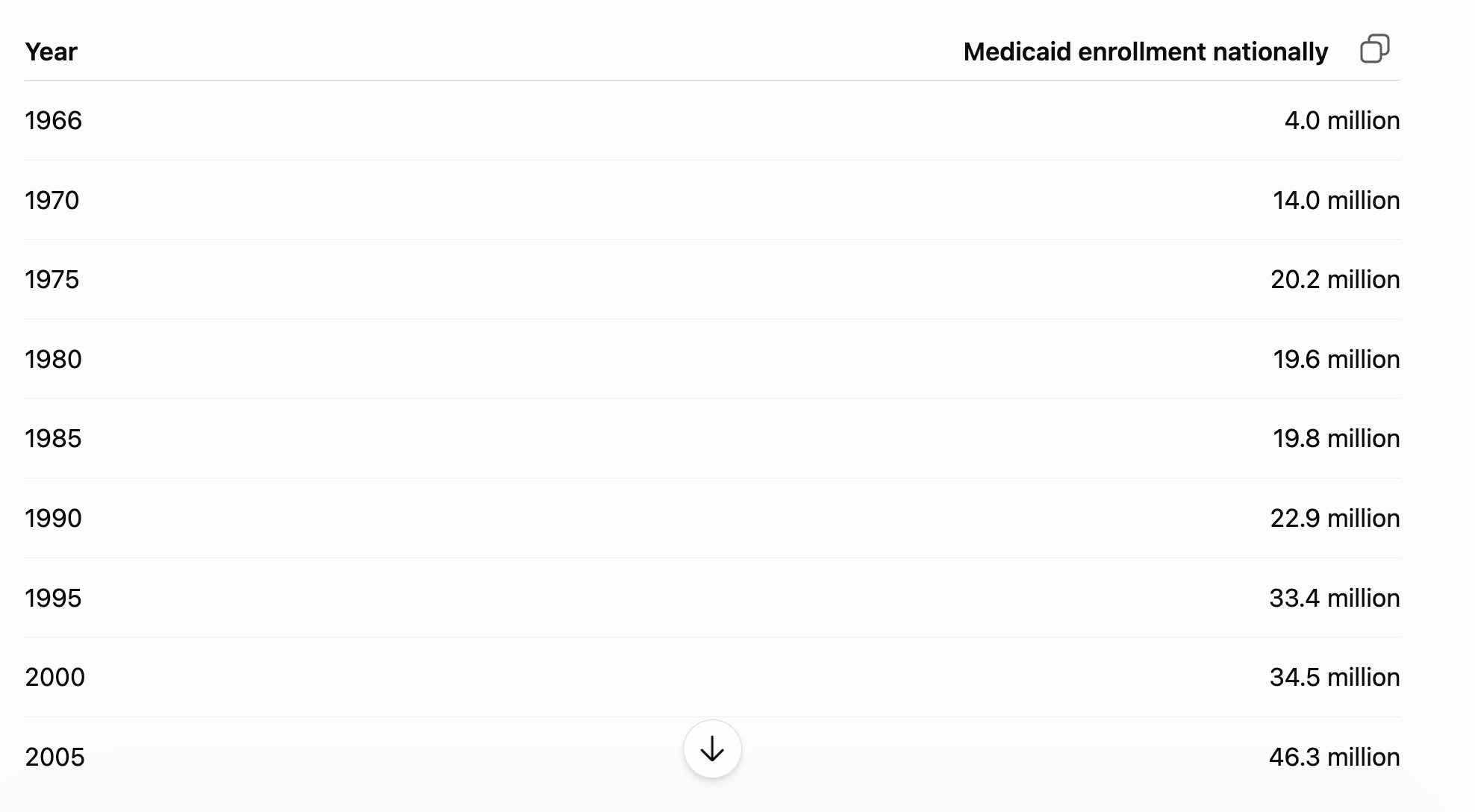
CMS's historical series shows approximately 4 million Medicaid enrollees in 1966, the program's first full year. By 1970 it was about 14 million, and in 1975 about 20.2 million. It then remained remarkably flat for a while: about 19.6 million in 1980 and 19.8 million in 1985.

For perspective, the United States had roughly 200 million people around 1970. So Medicaid was covering something on the order of 7% of the population, not 25%.

Then watch what happens:


Not a huge fan of the man, but RFK Jr. has the better argument here. Of course, the other party is CNN, so that's not much of challenge

kiss me, I’m a retard

Hey, me too!

Health Secretary Robert F. Kennedy Jr. blasted CNN host Erin Burnett, saying she has “abandoned both common sense and basic arithmetic” after a reporter on her show claimed the pol’s budget-friendly $20 meal actually costs $70.

Kennedy, 72 – who has flipped the food pyramid on its head to prioritize protein, dairy and “healthy fats” – recently launched a YouTube cooking show, “The Real Food,” with the goal of sharing affordable, healthy recipes that Americans can try at home.

During CNN’s “Erin Burnett OutFront,” journalist Tom Foreman did a deep-dive into Kennedy’s recent wild Alaskan salmon cakes and side salad recipe, which the health secretary says costs $19.64 to feed a family of four – or less than five bucks a head.

But Foreman said when he bought the cheapest versions of the ingredients needed for the recipe at a major grocery chain, the total came to more than $70. 

RFK Jr. blasted the report in a post on X on Thursday night, arguing his show uses “standard recipe costing,” meaning it doesn’t add the total costs of each ingredient but rather how much it costs for the portion of the ingredients used. A dollop of mayonnaise, for example, would cost much less than the entire bottle.

“Trump Derangement Syndrome has so debilitated @ErinBurnett that she has abandoned both common sense and basic arithmetic,” the “Make America Healthy Again” official wrote.

“CNN wants us to incorporate the full package price of every ingredient, regardless of what is used in the recipe. If you put a squirt of ketchup on your burger, would you be surprised if the restaurant charged you for the whole bottle?”

He argued that the goal of the show is to help Americans “cook healthy food without breaking the bank” and “stock their pantries with high-quality ingredients they can use again and again.”

In the CNN segment, Foreman compared the prices that “The Real Food” advertised for certain ingredients to the costs that CNN forked over at the grocery store.

Kennedy’s show said 1.5 pounds of wild-caught Alaskan salmon should cost $8.99, but Foreman claimed the cheapest, most similar salmon he could find cost more than $24.

A red onion was priced at 8 cents on “The Real Food,” since the recipe doesn’t require the whole onion, but a shopper would need to pay at least a dollar for the vegetable, Foreman added.

It was the same for the avocado mayonnaise used in the recipe, which Kennedy’s show priced at 40 cents for a few tablespoons – while the whole bottle costs $11.19, according to CNN.

The most expensive item here, wild caught salmon, may cost CNN $25 at Whole Foods, where CNN reporters presumably shop before stopping off at Starbucks for their $11 triple lattes, but at Costco you can get sockeye salmon, a bit pricer than regular salmon for $10 a lb.

Details

Costco Item number 221177

Located in the frozen food section.

$29.99 USD for a 3 pound bag.

38 grams of protein per serving.

Wild Caught Alaska Sockeye Frozen Salmon

Nimitz Place: Gone in (practically) 60 Seconds

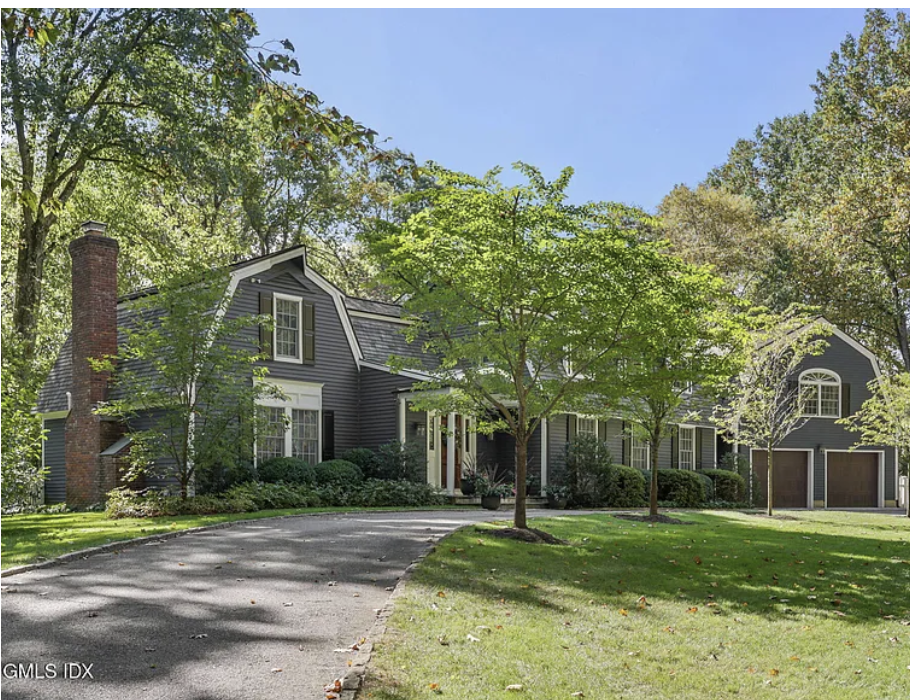
23 Nimitz Place, Havemeyer, guide price $1.695 million is reported pending. A land sale, and given the speed this came on and has gone off the market, it’ll be selling for more. The value of land in Greenwich, especially in Old Greenwich and Riverside, has so far exceeded the value of the current houses sitting on it that few, if any of the tract houses of the 1950s-1980s will be with us much longer.

All as predicted nine days ago.

Kathy Smith says "The City of Greenwich "; I'd call it Co-Op City East, but either way, it sucks

I was going to get around to this story later today, but Kathy Smith’s Greenwich Wise has it covered nicely.

Welcome to the City of Greenwich, CT

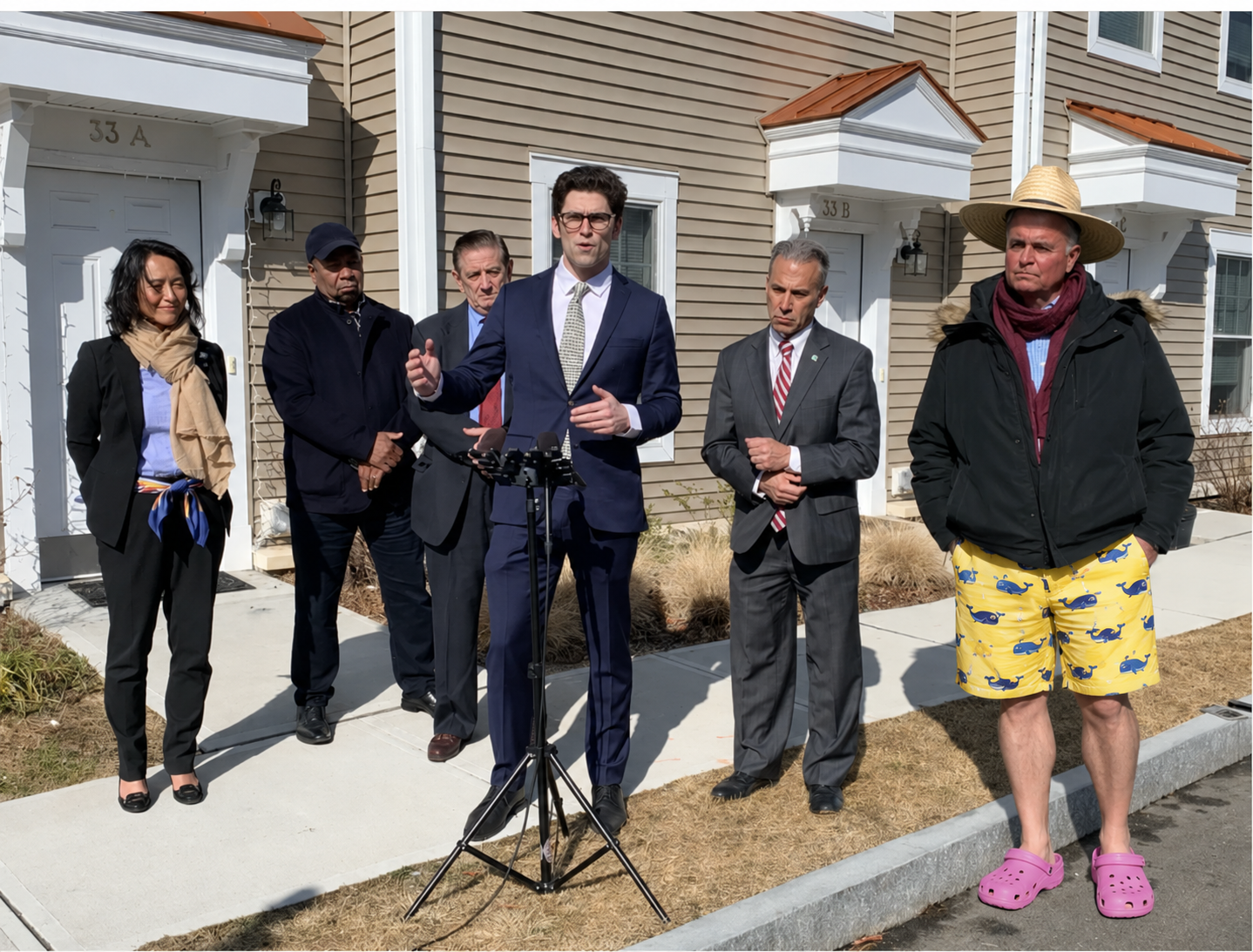
The sky has now become the limit in Greenwich under Hartford’s 8-30g affordable housing mandate.  A massive 6-story 176-unit residential complex is headed to P&Z to replace Putnam Green located at 7 and 9 Western Junior Highway.  It is twice the height limit of local zoning laws.  After Benedict Court (behind St Mary’s on Greenwich Ave.) and Chilston Court (at the bottom of Mason St), this is the 3rd such monstrosity.   Story here.

(And from FWIW) :

Coming soon, courtesy of our Hartford Democrats’ Ct 80-30 (g)

Meskers tries to look concerned, but it’s his own party that’s responsible for this

That's a lot of pizza

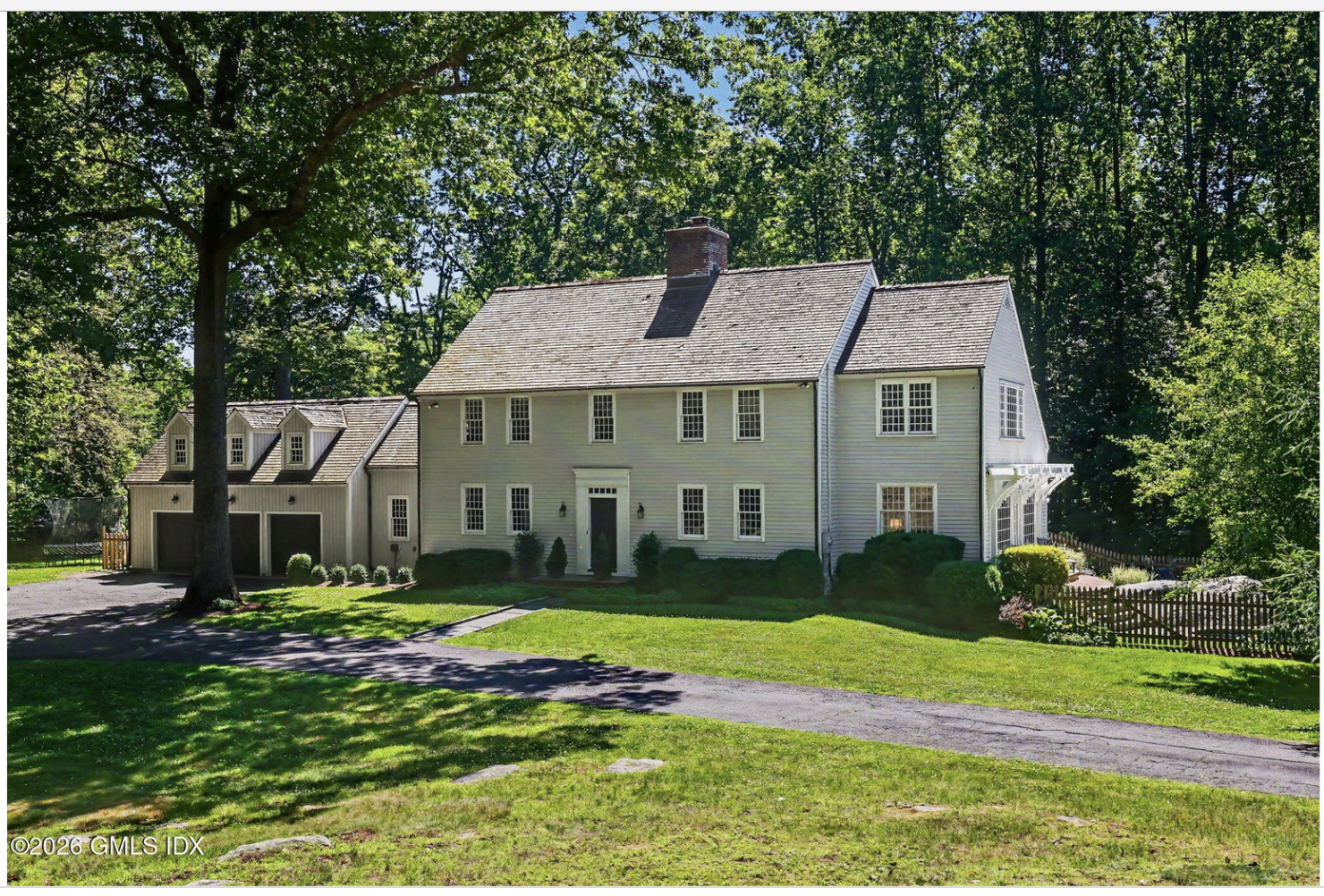
Not all that long ago, three million would get you a pretty impressive house on Arch Street Riverside: Now, it'll fetch you a place to set up your pup tent and air mattress and watch little league games across the street in Binney Park .

58 Arch Street, land priced at $2.750 million, is pending. Owned by the elderly widow of Vinnie Arcuri, of Arcuri’s Deli in Old Greenwich.

“The plot is .38 of an acre, 16,553 square feet- which offers an approximate FAR of 5,269 square feet. R-12 zoning Being sold ''as is''. Due diligence at the discretion of the buyer.”