It's not the heat, it's the stupidity (Updated)
/
“But our intentions were good — doesn’t that count for anything?”
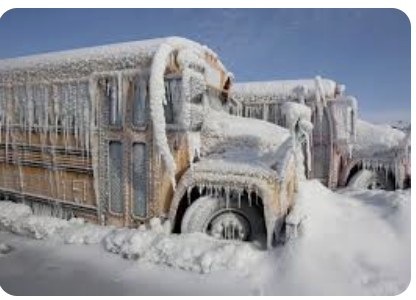
Parents Decry Electric School Buses As Iceboxes in Winter
New York officials mandated that all school bus purchases be electric by 2027, and parents are already thoroughly disgusted with the purchases so far. Apparently, New York officials think they are saving the planet with buses that freeze kids like popsicles.
Electric vehicles (EVs) are always a disaster from start to finish, with their short-lived, expensive, and toxic batteries, which are so dependent on slave and child labor in Africa and China, and they simply don’t work the way they are supposed to. That includes heating in the EVs during icy winter weather.
While the electric bus rule is to apply across the state of New York, parents in the Lake Shore Central School District are the ones vocally speaking out. WIVB News4 reported last week that parents are worried about their children’s health as bus drivers turn down the heat in the buses or even turn it off altogether as they try to conserve battery life. In fact, that is a recommended practice for EVs, which perform very poorly in the wintertime. And that is exactly why they should not be used to transport children to and from school in freezing temperatures.
Even the state of Maine’s “Green Schools” bureaucrats acknowledge that cold weather, an unexpected phenomenon in Vacation Land, can, er, ehem, affect the performance of EV buses:
Vehicle Range Electric buses can drive between 120 to 150 miles between charges. However, that distance shrinks by 25% to as low as 90 miles in cold Maine winters [48% less, in temperatures below 32º — see Cornell report, below — Ed] Rural districts with long routes or large districts where a bus may have multiple routes per day may find it more challenging to transition to electric buses. For districts with a mix of bus types, electric buses should be assigned to routes that are predictable and within the shortest winter range of an electric bus. If needed, buses can “top off” their battery by plugging in during the school day.
Maintenance and Service Maintenance personnel need to be trained by the bus manufacturer to operate high-voltage systems and drivers should be trained in electric bus operation. It is important for the manufacturer to be close enough to service the buses for any repairs that are beyond the capabilities of district staff.
And from up Ithaca way …
Electric buses don’t like the cold, study finds
By Caitlin Hayes, Cornell Chronicle
May 28, 2025
In 2021, Tompkins Consolidated Area Transit (TCAT) in Ithaca received a grant to procure seven all-electric buses and began a pilot program that didn’t go as they’d hoped. In addition to issues with the manufacturers, the buses struggled in Ithaca’s hilly terrain and were unreliable, with reduced range, in cold weather.
…. In a study published May 27 in Transportation Research Part D, researchers analyzed two years of TCAT data and quantified the increased energy consumption of the pilot fleet, finding that the batteries on the electric buses consumed 48% more energy in cold weather (between -4 to 0 degrees Celsius, or around 25 to 32 degrees Fahrenheit) and nearly 27% more in a broader temperature range (-12 to 10 degrees Celsius, or 10 to 50 degrees Fahrenheit).
…. The study is the first to assess and analyze electric buses’ performance in the northeastern U.S., with an unprecedented dataset that covers significant distance – more than 80,000 kilometers (nearly 50,000 miles) – at cold temperatures.
The researchers, including first author and doctoral student Jintao Gu, modeled how the buses would perform at optimal temperatures and compared that to the actual performance across more than 40 complex routes and schedules. They found that half of the increased consumption in cold weather comes from the batteries’ need to heat themselves. That’s because batteries in electric vehicles operate at an optimal temperature of around 75 degrees Fahrenheit, and the colder the battery is when the bus starts, the more energy it takes to warm it. The other main culprit is the heating of the bus’s cabin. With frequent stops, especially on urban routes in which the doors are opened and closed every few minutes, the batteries must work harder to heat the cabins.
“With an all-electric vehicle, the battery is the only onboard energy source,” said [Max] Zhang, who is also a senior faculty fellow at the Cornell Atkinson Center for Sustainability. “Everything has to come from it.”
The researchers also found that regenerative braking, whereby the battery recharges by capturing energy during braking, was also less efficient in cold weather. They said this is likely because the battery, which is about eight times the size of a standard electric vehicle battery, struggles to maintain an even temperature across its cells.
Oh! Keep ‘em indoors! Tell that to the Greenwich Board of Ed, which can’t even find an open field to park its fleet.
'We got bad buses': Winthrop, Yarmouth electric school buses still unsafe for road
WINTHROP (WGME) -- The bumpy road for electric school buses continues for two Maine school districts.
Winthrop and Yarmouth are keeping those buses off the road this school year. The Quebec-based manufacturer, Lion Electric, has filed for bankruptcy.
Winthrop has four electric buses. Superintendent Becky Foley says the buses have been nothing but trouble.
In its first year, one bus lost its brakes and ran into a snowbank. Nobody was hurt, but the buses have also spent months in repair shops, faced parts recalls and failed state inspections.
Winthrop’s bus warranty will not be honored by Lion Electric, since the company has filed for bankruptcy. But because Winthrop received the buses through a grant from the Environmental Protection Agency, they are required to keep and maintain the buses for five years. Foley hopes the EPA will give them an early out.
“We just want to hear from the EPA and learn how we can dispose of them, get rid of them and move on,” Foley said.
Yarmouth also went electric.
They have two Lion Electric buses, through a Maine Department of Education grant.
Superintendent Andrew Dolloff says the buses have been operational for one month total over a two-year span. He is still weighing options, including selling the buses, trading them in or working with another service provider and repairing the buses on their own dime.
“I don’t think anybody could foresee this happening, what took place with the manufacturer," Dolloff said.
UPDATE: There’s probably no truth to the rumor that Greenwich’s “Net Zero” nut jobs are circulating a petition to demand the town convert our bus fleet to geothermal powered motors, but then again, you never know.