Go peddle your garbage elsewhere
/Why anyone thinks it’s a good idea to make it easier for the denizens of southwest Stamford to travel back and forth to Old Greenwich is a puzzle that I can’t solve, but someone does, and the boondoggle continues to advance.
Greenwich-Stamford Multi-Use Path
From Binney Park to Boccuzzi Park
The trail itself will take the form of a 10’ wide paved pathway but also rely on painted bike lanes and shared lane symbol markings within the roadway to fill gaps where a 10’ wide pathway is not practical.
Expensive? Nah, what makes you think that?
Improvements associated with the trail are anticipated to include alterations to roadway geometry, additional public sidewalk construction, standard bicycle and pedestrian improvements, pavement structure improvements, and relocations of drainage and utility infrastructure.
Looking at the four proposed routes, it seems clear that there will be very little construction, for now, of that 10’ wide dedicated bike path the planners mention — there’s just no room to create much of it. That leaves “dedicated bike lanes” and “shared use lanes ” or, in the jargon, “Sharrows”. Illustrations of the three options are thoughtfully provided in the no-doubt-handsomely-paid consultants’ proposal, as shown:
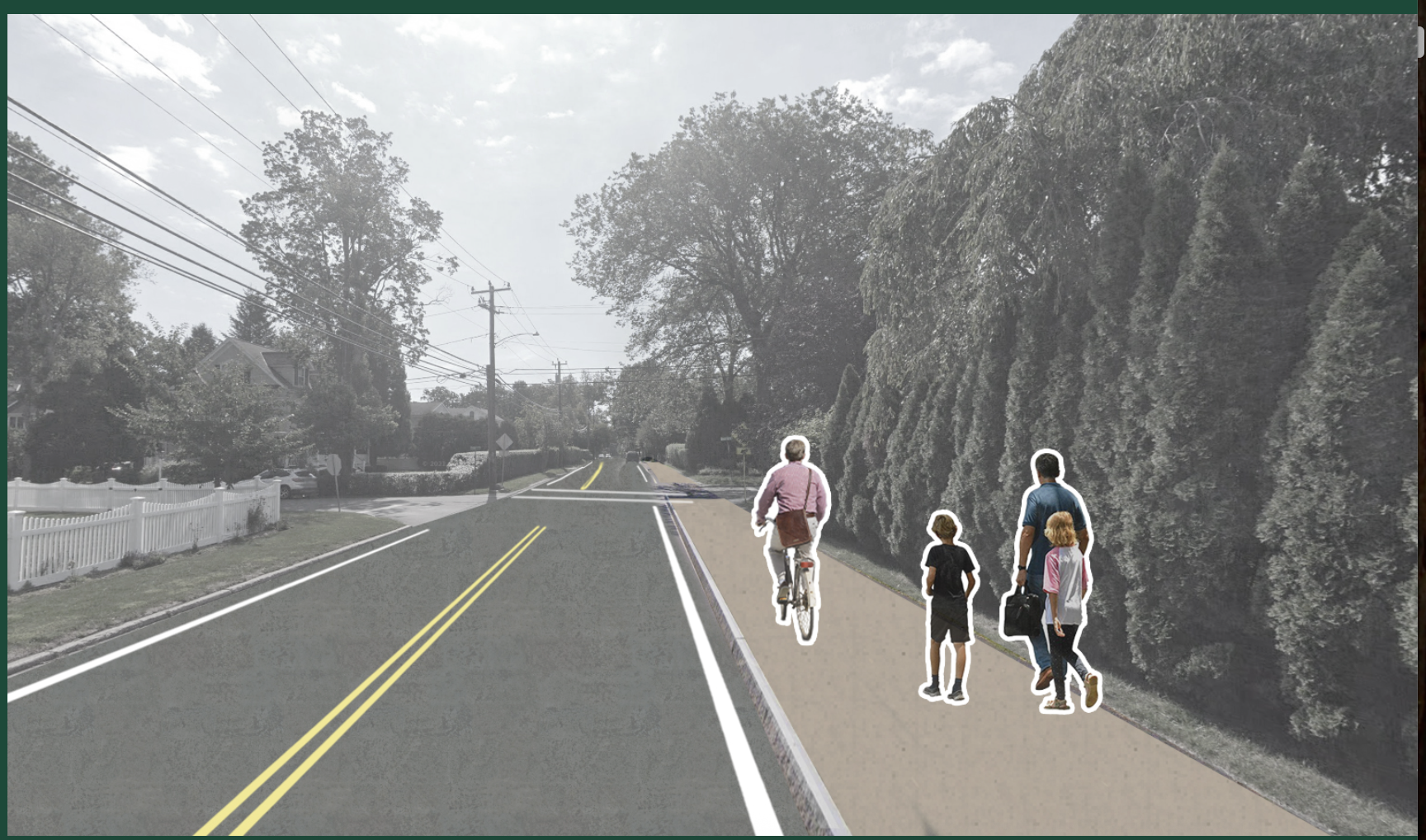
dedicated 10’ wide bike path
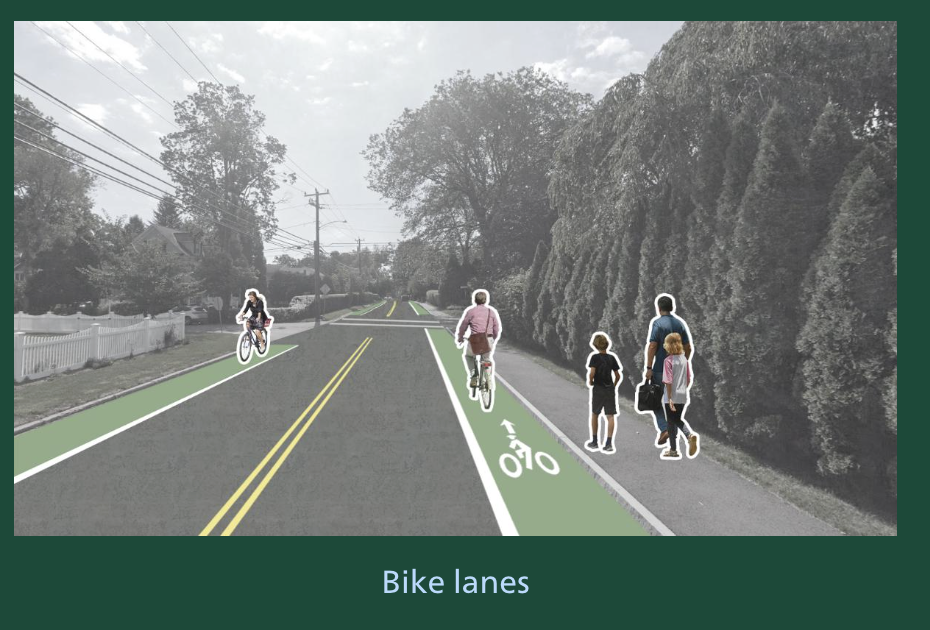
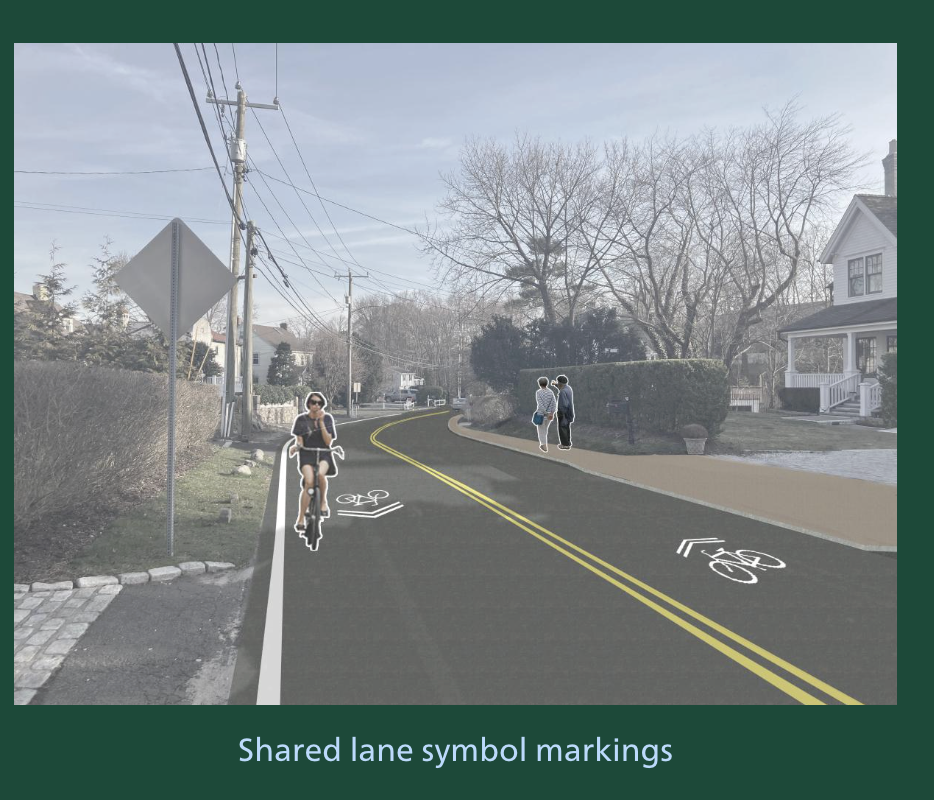
Sharrows
As you’ll note, even the “bike lanes” take up an enormous amount of roadway, space that will be coming out of a lot of residents’ front yards, at an expense that will be borne by all. Not good. And the third, cheaper option, marked-lane “sharrows”? They’re useless, if one goes by the experience of this avid bicyclist advocate from San Francisco, and I suspect one should:
People for Bikes
We Were Wrong About Sharrows
The former executive director of the California Bicycle Coalition was a key player in the proliferation of shared lane markings. Twenty years later, he’s disillusioned with them.
It was the late 1990s and I thought we were so clever. We had just convinced the San Francisco Department of Parking and Traffic to incorporate an innovative new design into its bike plan, a bold statement conveying “bikes belong” right there in the middle of the street. I had first seen a shared-use marking, or “sharrow” — a white bicycle painted directly on asphalt — in photos of Paris and Chicago, put there to help bicyclists get through intersections by indicating their path of travel. In 1993, James McKay, a bike planner in Denver, used it on a trial basis to emphasize a bicyclist’s right to ride in the middle of the lane.
I was the young executive director of the San Francisco Bicycle Coalition. We published a hard-hitting newsletter and organized leaders from businesses, churches, community organizations, youth groups, and more into a coalition that was giving unprecedented voice to the demands of San Franciscans for safer streets. Looking to those examples from Chicago, Paris, and Denver, we pushed to get an improved version of the sharrow design formally included in the city’s bike plan and approved for use by the state of California. Mayor Willie Brown famously painted the first sharrow on Grove Street outside of City Hall, getting some green paint on his fancy suit and laughing it off in his inimitable style. [Did Kamala wipe off the offending liquid for him? With what? Asking for a friend.]
…. San Francisco went on to paint thousands of these symbols all over its bike network, and hundreds of cities followed suit. I thought the sharrow would educate bicyclists to stay out of the “door zone”— the three or so feet of space adjacent to parked cars where motorists opening car doors and bicyclists could collide — and usher in a new era of safer streets, one where motorists would patiently wait behind bicyclists “taking the lane” because this painted symbol made it clear they had the right to do so. Where we couldn’t get a bike lane, I hoped this symbol would effectively convert the mixed-traffic lane into an adhoc bike lane when bicyclists were present.
I was wrong.
It turns out that motorists really don’t like to wait behind someone on a bike, regardless of the paint on the street. Even Oakland’s experiment with the so-called “super sharrow,” where the bicycle path of travel is painted solid green, isn’t enough to get people on bikes to comfortably “take the lane.” Sharrow or no sharrow, most people on bikes dangerously hug the edge of the roadway, squeezing themselves into the door zone to avoid blocking car traffic.
Simply put, sharrows don’t do what we hoped they would. Studies back up that claim.
Early research in San Francisco and Florida showed evidence that behaviors changed slightly on streets with sharrows. For example, some bicycle riders positioned themselves a few inches further from the curb or car doors. A 2010 evaluation of shared lane markings in three separate cities again showed that the markings had some positive impact on behavior. Looking closely at the results, however, it was clear the changes were too minor to make a difference. After Oakland’s experiment with the super sharrow, the Federal Highway Administration announced it would not support future experiments, and Oakland does not plan to continue the treatment when it repaves the street.
San Francisco still uses sharrows, but for the most part, city officials know better than to expect them to do much for safety. Today, beautiful sharrows point bicyclists along the circuitous path of the “wiggle,” where a right-left-right-left series of turns directs riders on a gentle grade between San Francisco’s steep hills. They are great for navigation and, perhaps, concentrating riders on certain streets — that’s about it.
Bright green arrows are useful for marking the zig-zag path that takes bicyclists across San Francisco while avoiding the steep hills.
It’s been more than 20 years since I had high hopes for the sharrow as a tool for safety. Today, we know so much more about what it takes to make our streets safer for bicycling. We need separate bike paths; we need protected bike lanes on busy roads; and where the lanes are shared, we need actual speeds reduced to 20 mph or slower. Sharrows don’t do any of that.
“Sharrows do, however, accomplish something pernicious which I did not anticipate. They allow officials to take credit for doing something for bicycle safety without impacting car traffic, even though that something is next to nothing. It’s just pretending, and it’s worse than being honest about priorities. It’s insulting to the public to encourage bicycling by painting bike symbols on the street but doing nothing to actually make riding a bike any safer.”
Yes, good bike infrastructure can require tradeoffs that are more politically challenging than simply painting a symbol on the street. Now, at PeopleForBikes, I’m part of a team that has successfully helped cities build networks of bikeways that actually get more people riding safely and joyfully. We help city leaders with communications, organizing, and political strategies to overcome the challenges they will surely face in building truly effective infrastructure.
“We never suggest using sharrows to create a bikeway. We’ve learned our lessons. Now that we know better, it’s time to do more.”
And that, of course, is the danger here: like all good-intentions plans, when one doesn’t work, its advocates never give up, they simply demand more. Hang onto your wallets, because these people will be back. Those 10’ wide bike paths that are too impractical and expensive today? Look for them tomorrow.