David Strom asks and answers the question …
/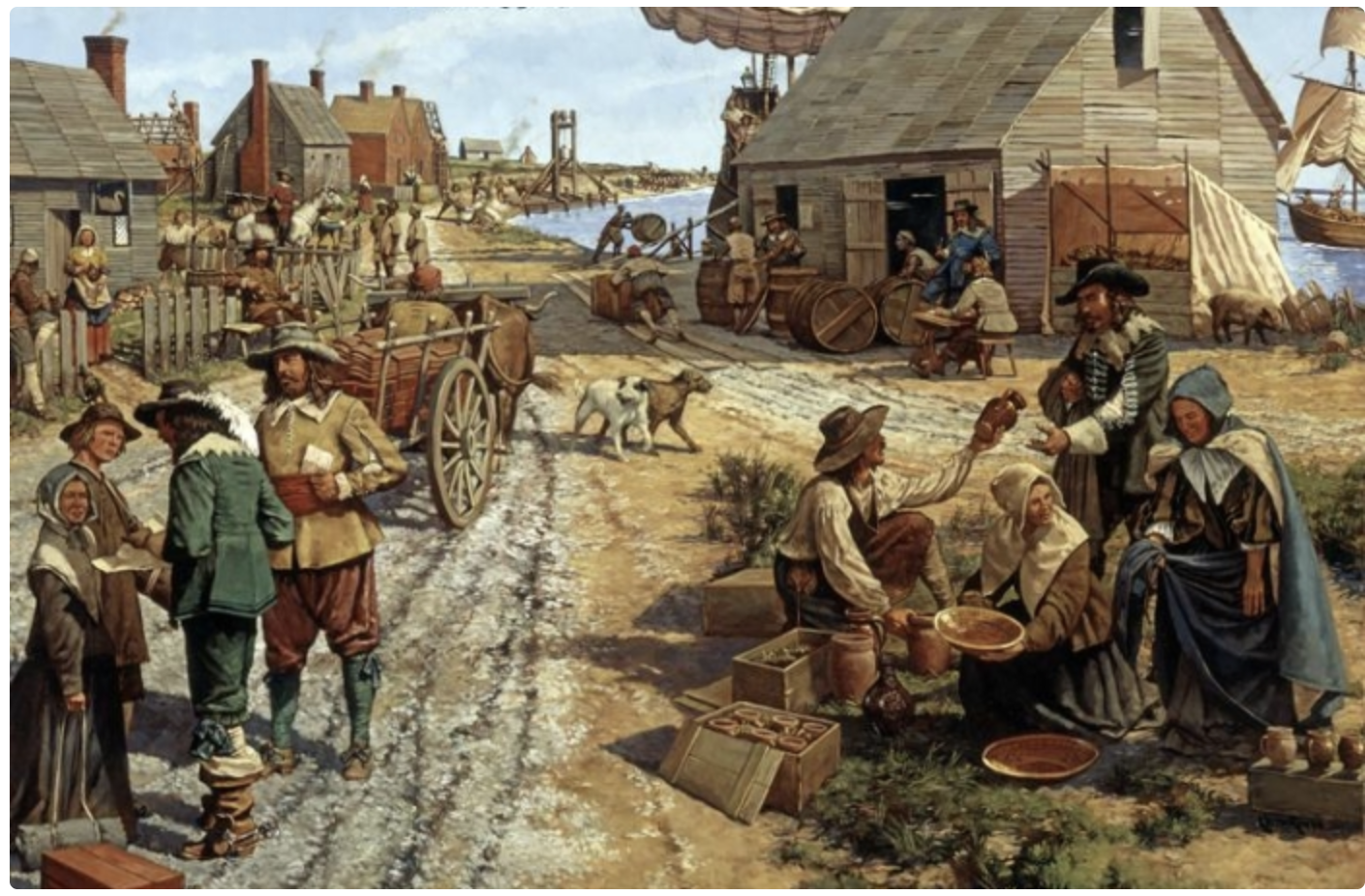
Once they shipped Bernie sanders back to England, the plymouth bay colonists prospered
What Does It Mean to Say Somebody Has a 'Right' to Something?
Most people agree that we don't want to live in a society with people starving and living on the streets. We want everybody to have the basics necessary to live.
But does it make sense to say that people have a "right" to such things? Is it outrageous to demand that able-bodied people work to feed and house themselves?
Many people who call themselves socialists think so. Everybody should have a right to food, clothing, housing, medical care, and all the basics that we expect today.
…. Socialists always skip the producer. They talk endlessly about consumption as if food grows in grocery stores, homes build themselves, electricity appears by magic, and doctors don't have to work. Every "basic necessity" they demand is someone else's profession, skill, investment, and effort. They speak as though declaring something a right somehow abolishes the need for someone else to create it. It doesn't. If you make consumption the entitlement while treating production as an obligation, you don't eliminate scarcity. You eliminate the incentive to produce.
This claim, though, is based on a fundamentally broken understanding of how those "basics" come to be. None of them merely exist in nature; each of them is the product of somebody's labor, and when you make the claim that everybody has a "right" to them, it is equivalent to saying that they have the right to others' labor.
Food doesn't just appear. Houses and apartments don't just grow out of the ground. Medical care is not magically produced in the air. All these things are produced, and one reason they are unevenly distributed is that some people and some systems are far better at producing them than others.
Industrial capitalism is extraordinarily good at producing them—so good, in fact, that the burden for giving them away is relatively small and people are willing to give them away without thinking that much about them. Some of that is out of the goodness of their hearts, and some is just a practical decision based on the fact that we don't want to be stepping over drug addicts who poop in the streets.
Whatever the reason, it's not that the recipients of others' largesse have a "right" to the labor and efforts of others. And if we rearrange our societies based on the mistaken notion that they do, it turns out the very system that produces all that extra wealth we are generally happy to share collapses.
It's not theoretical that this is the case. Socialism has been tried in many forms and many places*. The Nordic countries, which many socialists wrongly believe are socialist, gave up on the idea back in the 80s and 90s and are now free-market systems (in many cases freer than our own, which has become bogged down with excessive government regulations) with a high level of social insurance.
One of the reasons why all these countries are working mightily to kick migrants out is that they treat that social insurance as a "right" to state support and thus abuse the system, which is supposed to be for the aged, infirm, and those in temporary distress. When people demand something for free, they are really demanding that others do all the work while they get to consume the product of others' labor.
This is why communes tend to fall apart. I looked it up, and 90% of all communes fall apart within the first year. Almost none persist for any length of time. There are always makers and takers.
On a practical level, you can see how perverse the incentives are just by looking at the arguments around SNAP benefits, or all the welfare fraud that we have seen over the past few years. The less people feel that welfare is something to be avoided, the more people abuse the system.
Telling people they have a "right" to something inevitably means that they have no obligations attached to getting it.
EBT mom on junk food cuts: "What the point of food stamps if it's just for real food?!?!" pic.twitter.com/3gzlky9liv
— End Wokeness (@EndWokeness) December 17, 2025
When some states removed sugary drinks, snacks, cakes, and cookies from eligibility for SNAP benefits, the internet exploded with outrage. Democrats went apoplectic, based on the bizarre notion that it is wrong for taxpayers to have a say in how their money is spent.
The "basics" aren't manna from heaven. They only exist because people produce them. And there is more than enough to go around, and people are willing to share with others less fortunate, only when you have an economic system that generates a lot of surplus.
That's capitalism. Before capitalism, every society lived on the edge of famine. Under capitalism, starvation is nonexistent.
We can argue about the appropriate level of social insurance, who should receive it, and for how long. But once you cross the line into claiming that people have a "right" to the labor of others, you've gone off the rails.
*We’ve known this since the Pilgrims’ experiment with socialism in 1620-1622
AI Overview:
The Pilgrims arrived in 1620 and were originally required by their English investors to live and farm under a communal system, known as the "common course". This resulted in chronic food shortages, low morale, and near-starvation.
By the spring of 1623, facing another potential famine, Governor William Bradford abandoned the experiment and assigned private parcels of land to each family. This shift in economic incentives drastically increased productivity, and the colony never faced severe food shortages again.
(You can read more on the Pilgrims’ experience here).
“In 1620 Plymouth Plantation was founded with a system of communal property rights. Food and supplies were held in common and then distributed based on equality and need as determined by Plantation officials. People received the same rations whether or not they contributed to producing the food, and residents were forbidden from producing their own food. Governor William Bradford, in his 1647 history, Of Plymouth Plantation, wrote that this system was found to breed much confusion and discontent and retard much employment that would have been to their benefit and comfort. The problem was that young men, that were most able and fit for labour, did repine that they should spend their time and strength to work for other men’s wives and children without any recompense. Because of the poor incentives, little food was produced.”