I didn't post this yesterday because it was so long, but there have been a couple of reader comments on the issue, so here's a two-part look at "when's a lawyer a lawyer"?
/Part One: why do people flunk the bar exam in the first place?
Zacharia had for years offered legal analysis on national television, identifying herself as a lawyer. In reality, she never passed the bar exam in any state, as she admitted to Fox News’ Sean Hannity on Thursday evening.
Calling herself an attorney might have landed her in legal trouble — at least in Connecticut, where representing oneself as a lawyer violates state law.
J. Paul Vance Jr., president of the Connecticut Bar Association, told CT Insider in a phone call that Zacharia could have been investigated had she been holding herself out as a lawyer in Connecticut.
There may not be data on the number of people who misrepresent themselves, but there are statistics on how many people fail the bar exam each year.
In that regard, Zacharia is in good company. A two-day test, hopeful lawyers spend months in preparation only for many to come up short. In 2011, the year she sat for the exam, Zacharia was one of almost 25,000 test-takers in the United States who didn’t pass.
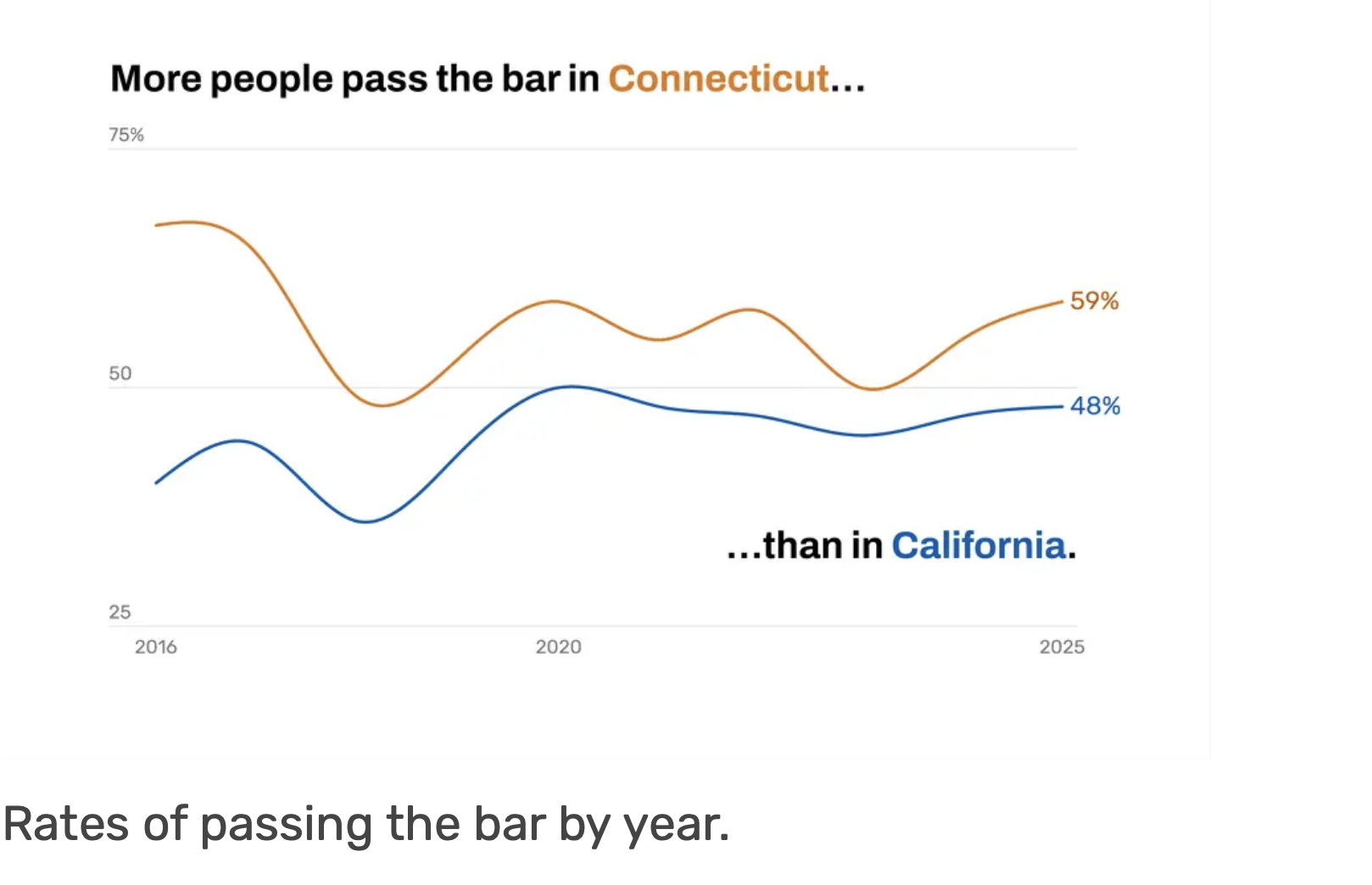
California, where she is believed to have sat for the exam, is one of the hardest states to pass the test in the country. That year, about half of exam-takers in the Golden State failed.
A couple of things: the bar exam is comprised of two parts, administered over two days: the nationwide Multi-State, and a second exam specific to the laws of the state examinees are seeking admission to. The Multi-State is pretty generic, testing for a general knowledge of broad legal concepts and if you flunk it, you probably shouldn’t have graduated law school to begin with.
The state portion can be harder, because it’s designed by already-admitted lawyers who want to limit competition. My best friend in law school, very, very bright, top of his class, LSAT scores (almost - ha!) as good as mine, once decided to take the Maine bar exam so that if he cared to, he could live and practice in Maine sometime in the distant future. It’s not required to retake the multi-state score in such circumstances (assuming you passed it in the first place) so my friend sat only for the Maine exam, and, to his utter outrage (and my gloating delight), he flunked!
At the time he was tested, Bob had already spent one year clerking for a federal judge (a highly competitive, coveted position), two years as an Assistant U.S. Attorney, 2 years as an associate at one of New England’s largest law firms and was into his 3rd year as partner at that same firm. If anyone knew “the law”, it was Bob. But he flunked anyway (the first time; he retook it, passed, was admitted, and then never left Boston); under the guise of testing for knowledge of local procedure, Maine, it turned out, tested on such super-specific topics as the sheriff’s fee for serving a subpoena on a witness. Hell, the sheriff would and could tell a lawyer requesting such service what the charge was or, gosh, the lawyer could pick the Practice Book off his desk and look it up himself. Stupid, irrelevant question, included in the test solely, in my and Bob’s opinion, to keep flatlanders from away, away.
All that said, the dismal failure rates cited in the linked-to article are misleading: many/most of the flunkees should never have been admitted to law school in the first place, and many of the law schools churning out these failers are low-tier schools teaching low-tier students — especially in California, where there are literally dozens of non-profit and even for-profit “law schools” that no one has ever heard of, and deservedly so: bar exam pass rates for their graduates are as low as 25%, some as low 10%. That’s why the state-wide passing percentage is so low.
Theres a high pass rate for those taking the exam the second time, but after that, forget it; there’s something in your brain or in your training that’s preventing you from succeeding in correctly filling out the little answer boxes and writing a few paragraphs on specific topics. Quit trying, relax, and go find something more profitable and enjoyable to do.
PART TWO: WHAT’S A “LAWER”?
I ASKED ChatGTP:
Q: Here's question I as a retired lawyer should know the answer to but don't: it's been revealed that the now one-day White House Press Secretary graduated from law school but never passed a bar exam. Is admission to at least one state's bar required before a law school grad can legitimately describe herself as a lawyer and, related question can she charge a client or be paid by an employer for legal advice? I'm sure that question was on at least some of the state bar exams I took (I passed several back in the early 1980s), but I really haven't thought about it since.
A: The short answer is generally no to the first question, and no to the second—with some important qualifications.
And I suspect that if you were taking the bar exams again today, you'd recognize the underlying principles immediately. The rules haven't changed nearly as much as the terminology surrounding them.
There are actually three distinct questions here:
Can someone who graduated from law school but was never admitted to the bar legitimately call herself a lawyer?
Can that person provide legal advice to clients for compensation?
Can an employer hire and pay that person to perform legal work?
The answers turn on a distinction that sometimes gets blurred in ordinary conversation: having a law degree is not the same as being licensed to practice law.
One other preliminary point: passing a bar examination isn't invariably necessary for admission. Wisconsin's diploma privilege, admission on motion, and certain other admission pathways illustrate why the legally significant event is ordinarily admission to practice, not passing an examination.
1. Can an unlicensed law graduate call herself a lawyer?
In most American jurisdictions, not in a professional context where the designation implies authorization to practice law.
The National Conference of Bar Examiners addresses almost precisely your question in its guidance on when a successful bar applicant may begin using professional titles. Its advice is that even passing the examination doesn't authorize someone to call herself a lawyer. She must first satisfy the jurisdiction's admission requirements.
Georgia's State Bar is particularly unequivocal. Its published guidance says that even someone who has passed the examination and is employed by a law firm cannot use the title until formally admitted.
The terms lawyer and attorney are sometimes distinguished colloquially, with lawyer supposedly referring to someone educated in law and attorney referring to someone licensed to practice. But that distinction is not a reliable statement of American licensing law. Many jurisdictions treat the two titles equivalently when determining whether someone has improperly held herself out as authorized to practice.
Someone can, of course, truthfully describe herself as a law school graduate, a J.D., a legal researcher, or a legal analyst, provided the description isn't misleading.
2. Can she charge for legal advice?
Ordinarily, no.
The relevant principle is the prohibition against the unauthorized practice of law (UPL).
Providing individualized legal advice—applying law to a particular client's circumstances and recommending what that client should do—is generally among the activities reserved to licensed practitioners or people otherwise specifically authorized by law.
And here's a distinction you undoubtedly remember from your own practice: the prohibition does not depend upon compensation.
An unlicensed individual can engage in unauthorized practice even if she gives the advice free of charge. Charging a fee may create additional problems, but it isn't essential to the underlying violation.
There are exceptions for certain authorized nonlawyer services, including particular administrative proceedings and specialized regulatory practices. But a J.D. alone does not confer that authority.
3. Can an employer pay her to do legal work?
Absolutely. And this is where the answer becomes more nuanced.
A law firm can employ a J.D. who has never been admitted to practice and pay that person to perform substantial legal work.
That work may include legal research, preparing memoranda, reviewing contracts, drafting pleadings, and analyzing statutes or regulations.
The critical requirements are that the employee not independently engage in activities requiring a license, that appropriate attorney supervision be provided where necessary, and that the employer not misrepresent the employee's professional status.
An Illinois State Bar ethics opinion, for example, expressly permits law graduates awaiting admission to perform much of the work ordinarily assigned to first-year associates, subject to attorney supervision and responsibility for the work.
The same basic distinction applies to corporate employment. A corporation can pay an unlicensed J.D. to perform compliance work, legal research, contract administration, or policy analysis. But simply being an employee does not create a general exemption permitting that person to act as the corporation's independent legal counsel.
ABA Model Rule 5.5 provides special multijurisdictional rules for certain in-house counsel, but those provisions generally contemplate lawyers already licensed somewhere or otherwise authorized under applicable law.
4. Now, the particularly interesting California question
This brings us to Katie Zacharia.
According to CBS News reporting dated October 15, Zacharia acknowledged that she had taken but not passed the California bar examination. She has maintained that legal experts told her she could describe herself as a lawyer, although not an attorney at law, because she possessed a J.D. and had international transactional-law experience.
California Business and Professions Code § 6126(a) makes it a misdemeanor for an unauthorized person to hold herself out as practicing or entitled to practice law, or to actually practice law.
The significant issue is not simply whether she used the word lawyer. It is whether, considering her statements and their context, she represented herself as someone legally authorized to practice.
There's also a separate factual question: she reportedly identified herself as general counsel to a California nonprofit. That title and the duties she actually performed could be much more consequential than describing herself as a lawyer during a television appearance.
Her employment at a Chinese law firm raises still another issue. Working on international transactions under appropriate supervision is not necessarily the same as being admitted to practice Chinese law, and neither establishes authorization to practice California law.
My conclusion
I would distinguish the issues this way:
Conduct by an unlicensed J.D.
General legal position
Identifying herself as a J.D. or law graduate
Permissible
Calling herself a lawyer in a professional biography
Potentially misleading or prohibited
Calling herself an attorney entitled to practice
Generally prohibited
Giving individualized legal advice independently
Generally prohibited absent specific authorization
Being paid for supervised legal research or drafting
Permissible
Serving as independent general counsel
Generally requires appropriate licensure or other authorization
Offering general legal commentary on television
Generally permissible, provided professional status isn't misrepresented
What strikes me as particularly interesting about Zacharia's explanation is her apparent reliance on the distinction between lawyer and attorney at law. That might have some colloquial appeal, but it is not a distinction I would want to rely on as a defense to a California unauthorized-practice allegation.
And I think you'd recognize the underlying issue from your early-1980s bar exams: it is fundamentally a question of holding oneself out as authorized to practice, quite apart from whether one has actually represented a client.
One final wrinkle worth mentioning: California's statute expressly reaches representations of entitlement to practice. Consequently, an investigation wouldn't necessarily have to establish that Zacharia ever charged a client or even rendered a single piece of legal advice. The manner in which she presented her professional qualifications could itself be relevant.
That's what makes this more than an academic question about nomenclature.