But, but, solar energy is FREE! A second government solar plant goes bust — with more to follow — and Trump didn’t do it
/
How a $1B Obama-era solar plant went bankrupt twice, leaving taxpayers with the tab
The plant was backed by a $737M federal loan guarantee and a reported $275.6M Treasury cash grant before going bankrupt
TONOPAH, Nev. — An Obama-era solar power plant once hailed as a "clean energy marvel" and backed by more than $1 billion in federal support has gone bankrupt for a second time and sold for just $7 million — with the estimated taxpayer tab potentially reaching $507.6 million.
Rising from the barren Nevada desert, the Crescent Dunes Solar Energy Project looks like a futuristic fortress in a vast, dusty wasteland, with more than 10,000 mirrors surrounding a giant central tower. The plant was designed to generate solar electricity even after sunset, using an emerging technology that promised to revolutionize green energy in America.
The Obama administration bet big on the project, backing it with a $737 million federal loan guarantee and around $275 million in Treasury grant awards as part of its broader $90 billion push to combat climate change and stimulate the economy following the 2008 financial crisis.
But the promise never matched the performance.
After operations began in late 2015, leaks and equipment failures repeatedly knocked the plant offline, production fell short and cheaper solar alternatives undercut its economics — driving the project into financial ruin and leaving taxpayers shouldering the cost.
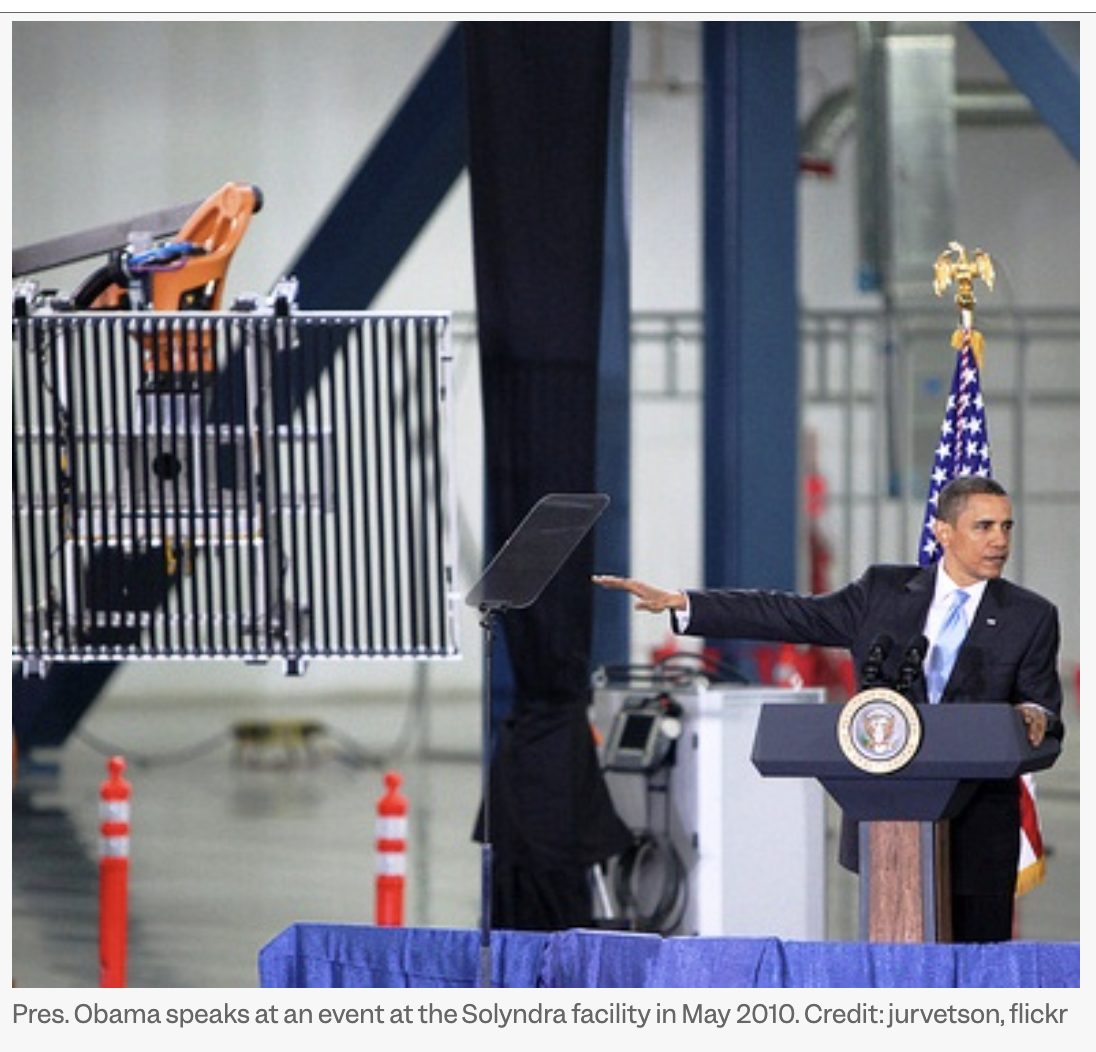
The financial collapse comes 15 years after Solyndra, another Obama-backed solar company, went bankrupt and left taxpayers in the red for $528 million — a sum Crescent Dunes' estimated taxpayer tab could nearly match. [$528 million here, $528 million there, pretty soon you’re talking real money.]
The billion-dollar bet
Crescent Dunes sits about 13 miles northwest of the old mining town of Tonopah, roughly halfway between Las Vegas and Reno.
The isolated facility, which Fox News Digital toured, is surrounded by miles of barren desert, scrubland and distant mountain ranges.
Across the 2,250-acre federal site, more than 10,000 giant mirrors surround a 640-foot tower — the centerpiece of a system designed to overcome one of solar power's biggest limitations: darkness.
Unlike ordinary solar panels, which convert sunlight directly into electricity, Crescent Dunes focuses the sun's rays onto a receiver atop the tower, heating molten salt to roughly 1,050 degrees Fahrenheit. The salt stores that heat in a massive insulated tank, allowing it to produce steam that drives an electricity-generating turbine long after sunset.
That combination made it the first commercial-scale U.S. solar tower to use molten salt to both collect and store the sun's heat. DOE projected [it never came close to that] it would generate 482,000 megawatt-hours annually, with a maximum output of 110 megawatts — enough to supply more than 75,000 Nevada homes during peak periods.
Then-Senate Minority Leader Harry Reid, D-Nev., championed the project. In 2016, he called it an "engineering and clean energy marvel" and predicted that "Nevada will benefit for decades."
The project reflected the Obama administration's push to expand clean energy by using taxpayer-backed financing to help bring promising but commercially risky technologies to market.
But Crescent Dunes showed how expensive those gambles could become when they failed.
The promise unravels
Crescent Dunes' problems emerged almost immediately.
A major leak in its molten-salt storage tank occurred in October 2016 — less than a year after commercial operations began.
During that shutdown, Treasury approved a cash-grant payment in March 2017 under the Obama-era stimulus program — funding that later became the subject of serious fraud allegations.
It went back online in July 2017, but restarting the plant did not resolve its performance problems.
Even in 2018, its best full year through 2025, Crescent Dunes generated just 41% of the annual electricity output projected by DOE, according to federal energy records.
Then another tank failure halted generation in March 2019.
Seven months later, the repeated breakdowns and poor performance eventually cost Crescent Dunes its sole electricity customer when NV Energy terminated its 25-year agreement.
Without its long-term power contract, Crescent Dunes spiraled into financial trouble, culminating in its first bankruptcy in July 2020.
The 2020 restructuring handed ownership to ACS through its affiliate, Crescent Dunes Investment, with Cobra running the plant. The turnaround plan counted on extensive repairs restoring production to 400,000 megawatt-hours a year — more than twice its best annual output.
….
Those same economic pressures have battered California's Ivanpah solar plant, another Obama-era project Fox News Digital reported on that uses thousands of heliostats to concentrate sunlight. Unlike Crescent Dunes, Ivanpah cannot store the sun's heat to generate electricity after dark.
And then there’s the Solyndra fiasco. Here;s a post-mortum from that time:
August 27, 2015
Solyndra: A Case Study in Green Energy, Cronyism, and the Failure of Central Planning
By David Boaz
Back in 2011 I wrote several times about the failure of Solyndra, the solar panel company that was well connected to the Obama administration. Then, as with so many stories, the topic passed out of the headlines and I lost touch with it. Today, the Washington Post and other papers bring news of a newly released federal investigative report:
Top leaders of a troubled solar panel company that cost taxpayers a half-billion dollars repeatedly misled federal officials and omitted information about the firm’s financial prospects as they sought to win a major government loan, according to a newly-released federal investigative report.
Solyndra’s leaders engaged in a “pattern of false and misleading assertions” that drew a rosy picture of their company enjoying robust sales while they lobbied to win the first clean energy loan the new administration awarded in 2009, a lengthy investigation uncovered. The Silicon Valley start-up’s dramatic rise and then collapse into bankruptcy two years later became a rallying cry for critics of President Obama’s signature program to create jobs by injecting billions of dollars into clean energy firms.
And why would it become such a rallying cry for critics? Well, consider the hyperlink the Post inserted at that point in the article: “[Past coverage: Solyndra: Politics infused Obama energy programs]” And what did that article report?
Meant to create jobs and cut reliance on foreign oil, Obama’s green-technology program was infused with politics at every level, The Washington Post found in an analysis of thousands of memos, company records and internal e‑mails. Political considerations were raised repeatedly by company investors, Energy Department bureaucrats and White House officials.
The records, some previously unreported, show that when warned that financial disaster might lie ahead, the administration remained steadfast in its support for Solyndra.…. “Employees acknowledged that they felt tremendous pressure, in general, to process loan guarantee applications,” the report said. “They suggested the pressure was based on the significant interest in the program from Department leadership, the Administration, Congress, and the applicants.”
As for those who insist that solar energy is “free”, I asked Google to dredge up some of the most egregious liars:
1. Wholesale Electricity Pricing ("Reliably Free" Daytime Power)
Jenny Chase (Bloomberg NEF solar analyst): Quoted in a 2024 New York Times opinion piece, Chase estimated that by 2030, solar power will be "absolutely and reliably free during the sunny parts of the day for much of the year 'pretty much everywhere.'" Her claim refers to wholesale daytime market prices dropping to zero (or negative) when abundant solar generation exceeds immediate grid demand, rather than zero equipment or retail delivery costs. [1]
2. The Resource Itself (No Fuel Cost)
Neil deGrasse Tyson (Astrophysicist and science communicator): On his StarTalk program, Tyson argued that "solar energy is so plentiful and it's so free... I don't need to pay for the energy to arrive to my house." He uses "free" to describe sunlight as an unowned, zero-fuel-cost resource, distinct from the upfront cost of panels and hardware. [1]
Ralph Nader (Consumer advocate): In 1974, Nader similarly framed sunlight as an unowned public resource, stating: "The use of solar energy has not been opened up because the oil industry does not own the sun." [1]
3. Public Policy Proposals (Taxpayer-Funded Basic Supply)
Harald Desing and Empa researchers (Swiss Federal Laboratories for Materials Science and Technology): In a 2025 study detailed by Empa, Desing and colleagues proposed a publicly funded "solar basic service" providing every resident with 4,400 kWh of solar electricity per year "for free"
(when the sun is shining). In this model, "free" means free at the point of use like public roads, financed by an estimated 58 billion Swiss franc public investment. [1, 2, 3]
Things weren’t going well for the free energy industry as long ago as 2011; nothing’s changed for the better, a lot has changed for the worse. From the (pro-solar) Inside Climate News, November 4, 2011:
Solar Subsidies Get the Axe in the UK, Ontario; Chinese Giants Scale Back
…For the world’s global solar panel suppliers, the tough economic climate got tougher this week.
Britain’s energy ministry on Monday proposed slashing subsidies for small-scale solar energy systems in half, in order to save the UK more than $1 billion annually during next few years. The country’s solar industry has contested the plan, claiming the cuts would destroy 25,000 jobs in the sector, Reuters reported Tuesday.
Ontario is also likely to scale back its solar feed-in-tariff after its energy ministry launched a review of the subsidy program on Wednesday. Poll-conscious officials said that while the tariff has helped to spur a sizeable solar industry in the Canadian province, higher electricity bills have angered ratepayers.
The cutbacks mean solar panel manufacturers could lose even more business. Many firms have struggled to remain profitable as diminishing subsidies in Germany and Italy have caused demand to plunge in key solar markets.
Concern Over Advanced Battery Firms
Warning signs of another shakeout in the cleantech sector are popping up, according to an E&E report.
Currently, worldwide supply of lithium-ion batteries for electric vehicles far exceeds demand for the low-carbon cars. Some say the glut could soon spur a shakeout similar to the one wreaking havoc on the solar industry, with less competitive firms getting squeezed out of the market.
Smaller firms like DOE-backed Ener1, for instance, are likely to face significant competition from bigger Japanese and South Korean manufacturers, Bloomberg reported Friday. New York-based Ener1, one of 30 battery manufacturers to win stimulus grants, ran into financial trouble last week when its shares were delisted from Nasdaq. DOE said this week it was “closely monitoring the status” of the firm.