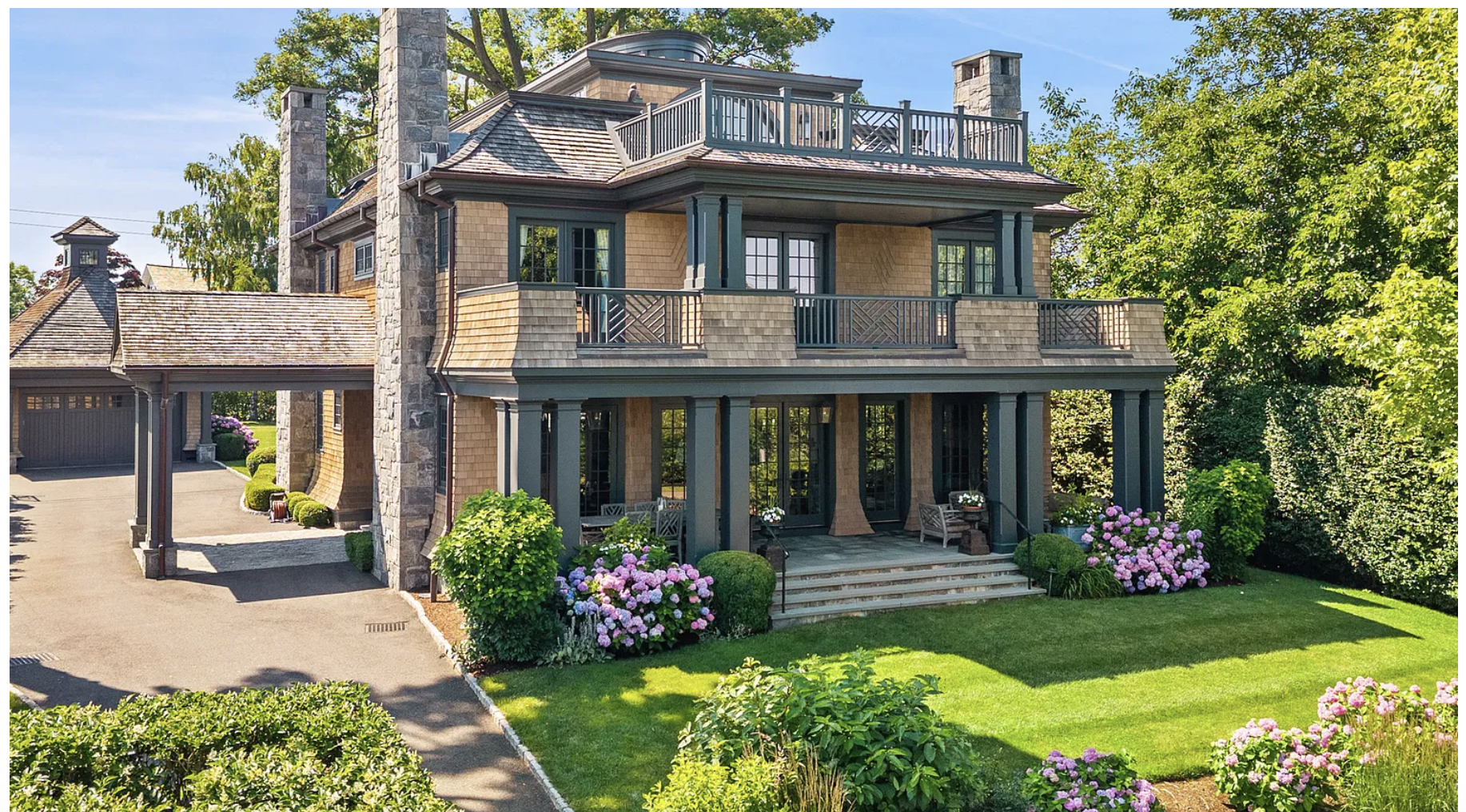
Poor Town, Rich Town, rich house, cheap house: Greenwich vs Scarsdale
/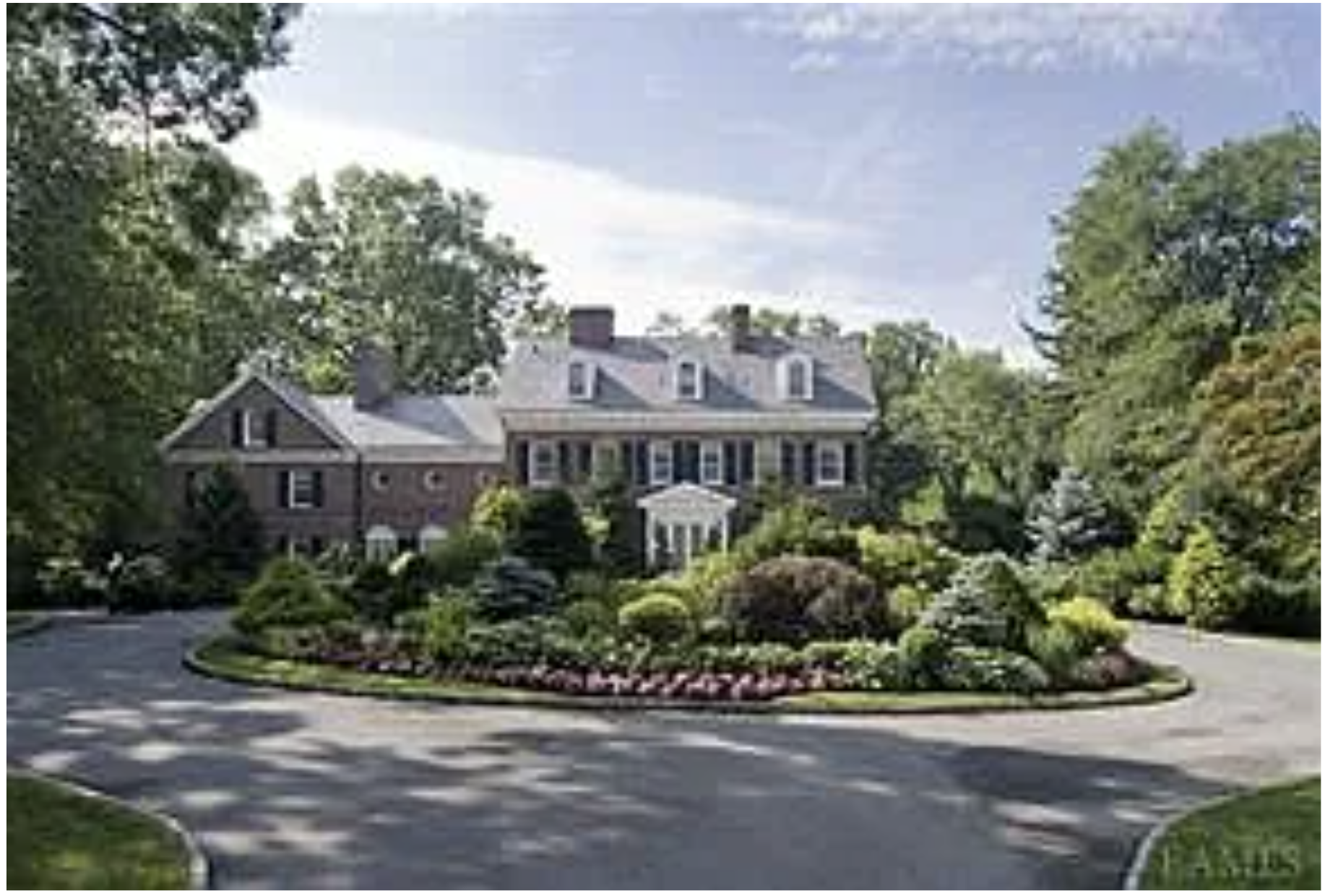
There are exceptions, of course: No. 8 heathcote Road, Scarsdale, one of two houses at No. 8 and No. 10 gerard Fountain built for his family and sister in the early 1900s (1903 and 1907)still retains its original 5 acres and its estimated value is $12 million. No. 10, after a lot-split, is down to just 2 acres, but still in the $9-$10 range. Too bad both houses passed from family ownership back in the 1940s.
I saw this article in Greenwich Time, and I was struck by the the million dollar difference between the average price of Scarsdale homes vs Greenwich’s; Scarsdale’s is a million dollars lower, despite its residents enjoying a much higher household income: $612, 591 vs $312,433. Of course, far-larger Greenwich has much more public and multi-family housing whose residents don’t earn plumber of Wall Street salaries, so it’s hardly surprising that our average income is lower, but what factors account for the huge discrepancy between the two towns’ average house price? Taxes, certainly, because Westchester County has a huge county government to maintain while Connecticut has none, but what else? I asked ChatGPT, and got what I think is a pretty good, and interesting, answer, which i’m pasting in its entirety below.
First, here’s the portion of the GT article that caught my eye:
Financial website MoneyLion released its list of the "Wealthiest Suburbs in America" in June, ranking the top 50 wealthiest towns in the country based on average household incomes and average home values. The suburbs were sorted to show the highest average household income first, according to MoneyLion.
Greenwich was the only Connecticut location to be named to the list. The Connecticut town was ranked No. 27 with a year-over-year change in income of 5.2% and a year-over-year change in home value of 13.5%.
In 2024, Greenwich had an average household income of $312,433, and its average household income in 2023 was $297,081.
The average home value of a Greenwich property as of April 2026 was $2,688,308, according to MoneyLion's data. In April 2025, the town's average home value was $2,369,349.
The wealthiest town on MoneyLion's list was Scarsdale, New York. The town's average household income in 2024 was $612,591. Scarsdale's average home value in April 2026 was $1,673,358.
And here’s ChatGPT’s response to my question — it brings in some factors I hadn’t considered:
Yes. Your instinct is right that taxes matter, but after looking at the underlying data, I think taxes are only part of the explanation—and probably not even the most important part.
There is also an important wrinkle in the article: that $2.688 million Greenwich figure and $1.673 million Scarsdale figure are not really “average home prices.” MoneyLion took them from Zillow's Home Value Index (ZHVI), which Zillow describes as the value of the typical home, calculated from the middle portion of the housing stock. MoneyLion ranked the suburbs by income and supplied ZHVI as additional context. So we're looking at a genuine and very large valuation difference, but not literally “all Greenwich houses added up and divided by the number of houses.”
And I think the explanation is fascinating because Greenwich and Scarsdale are actually rather different products masquerading as comparable wealthy NYC suburbs.
1. The biggest factor is probably land
This strikes me as the thing that's easy to overlook if one thinks of Greenwich and Scarsdale simply as two affluent Metro-North towns.
Greenwich has an enormous inventory of residential land that Scarsdale simply doesn't replicate. Mid-country commonly has one- and two-acre parcels, while backcountry is characterized by estates on four acres or more.
And then Greenwich adds something Scarsdale cannot offer at any price: Long Island Sound waterfront. Recent ultra-luxury listings illustrate what that means—a one-acre Old Greenwich compound with 300 feet of Sound frontage, a dock, guest house and pool house, as well as private-island properties and large backcountry equestrian estates.
So Greenwich's housing stock includes substantial numbers of properties for which the buyer isn't principally buying a house. They're buying:
two acres, four acres, privacy, a pool, guest house, tennis court, barn, waterfront, dock, or some combination thereof.
That land value pulls the whole Greenwich distribution upward.
Scarsdale is extremely expensive suburban real estate, but its basic luxury product is much more often a very nice house on a suburban lot. Greenwich's upper-middle and upper end includes an entirely different category: the country estate and the waterfront estate.
That's probably the single most important structural difference.
2. Greenwich is simultaneously more economically diverse and has a more extreme luxury housing stock
This is the apparent paradox you noticed.
The Census data actually confirms your observation about the housing mix quite dramatically. In Scarsdale, 92.3% of occupied housing units are owner-occupied. In Greenwich it's only 70.0%.
That's an enormous difference.
Greenwich contains Byram, Chickahominy, parts of Cos Cob, downtown apartments and condos, multifamily housing, public/affordable housing, etc., alongside Belle Haven, Rock Ridge, Round Hill, Conyers Farm, backcountry estates and waterfront Old Greenwich.
The town itself says roughly 5.3% of its housing stock qualified as affordable under Connecticut's statutory definition at the time of its analysis, and Greenwich zoning explicitly contains multifamily and several planned-housing classifications.
Scarsdale is much more homogeneous as a housing market.
That helps explain the initially bizarre combination:
Scarsdale household income: $612,591
Greenwich household income: $312,433
yet
Scarsdale ZHVI: $1.67m
Greenwich ZHVI: $2.69m.
Greenwich has many more households that pull its income average downward, while simultaneously possessing a huge stock of extraordinarily valuable land and estates that pushes its property values upward.
Those aren't contradictory at all.
3. And yes—the property-tax difference is enormous
Your point about county government is very much on target, although the underlying difference goes beyond simply having Westchester County government.
A Scarsdale homeowner gets three separate property-tax bills: county, village and school district.
Greenwich essentially funds the municipal government and school system through one town tax structure.
The magnitude becomes striking in actual property records. For example, one Scarsdale property assessed at $861,300 had 2025–26 combined county, village and school taxes totaling $24,077.
Greenwich's newly established post-revaluation mill rate for FY2026–27 is about 10.124 mills on 70% assessment, which translates to an effective real-estate tax rate of roughly 0.71% of market value.
That's an extraordinary competitive advantage at Greenwich price levels.
Consider the capitalization effect. Suppose two otherwise identical houses provide the same housing services, but one costs $15,000–$20,000 more every year in property taxes. A buyer doesn't simply shrug and pay the same purchase price. The market capitalizes some of that recurring tax burden into a lower house price.
So high Westchester taxes don't merely make Scarsdale houses more expensive to own. Paradoxically, they tend to make the underlying houses cheaper to buy.
That distinction is crucial.
A wealthy buyer might rationally pay, say, $500,000 more for a Greenwich house if the annual carrying cost is $20,000 lower. Over a long ownership period, especially when capitalized at wealthy-household discount rates, those differences become enormous.
4. Greenwich has another advantage for the extremely wealthy: Connecticut
This matters more at the Greenwich end of the market than it does for ordinary suburban buyers.
A $2–10 million home isn't merely a consumption decision for someone with $50 million or $500 million. Residency, estate planning, income taxation, investment businesses and where one's primary domicile is located can become part of the decision.
That creates a pool of buyers for whom “Connecticut rather than New York” has independent value.
It's not that Connecticut is uniformly a low-tax state—it certainly isn't. And Connecticut actually has a fairly substantial graduated seller-side conveyance tax on expensive residential sales: the state rate rises to 2.25% on consideration above $2.5 million, plus the municipal portion. New York, meanwhile, imposes its 1% buyer “mansion tax” at $1 million and above.
But for a hedge-fund principal, private-equity executive, family-office principal or retired financier, being a Connecticut resident rather than a New York resident can be financially consequential in ways that dwarf ordinary homeowner calculations.
And Greenwich has developed an ecosystem around exactly that population—finance firms, family offices, private clubs, schools, services, etc. That reinforces the demand.
5. Greenwich has an unusually deep non-commuter luxury market
This is another subtle distinction.
Historically we tend to think of both places as railroad suburbs: live here, commute to Manhattan.
But Greenwich increasingly has buyers whose work is in Greenwich itself, elsewhere in Fairfield County, hybrid, or essentially location-independent.
That matters because Scarsdale's fundamental economic proposition remains closely tied to “exceptional residential community + schools + access to Manhattan.”
Greenwich can offer that plus an employment center and luxury commercial center of its own. Greenwich Avenue, the financial-services cluster and the surrounding Fairfield County wealth ecosystem give it a degree of economic independence that most Westchester bedroom communities don't possess.
So Manhattan proximity sets a floor under both markets, but Greenwich has additional sources of demand.
6. Greenwich has several scarce housing products that can't really be created
This is where zoning and geography meet economics.
You can build another beautiful 8,000-square-foot house.
You cannot manufacture another:
four-acre parcel near Round Hill Road,
Belle Haven waterfront lot,
Lucas Point waterfront property,
Riverside waterfront parcel,
backcountry equestrian estate,
private island,
or two-acre mid-country lot five minutes from downtown Greenwich.
Greenwich zoning preserves a substantial amount of low-density residential land—the town has RA-1, RA-2 and RA-4 residential zones among others.
So a great deal of Greenwich's value resides in scarcity of land rather than replacement cost of structures.
That's particularly important during periods when wealthy buyers have become richer. You can respond to rising demand for luxury condos by building more condos. You can't respond to rising demand for four-acre Greenwich estates by creating more Greenwich.
7. COVID probably widened the Greenwich–Scarsdale gap
There's a clue in MoneyLion's latest numbers.
Greenwich went from $2.369m in April 2025 to $2.688m in April 2026—a reported 13.5% increase in one year.
Greenwich itself noted how extraordinary the pandemic-era market became: 860 single-family houses sold in 2020 and 1,001 in 2021 versus an annual average of only 588 during 2013–19, with inventory falling to exceptionally low levels.
The post-2020 market put an enormous premium on exactly what Greenwich has in abundance at the upper end:
space + acreage + home offices + pools + privacy + proximity to NYC.
In other words, the pandemic didn't merely make “suburbs” more valuable. It disproportionately increased demand for the particular kind of suburb Greenwich is.
There is one statistic that makes me slightly cautious about taking MoneyLion's $1.015 million gap too literally.
The Census's entirely separate 2020–24 measure of median value of owner-occupied housing puts Greenwich at $1.696 million and Scarsdale at $1.801 million—Scarsdale is actually slightly higher on that measure.
That doesn't mean MoneyLion/Zillow is wrong. The metrics are measuring different things. Zillow explicitly warns that ZHVI is a typical home value, not a median sale price or Census-style median homeowner-reported value.
But it tells us something important:
I would not interpret the MoneyLion figures as “the equivalent Greenwich house costs $1 million more than the equivalent Scarsdale house.”
It doesn't.
I'd interpret them as saying that the composition and valuation of the Greenwich housing stock is radically different from Scarsdale's, and Zillow's methodology is picking that up.
The most revealing apples-to-apples comparison would therefore be something MoneyLion didn't do: take, say, a 4-bedroom/3.5-bath, 3,500-square-foot house on 0.5 acres, 50–70 years old and similarly renovated, within a similar walk/drive of Metro-North, and compare Scarsdale against Riverside/Old Greenwich/Central Greenwich. Then separately compare annual property taxes and total 10- or 20-year carrying costs.
My suspicion is that the million-dollar headline gap would shrink dramatically, while the Greenwich tax advantage would become even more conspicuous. The remaining Greenwich premium would then tell us much more cleanly what buyers are actually paying for Connecticut residency, Greenwich amenities and market prestige rather than simply differences in the housing stock.
And your Byram observation is particularly interesting in this respect: Greenwich is sufficiently heterogeneous that comparing the entire town with Scarsdale may itself be the biggest statistical problem in the article. Scarsdale is closer to comparing one slice of Greenwich with an entire municipality than it is to comparing two genuinely equivalent towns.