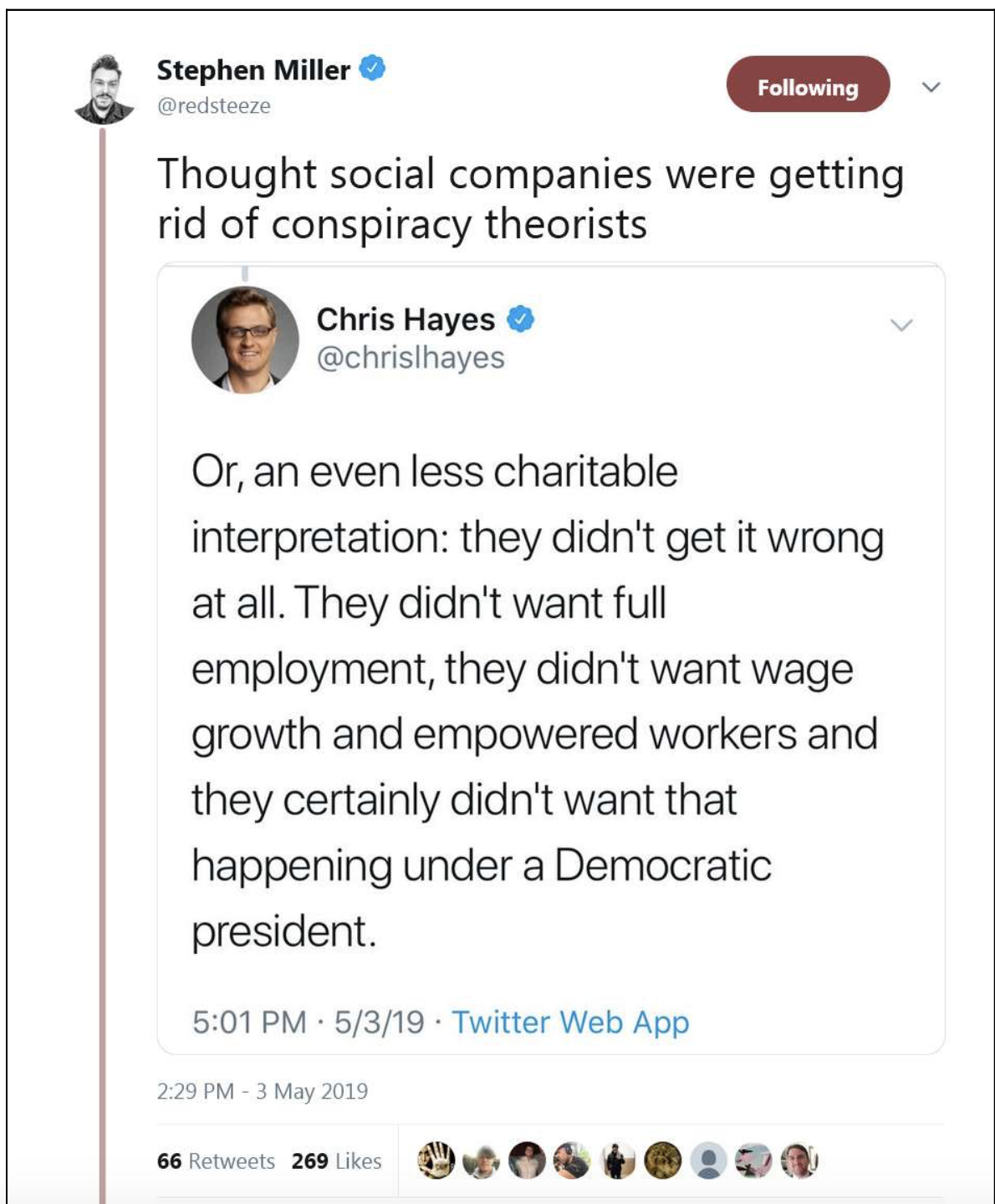
When can we expect Twitter to deplatform MNBC?

Screen Shot 2019-05-06 at 1.31.50 PM.png

Twitter claims there is no space on its platform for conspiracy theorists, yet here we are. According to this MNBC “expert”, millions and millions of businesses conspired to deny themselves profits and tank the economy, solely to hurt our first black president.

Good Lord, what’s next, a claim that a shadowy Russian cabal stole the 2016 election from Hillary? It’s probably best if Twitter leaves MNBC up and running, just to remind voters of the utter insanity of our mainstream media.

When Pravda speaks, people wonder

out from the black hole

out from the black hole

Last week the New York Times published a lengthy investigative article on Joe Biden’s lending a helping hand to his son Hunter, so that the boy could enrich himself at the corruption trough that is Ukraine. A neat summary of that report can be found at The Daily Caller, but the real question is why, since this is old news to everyone except heretofore-shielded Times readers, has the paper chosen to dig up the scandal now? Just as in the old days of the Soviet Union and its house organ, Pravda, there’s always a hidden message in what the Times chooses to cover and the timing behind such coverage.

And it’s not just the stench from Ukraine that the Times and the Washington Post are revealing: next up, more details on Ol’ Joe assisting Hunter in China. Again, nothing new here, but it will be interesting to see whether this turning against Biden signals the selection of a “preferred” candidate for the newspaper, or simply the first step in the Deep State’s selection process to decide which candidate will be the “right” one for the nation’s voters.

Read between the lines

Is that whistling I hear?

Is that whistling I hear?

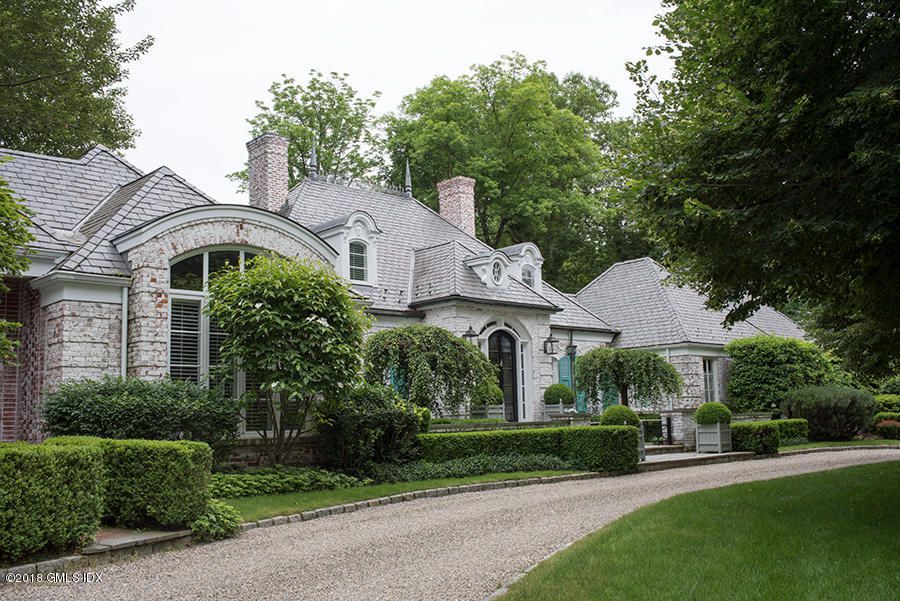
Greenwich Free Press covered a panel discussion on back country real estate last week. No link, because the owner/reporter for that publication has made it clear that she wants nothing to do with this site or its readers, but the doctrine of fair use does permit me to cherry pick some of the panelists’ comments; notwithstanding the Free Press’s overall rosy view (it sells ad space to realtors), there were moments when the mask slipped:

The panelists agreed 2019 is not shaping up to be a great year for Greenwich real estate, but neither is it for towns like Westport or New Canaan.  “No place is seeing 2019 as a good year,” said panelist Mark Pruner of Berkshire Hathaway.

“There are a couple of bright spots, but the market overall this year for sales and contracts is down significantly,” Pruner said. “There is FUD – fear, uncertainty and doubt.”

“People wonder what’s gong to happen with the legislature,” he said. “My belief is sales will go up once our legislature retires for the year.” [Nicely said, Mark].

“One thing driving me up the wall is press reports [I believe that Mr. Pruner is referring to FWIW] that a house that sold at discount from its original list price as a sign of weakness,” Pruner said. “To me it’s a sign you had a very optimistic owner with a cooperative broker.  Whatever that ratio is, it’s irrelevant at the high end.”

[Carolyn Anderson, Anderson Associates] said pricing a home realistically is key.

“You may have purchased it years ago and counted on it rising, or bought at the high market,” she said, adding it’s important to look at recent comparable sales….

“The saddest realization home owners have to come to, is that it just doesn’t matter what you paid for your home,” Anderson said, adding, “The only thing that matters is what the buyer is willing to pay in today’s market.”

[Paul Pugliese, Greenwich Land Company] said sellers’ expectations need to change.

“For a while we were used to double digit inflation and overseas buyers coming to work for a couple years who would buy a home and resell it and make more than they made from their entire income while they were working here,” he said. “There was the anticipation that it would continue to rise. When the bubble ceased, people still remembered the high water mark. We may have to go through a period of adjustment before we get back to that point.”

Pugliese was a little vague on how long he thought that “period of adjustment” might last, but it’s been nine-years now, and some owners may be growing restive. Heck, they might even be ready to, as Pugliese suggests, “change their expectations”.

The Revolution always ends up eating its young

Mssr. Robespierre discovers that he is no longer relevant to the struggle

Mssr. Robespierre discovers that he is no longer relevant to the struggle

The star of “Captain Marvel,” Brie Larson, is an actress who has waved the social justice flag in the faces of everyone she could, saying all the necessary things and accomplishing all the necessary tasks to make sure it’s understood that she is the warrior’s warrior. A “captain” if you will.

Larson made it clear throughout the promotion of Captain Marvel that she wanted more people of color to review her films, not white men. She made it clear that she doesn’t care what old white men thought of films because some films weren’t for them. She promoted the idea of more gay superheroes and said the social justice takeover of the Marvel Cinematic Universe needs to happen faster.

And it didn’t save her. The monster has now come to eat her too.

And we're back up

Ain’t happening

Ain’t happening

Nothing wrong with the modem, it turns out: service provider problem.

In the meantime, I see that Greenwich Time is following through with its threat to move much of its local news behind a cash wall; good luck with that. I understand the need for a publisher to generate cash to pay reporters, but readers have to be convinced that the content is worth paying for before they’ll part with their money. Nothing I’ve seen in our local paper over the past couple of decades has ever persuaded me to pay up.

Next.

UPDATE: Arcticle on the future of local newspapers in today’s WSJ. It’s not encouraging:

The shrinking of the local news landscape is leaving Americans with less information about what's happening close to them, a fact Facebook recently acknowledged as it struggled to expand its local-news product but couldn’t find enough stories. Local TV news is still a major, if declining, source of news for Americans, but local newspapers are vanishing.

“It’s hard to see a future where newspapers persist,” said Nicco Mele, director of the Harvard’s Shorenstein Center on Media, Politics and Public Policy, who predicts that half of the surviving newspapers will be gone by 2021.