Appearing at the annual Munich Security Conference today, Vice President J.D. Vance torched Europe in a manner they’ve never heard before. I kept seeing squibs from the speech on social media this morning, and couldn’t believe what I was seeing.
Some excerpts:
The threat that I worry the most about vis a vis Europe is not Russia, it’s not China, it’s not any other external actor. What I worry about is the threat from within. The retreat of Europe from some of its most fundamental values: values shared with the United States of America.
I was struck that a former European commissioner went on television recently and sounded delighted that the Romanian government had just annulled an entire election. He warned that if things don’t go to plan, the very same thing could happen in Germany too.
Now, these cavalier statements are shocking to American ears. For years we’ve been told that everything we fund and support is in the name of our shared democratic values. Everything from our Ukraine policy to digital censorship is billed as a defence of democracy. But when we see European courts cancelling elections and senior officials threatening to cancel others, we ought to ask whether we’re holding ourselves to an appropriately high standard.
Vance was just getting started:
Free speech, I fear, is in retreat and in the interests of comity, my friends, but also in the interest of truth. I will admit that sometimes the loudest voices for censorship have come not from within Europe, but from within my own country, where the prior administration threatened and bullied social media companies to censor so-called misinformation. Misinformation, like, for example, the idea that coronavirus had likely leaked from a laboratory in China. Our own government encouraged private companies to silence people who dared to utter what turned out to be an obvious truth. . .
The organisers of this very conference have banned lawmakers representing populist parties on both the left and the right from participating in these conversations. Now, again, we don’t have to agree with everything or anything that people say. But when political leaders represent an important constituency, it is incumbent upon us to at least participate in dialogue with them.
Now, to many of us on the other side of the Atlantic, it looks more and more like old entrenched interests hiding behind ugly Soviet era words like misinformation and disinformation, who simply don’t like the idea that somebody with an alternative viewpoint might express a different opinion or, God forbid, vote a different way, or even worse, win an election.
Has Vance been reading Power Line’s Lexicon of Political Terms, in which we define “populism” as “When the wrong person or party wins an election”? This is a clear reference to the AfD (Alternative for Germany) party that may well come in first in Germany’s election next weekend, which will cause a political crisis. And the established but discredited ruling parties will richly deserve it.
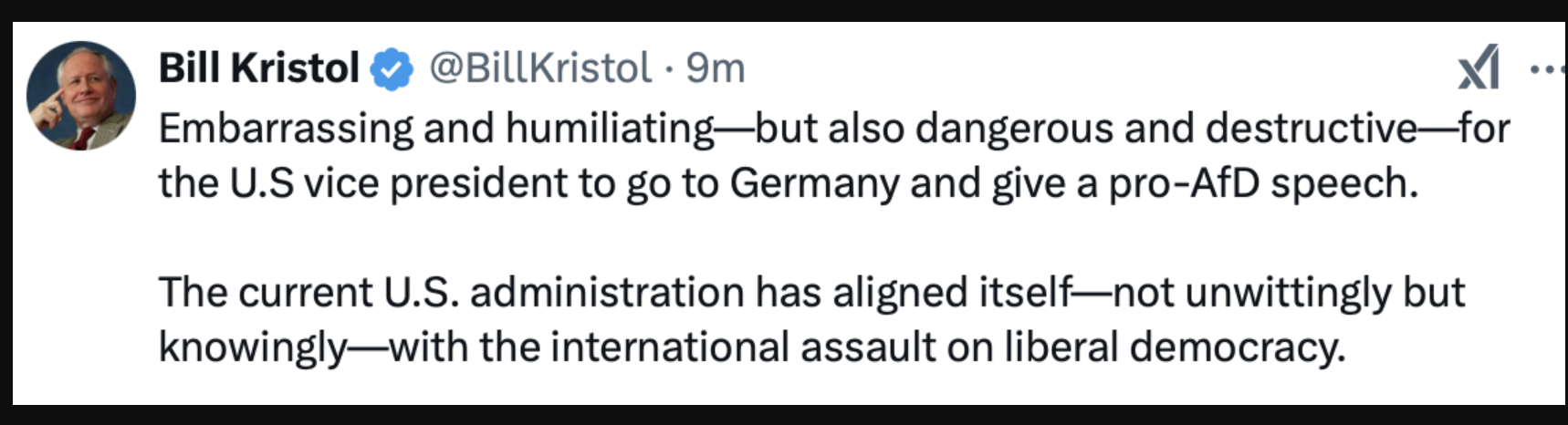
Naturally this aspect is summoning the predictable response: