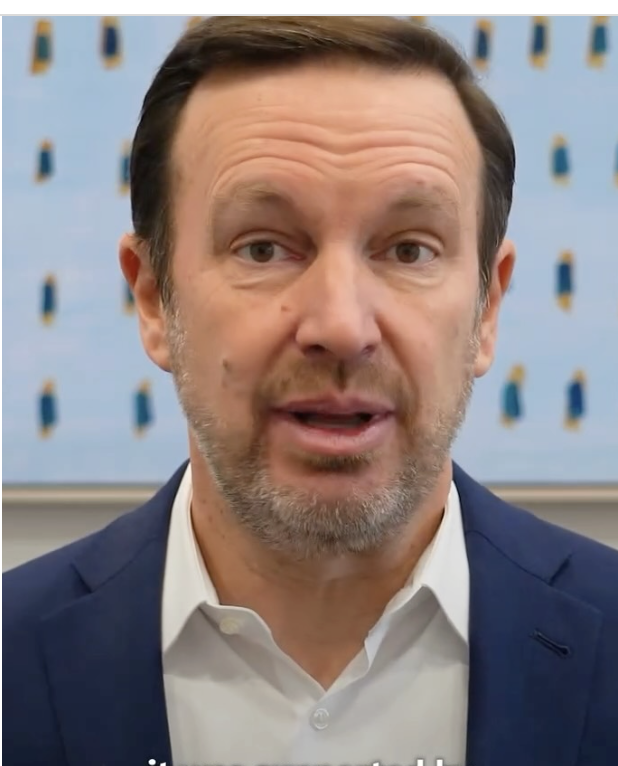
Now do the other 49 states and D.C. and Puerto Rico, and the Virgin Islands, and Guam, and ....

It's Not One Thing; It's EVERYTHING

David Strom, Minnesota native, has a long, long article, repleate with numerous videos, detailing still more of the Somali frauds and the Democrat politicians who hid it and profited from it.

Here are just a few samples:

There’s plenty more at the link, but Strum summarizes it neatly:

We need to wrap our heads around the fact that every single program is exploited to fund the NGO-Democrat-organized crime triangle. That is what they exist to do, with funding some legitimate facilities as a cost of doing business. 

Have you ever wondered why billions of dollars are spent on homelessness with no results? Same thing. It's a scam. 

It is all scams, all the way down. 

Their appeal seems to have become more selective than was hoped

No Eating Ze Bugs: Europe’s Biggest Insect Company Goes Bankrupt

Italian outlet Press Kit announced today that Ÿnsect, a French-based entity that was the biggest insect production company in Europe, could not secure necessary financing. The significant amount of funding poured into it in the past by woke investors and governments was insufficient to keep the boondoggle going. Therefore, as of this week, Ÿnsect was liquidated, declared bankrupt, and then placed into judicial liquidation over its insolvent state.

According to publicly available data, Ÿnsect's revenue from its parent company peaked at €17,8 million in 2021 (about $21 million), a figure apparently inflated by internal transfers between subsidiaries. By 2023, the company had accumulated a net loss of €79,7 million ($94 million), Tecno Crunch reports…[Ÿnsect] had raised over $600 million, including funds from Downey Jr.'s FootPrint Coalition, taxpayers, and many others. The company also secured a €160 million ($175,5 million) Series D financing round in 2023.

But Ÿnsect went bankrupt anyway.

Speaking of bankrupt, here’s an interesting article on bug dining that I found in a now defunct progressive online publication:

This site is an archive. The Seattle Globalist ceased operations on September 30, 2020. 

Seattle’s ‘Bug Chef’ promotes the benefits of an insect diet

From the article:

Overall, the [United Nations Food and Agriculture Organization] FAO gives cites three major benefits of entomophagy:

  • Health – “Many insects are rich in protein and good fats and high in calcium, iron and zinc.”

  • Environmental – “Insects promoted as food emit considerably fewer greenhouse gases (GHGs) than most livestock.” Also, “Insect rearing… does not require land-clearing to expand production.”

  • Livelihood – “Insect harvesting/rearing is a low-tech, low-capital investment option that offers entry even to the poorest sections of society, such as women and the landless.”


Elsewhere, Bill Gates and George Soros’ World Economic Forum troopers have always been in favor of the Little People eating bugs.

WEF Feb 9, 2022: 5 reasons why eating insects can reduce climate change

1. Edible insects can produce equivalent amounts of quality protein when compared to animals. · 2. Insects require less care and upkeep than ...Read mor

WEF July 12, 2021: Why we need to give insects the role they deserve in our food systems

Insects are a credible and efficient alternative protein source requiring fewer resources than conventional breeding.Read more

Once they work the bugs out, they’ll be back.

Another impeachable judge

Judge Angel Kelley, a Biden-appointed District Court judge, issued an administrative stay on Tuesday blocking the Trump administration’s decision to strip South Sudan of its Temporary Protected Status (TPS).

South Sudan’s TPS designation was scheduled to end on Jan. 6, which would have allowed Homeland Security to deport 232 South Sudanese nationals with lawful status and 73 additional nationals with pending applications, according to Fox News.

Kelley cited legal complexity and “serious, long-term consequences, including the risk of deadly harm” as her justification for preventing the termination of South Sudan’s TPS designation. Kelley’s decision claims stay is not a ruling on the merits of the case, but “to preserve the status quo” before a complete ruling can be made.

The country first received the TPS designation during President Barack Obama’s second term in Nov. 2011. It was most recently renewed by President Joe Biden in 2023. Sec. Kristi Noem published a Federal Register notice in November of this year announcing the Trump administration’s intent to terminate the status.

Temporary Protected Status is a legislatively created category with set expiration dates. The Supreme Court has already ruled twice this year that lower federal court justices do not have the jurisdiction or the power to rewrite the law as they would prefer it: No, 532,000 TPS beneficiaries do not have the right to individual hearings before the government can remove them (7-2 decision); and yes, the government can deport 350,000 Venezuelans after their TPS status has expired (8-1 decision). Judge Kelly’s order is one of complete defiance of the Supreme Court, an act that even the dullest of DEI appointees* must know is illegal. Thow her out.


*Education

  • B.A., Colgate University, 1989.

  • J.D., Georgetown University Law Center, 1992.

  • LL.M. in Trial Advocacy, Temple University School of Law, 2003. 

Professional Experience

  • Judge, U.S. District Court for the District of Massachusetts (2021–present).

  • Associate Justice, Massachusetts Superior Court (2013–2021); also served as the Regional Administrative Judge for a period.

  • Associate Justice, Brockton District Court (2009–2013).

  • Assistant United States Attorney for the District of Massachusetts (2007–2009).

  • Clinical Instructor, Harvard Law School (2005–2007).

  • Attorney for the Port Authority of New York and New Jersey (1997–2005).

  • Staff Attorney, The Legal Aid Society in the Juvenile Rights Division in Brooklyn, NY (1993–1997). 


So free food stamps and medical care for everyone — we'll all be rich!

No one expects economists or administrative gravy train recipients to be economically literate, but it’d nice if reporters or their editors were. Ah well, they probably graduated from the same institutions of higher learning that the first two groups did, so it’d be foolish to expect more. Example, this article from Hearst:

Federal cuts to Medicaid and SNAP could result in job loss in Connecticut, economists warn

Hospitals in Connecticut are expected to spend more on care for the uninsured and get less funding, and economists predict the loss of thousands of jobs in Connecticut in the coming year, as a direct and indirect result of federal cuts to Medicaid and SNAP.

President Donald Trump’s so-called One Big Beautiful Bill placed restrictions and requirements for eligibility in order to receive food assistance benefits under the SNAP program and health-care benefits through state-run health-care exchanges. 

Those changes, due to begin taking effect in 2026 with some rolling out as late as 2028, are expected to result in less money available for health care and an increase in uncompensated care, health-care costs borne by hospitals when patients can’t pay. 

“When you take away SNAP, it means that a household is going to have a harder time covering their bills,” University of Connecticut economist Fred Carstensen said. “There will be layoffs across the medical sector, and when people are laid off, they stop spending on anything discretionary and they cut back very significantly. They won't eat out anymore. You'll see fewer purchases in restaurants, the ripple effects, what economists call multipliers.”

Ah, the great Keynesian multiplier effect: take a dollar from one person who was planning to spend it on, say, a happy meal, a computer, or hiring a gardener to mow his lawn, and give it to another person to spend on, say, a happy meal, a computer, or hiring a gardener to mow his lawn, and because the government has taken it from one and given it to another, that second person’s spending will generate 150% more economic activity than if the first person had been allowed to spend as he chose. Fabulous! Even better, if the government has already taken every dollar that first person has so that there’s nothing to “redistribute”, then it can just fire up the printing press and pass out imaginary dollars for everyone to spend their way to riches.

How about just printing money, instead of diverting it from the pockets of those who earned it in the first place to “others” (voters). Well, as of January 31st, 2023, Congress had printed and distributed $4.5 trillion or so-called “COVID relief” money; by these experts’ reasoning, and the reasoning of other notables like Nobel Prize winners like Paul, “for every dollar spent, we get back $1.50, Krugman”, our economy should be booming, inflation should be non-existent, there should be no “affordability crisis”, God should be in his heaven and all right in the world. For a counterview, you could check out, say, The Government Spending Multiplier: Less Bang for the Buck. Or you can just go visit the supermarket.

One of my favorite political pundits, David Strom, peers into the future and has some interesting observations

the peasants’ revolt and the execution of dozsa

The West Will Look Radically Different in 5-10 Years

It's hard to say exactly when the coming seismic shift in governance will come in the West, nor can we easily predict the contours of the structures that will be left after the cataclysm. As with earthquakes, you can be pretty sure that some fault will rupture, but the exact time, size of the rupture, and what will result are unpredictable. 

But, looking around at the state of societies in the West, it's easy enough to see that the "Big One" is coming, and what follows will be dramatically reshaped from its current configuration. 

….

First, the European Monetary Union as it exists today is done, and its demise was perfectly predictable from its inception. It all boils down to the fact that no one currency, or especially monetary policy, is appropriate to managing economies as diverse as Germany and Greece, Sweden and Bulgaria, France and Latvia. Their economies are not synchronized, and the political pressures are vastly different. When Germany has a youth unemployment rate of 6% and Spain has one of 26%, you can't square the circle.
Find more statistics at Statista

And that's before you get to any political differences, which the EU is currently trying to suppress using increasingly totalitarian means such as censorship, banning political parties, and dawn raids on dissenters. 

You see the growing divergence between elite transnationalist opinion and "man on the street" anger everywhere, whether it is the backlash against mass migration or the inability of France to maintain a government. France has had five Prime Ministers in the last TWO years, and there seems to be no prospect that the structural problems that are plaguing the country can be fixed before an economic earthquake. 

Germany is deindustrializing, and without Germany as the beating heart of the European economy, it is in for a rough ride. The countries of the EU are committed to keeping a losing war going—to the extent that European leaders are, increasingly, more committed to extending the war than many Ukrainians. The only reason why the US has been involved at all is our security commitment to NATO—the US has little at stake strategically in this war, unlike Taiwan, which is a vital adjunct to our economy. And Russia is not really a strategic competitor to the United States in the way that China is. 

….

What can't go on forever won't. History shows that there is a "Wiley E. Coyote" effect—things go on longer than one expects, but the crash does come. 

The technocrats know this, and their strategy is unfolding before our eyes: centralize power. The big threat to the EU project is that sovereign states will do what Britain did and leave, so they are suppressing dissent and working to centralize power in a federal system. Whether this project succeeds is unknowable, especially in the shorter term, but the farther out you look, the less likely it becomes. The US federal system (mostly) works due to a common culture and language, and Europe doesn't have anything like that. 

…..

In short, Europe will soon look very different and far less stable, and it's likely that, politically, the countries will diverge quite a bit in how they address the crisis. 

The security situation in the Far East, too, is highly difficult to predict. China's status as an economic juggernaut is at risk due to economic imbalances and a looming population crash, while the country is still rising as a military power with ambitions to change the regional power balance. Who knows how Xi will square that circle? He is rattling his sabers loudly, and the appeal to nationalism to maintain power will be strong, while the risk of a Taiwan war going badly is very high, especially since China's military power is entirely notional and untested. It certainly has the ability to impose high costs on its adversaries, but does it have the capacity to win an extended war, and would the costs be worth it either to the country or to Xi?

…..

We have entered an age of increasing political instability. Governments will fall, and policies will radically change. Either the technocrats or the nationalists will win in Europe, and I would bet on the latter. 

Here in the United States, we have the same political tensions over similar issues as in Europe, but the balance of power between the two ideological camps leans a bit farther right, and there is a substantially larger ability to "sort" lefties and righties as is happening now. We have states that work, and states that don't. Florida and Texas on the one hand, California and Minnesota on the other. Socialists are winning in Blue cities, and conservatives are fleeing to friendlier climes. 

The big question is, can the federal government start working again? Unlike most places in the world, we have vast swathes of our economy that still work well, and the US is the home of technological innovation and business development. The raw capacity for renewed influence and strength is enormous here; the big question is whether the government gets its act together in time. 

A reckoning is coming. For all its flaws, the US is in the best position to survive the coming reshaping of the world, as long as we can beat back the socialist wave that is threatening to disrupt everything. 

How dare anyone suggest that the government wastes even a dollar of the money it prints?

DEI and the death of Excellence — and literacy

https://pjmedia.com/jamie-wilson/2025/12/18/dei-and-the-death-of-excellence-how-ideological-selection-degrades-culture-over-time-n4947236

And absoluted related:

David Strom, HotAir:

Why Johnny Can't Think

College professors have been complaining that students are incapable of reading anything longer than a few pages and often struggle to achieve that modest goal. 

Nicholas Dames has taught Literature Humanities, Columbia University’s required great-books course, since 1998. He loves the job, but it has changed. Over the past decade, students have become overwhelmed by the reading. College kids have never read everything they’re assigned, of course, but this feels different. Dames’s students now seem bewildered by the thought of finishing multiple books a semester. His colleagues have noticed the same problem. Many students no longer arrive at college—even at highly selective, elite colleges—prepared to read books.

This development puzzled Dames until one day during the fall 2022 semester, when a first-year student came to his office hours to share how challenging she had found the early assignments. Lit Hum often requires students to read a book, sometimes a very long and dense one, in just a week or two. But the student told Dames that, at her public high school, she had never been required to read an entire book. She had been assigned excerpts, poetry, and news articles, but not a single book cover to cover.

“My jaw dropped,” Dames told me. The anecdote helped explain the change he was seeing in his students: It’s not that they don’t want to do the reading. It’s that they don’t know how. Middle and high schools have stopped asking them to.

Columbia University is one of the most elite schools in the world, a member of the highbrow Ivy League, and literature students can't sit down to read a book because they were never asked to. 

While I am as conspiratorial as the next guy when it comes to our cultural elite, in this case I think the problem lies more in laziness, the ignorance of teachers themselves, and a curriculum in most schools that emphasizes checking boxes. We love to romanticize our own school experiences and likely had much better educations than today's children, so most Americans have no idea how bad the average education has become. It's not that there aren't good teachers and good schools, but when a student can arrive at an elite school without ever having read a single book in school, you should be hearing alarm bells. 

The issue that Dames and other professors have observed is distinct from the problem at community colleges and nonselective universities, where some students arrive with literacy and comprehension deficits that can leave them unable to complete collegiate courses. High-achieving students at exclusive schools like Columbia can decode words and sentences. But they struggle to muster the attention or ambition required to immerse themselves in a substantial text.

Faced with this predicament, many college professors feel they have no choice but to assign less reading and lower their expectations. Victoria Kahn, who has taught literature at UC Berkeley since 1997, used to assign 200 pages each week. Now she assigns less than half of that. “I don’t do the whole Iliad. I assign books of The Iliad. I hope that some of them will read the whole thing,” Kahn told me. “It’s not like I can say, ‘Okay, over the next three weeks, I expect you to read The Iliad,’ because they’re not going to do it.”

The Times' story on this phenomenon focuses on the major publishers that produce the texts on which curricula are based, and no doubt they have a point: this is a significant component of the problem, which is the result of a perfect storm of horrible trends that include the degrading attention span caused by electronic overstimulation—I have noticed my own attention span declining even though I don't use the most dopamine-inducing social media apps—ignorant and politicized educators and unions, a focus (likely necessary due to declining educational attainment) on metrics, and an ideological focus on social justice. 

Many were longtime teachers who reported assigning fewer whole books now than they did earlier in their careers. Some complained about the effect of technology on students’ stamina for reading and interest in books. But more pointed toward the curriculum products their schools had purchased from major publishers.

Those programs often revolve around students reading short stories, articles, and excerpts from novels, then answering short-form questions and writing brief essays.

Students typically access the content online, often using school-issued laptops.

These practices begin in elementary school, and by high school, book-reading can seem like a daunting hurdle.

Students using excerpt-based curriculums are often assigned snippets of classic novels, which they access through a web interface. This program, StudySync, offers an 859-word segment of “Beloved,” by Toni Morrison.Credit...StudySync

Popular curriculum programs like the one above were created by publishing companies, in part, to help prepare students for state standardized tests. Many schools and teachers are under significant pressure to raise students’ scores on these end-of-year exams, which feed into state and federal accountability systems. Test results are also prominently featured on school-ranking and real estate websites.

Why Johnny can’t read

https://hotair.com/stephen-moore/2025/12/20/why-johnny-cant-read-n3810101

Teacher shocked by students’ lack of basic classroom skills: ‘It’s scaring me’

A concerned middle school teacher recently took to social media to explain the lack of reading and problem-solving skills in her teen students.

“I don’t understand how these kids ended up at this point,” a Dallas, Texas, teacher named Ms. L said about her 8th-grade students in a now-viral TikTok video.

“I teach 8th-grade history and I have 110-ish students — two of them are reading at grade level right now. 18 of them are at a kindergarten level, 55 of those students are between a second and fourth grade level,” she continued. “It’s typical of what I’ve seen lately from students.”

This baffled educator couldn’t believe that her 13 and 14-year-old students lacked such basic skills.

“They cannot apply inference; they cannot process questions that are longer than a sentence. They cannot connect cause and effect. They can’t track multi-step ideas…” Ms. L explained. “It’s scaring me a little.”

The sad reality is that this isn’t just a one-off case — it seems to be a nationwide issue in schools.

The 2022 National Assessment of Education Progress, aka the “Nation’s Report Card,” showed that 70 percent of young teens scored less than “proficient” in reading, while 40 percent scored “below basic.

Sale price reported

490 North Street, pending since October, has sold to a Los Altos buyer for $4.140 million on an original May 30, 2024 price of $4.795. Although I expect no thanks from listing agent Cate Keeney — Cate’s just that way — I’m confident that it was my reworking/improving the property’s listing pictures by adding the Orange, the Zebra, and the Tipi that finally did the trick here.