It's all good, but unless Congress changes the laws that give regulatory agency bureaucrats unlimited power, this can easliy be reversed by another executive order

(Not if they don’t buy a car, eh? Oh, well …)

WASHINGTON — President Trump and EPA Administrator Lee Zeldin unveiled what they called the largest deregulation in US history Thursday by axing a sweeping anti-greenhouse gas policy — saying it could save Americans $1.3 trillion, or about $3,823.50 per US resident.

“Today, the Trump EPA has finalized the single largest act of deregulation in the history of the United States of America,” Zeldin said alongside Trump in the White House Roosevelt Room.

“Referred to by some as the holy grail of federal regulatory overreach, the 2009 Obama EPA endangerment finding is now eliminated.”

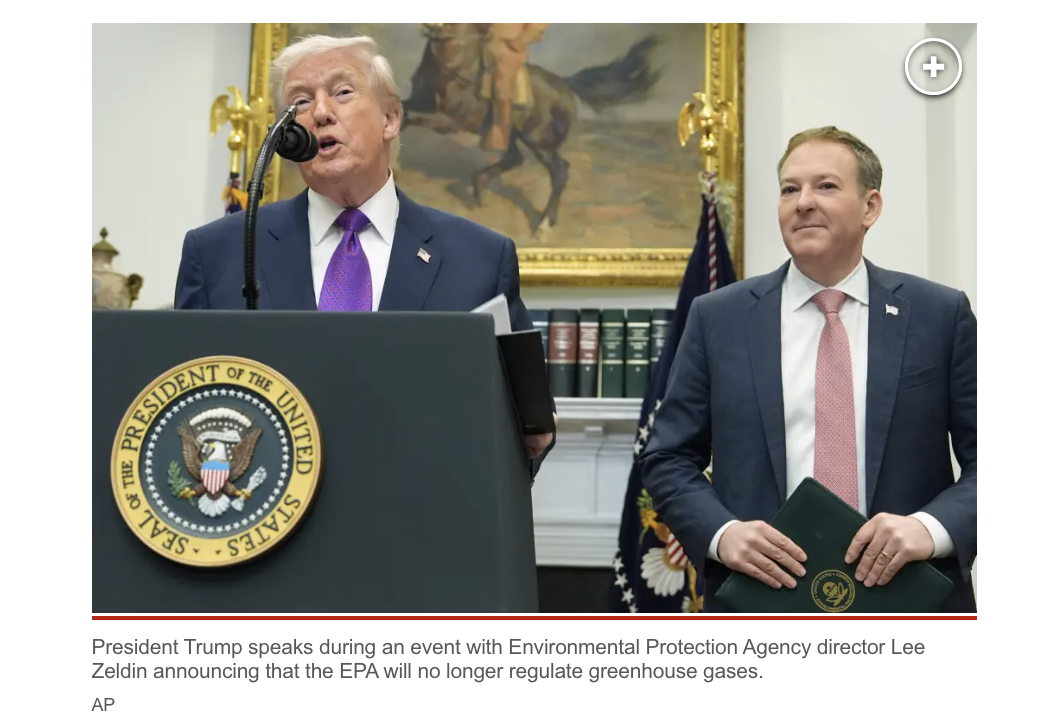
President Trump speaks during an event with Environmental Protection Agency director Lee Zeldin announcing that the EPA will no longer regulate greenhouse gases.AP

The repeal ends a policy allowing the feds to regulate the emissions of fossil fuels by declaring them dangerous to public health.

The so-called “endangerment finding” allowed the EPA to regulate six greenhouse gases under the Clean Air Act — providing for a regulatory framework to measure and constrain the expulsion of carbon dioxide, methane and nitrous oxide. 

Trump called the finding “a disastrous Obama-era policy that severely damaged the American auto industry and massively drove up prices for American consumers,” predicting they would save “trillions of dollars” as a result of Thursday’s action.

The president added that his administration was “terminating all additional green emission standards imposed unnecessarily on vehicle models and engines between 2012 and 2027 and beyond.”

Zeldin said that action could lower car costs by an average of about $2,400.

The environmental chief and Trump singled out one practical impact of Thursday’s announcement: The looming absence of the car feature that switches engines off while drivers are idling at stop lights.

“Under the endangerment finding, they forced the hated start-stop feature onto American consumers, which unnecessarily shuts off a car’s engine. When you stop at a red light, in other words, the engine goes off. That’s great,” Trump said.

Zeldin also said that “manufacturers will no longer be burdened by measuring, compiling or reporting greenhouse gas emissions for vehicles and engines.”

Under our current laws, Congress enacts feel-good, noble-sounding laws and then turns them over to unelected staffers at regulatory agencies to define and implement them. What one president can do, another can undo, as we’ve witnessed so many times recently: Biden cancels the XL Pipeline by executive order on his first day in office, Trump reverses that by his own executive order on his first day in office. And so one. Given the lead time required for manufacturers to redesign and restart production of products whose specifications change with each change in government, this is aa lousy way to run a country.

Congress could end much of this bs by reclaiming its authority, but it won’t; both parties like things just the way they are, allowing them to sound good while avoiding taking responsibility for the unexpected and expected consequences.

It’s been a long time since I dabbled in administrative law, but the summary below, even if provided by an anti-trump, pro-regulatory group, jibes with with my memory of the processes involved. Regardless, count on the lawsuits to begin flying by the close of business today.

FACT SHEET 5: Reversing or Revising Agency Regulations, Generally

Source: Environmental Law Institute — Regulatory Reform in the Trump Era

ACTORS: Federal Agencies, Department of Justice, Congress

Most environmental regulation takes the form of detailed rules promulgated by agencies under their statutory authority, using a public notice-and-comment procedure. Final agency rules cannot simply be undone by the president, but they may be challenged in  court, amended or reversed through a subsequent agency rulemaking process, or revoked by congressional act. Many Obama Administration rules, including the Clean Power Plan and Waters of the United States (“WOTUS”) Rule, are vulnerable to each of these forms of revision, and more than one might get attempted at the same time.

Process. When enacting environmental statutes, Congress typically outlines a general regulatory structure for protecting public health and natural resources, then delegates  the details to EPA or other federal agencies. These agencies fulfill Congress’ intent and fill  statutory gaps by issuing administrative rules that spell out detailed standards, create permitting and approval procedures, and govern agency monitoring, inspection, and enforcement. Some rules are mandated by the statute, which may even set out  specific deadlines. Others are developed over time or in response to new information or events, allowing the agency to bring its expertise to bear in interpreting its congressional mandate.

Most regulations go through a formal rulemaking procedure governed by the Administrative Procedure Act (APA), 5 U.S.C. ch. 5, which requires public notice of a  proposed rule; a period for receiving comments on the proposed rule; and issuance of a final rule, including responses to the comments received and an explanation of whether and how they were taken into account. The record of this process includes the agency’s  justification for the rule and provides the basis for any subsequent judicial review. These “administrative records” can be voluminous, spanning several years and comprising thousands of pages, from initial scientific studies to advisory committee deliberations and public hearings to publication of the final rule.

Judicial Review. A final agency rule may be challenged in federal court on the grounds it is “arbitrary and capricious, an abuse of discretion, or otherwise not in accordance with the law.” 5 U.S.C. § 706(2)(A). This standard sets a high bar, but does allow judges to  intervene where an agency has, for example, failed to follow the notice-and-comment  procedure, offered incomplete or inconsistent justifications for its action, or exceeded its  statutory mandate. If the challenge is to an agency’s interpretation of its governing  statute, the court looks to the statutory language to determine Congress’ intent; if the  statute is silent or ambiguous, the court will accept any agency interpretation that is “reasonable.” This so called “Chevron deference”1 has tended to favor EPA in environmental cases, where Congress often has not spoken with precision and courts defer to the agency’s scientific expertise.

Discussion. Although they are promulgated by the executive branch, agency rules cannot simply be undone by executive order or other presidential action. Agencies remain governed by their underlying statutory mandates, and must still follow the procedures  established by the APA. Thus, while the president may direct agencies to begin the  process of reversing or revising an existing regulation, they generally must go through another full rulemaking. More immediately, where an existing rule has been challenged in court, the Department of Justice may decline to appeal an adverse ruling, or reach a settlement more favorable to industry. Congress also may attempt to revoke specific rules or remove certain subject matter from an agency’s jurisdiction.

Reversing Rules Through Subsequent Rulemaking. In general, formal agency rules can only be amended or reversed through another rulemaking, including a notice-and- comment period and development of a full administrative record. In order for the new rule to survive judicial review under the “arbitrary and capricious” standard, the record  must provide a “reasoned explanation,” beyond a mere change of presidential  administration, of the basis for the revision.2  Key Obama Administration rules that relied on reams of scientific evidence and months of public procedure, like the Clean Power Plan or WOTUS Rule, might require an equally laborious effort to undo. It will be even harder to vacate something like EPA’s “endangerment finding,” the underpinning for the CPP and other climate measures, where the agency’s analysis has been upheld in court.

Declining to Defend Agency Rules. For rules facing litigation, there is also a question of whether or how vigorously the Department of Justice will defend the rules in court. Representing federal agencies is a core part of DOJ’s mission, but a change in administration presents the opportunity to reevaluate litigation priorities, change tactics, and revise legal interpretations to bring them more in line with new policy goals. For pending challenges … DOJ might petition the court to delay its decision schedule (which has already occurred in several cases), or to remand the rule to allow the agency to reconsider it.

If a court reaches a decision invalidating (and vacating) all or part of a rule, DOJ might decline to pursue an appeal, in which case the agency could rewrite the rule or drop it altogether. DOJ also might opt to settle cases on terms at odds with some stakeholders’ interests. To guard against these possibilities, environmental groups or state attorneys general often seek intervenor status, so they can participate in settlement discussions or maintain an appeal if DOJ fails to do so.

Congressional Revocation. Finally, Congress retains the option to weigh in against an agency rule at any time. This may take the form of legislation disapproving or revoking a specific rule (similar to the Congressional Review Act, see Fact Sheet 6, but via regular congressional procedures); or a broader repeal of the agency’s statutory authority to issue a rule.   …

Related to the post below? (Updated)

A reporter asks filmmaker Nikolaj Arcel, "Why is your new Danish movie "The Promised Land" entirely Nordic? ... it lacks the black people, it lacks diversity. Mads Mikkelsen ~ 'What??... right from the get-go". Arcel: "Hmmm, well first of all, the film takes place in Denmark in the 1750s" — you f"ing retard"

The reporter’s right, and here’s proof — they couldn’t put it on YouTube if it wasn’t accurate, could they?

Perhaps the morons have this black Viking in mind:

UPDATE:

HotAir’s Ed Morrissey adds some context here. It’s still a ridiculous situation, but does explain the reporter’s question, if not the reasoning of the woke:

Ed: This is amusing, but there is some exculpatory context. The reporter was asking the question in light of its potential disqualification from Oscar consideration, since it does not meet the prerequisite "diversity" thresholds, even if the foreign film category. As some pointed out on Twitter, "Parasite" won an Oscar despite its cast being entirely South Korean, while this film will likely be excluded for its all-Dane cast. The absurdity is well worth considering. 

Conceding to the demands of the Ladies of Greenwich Invisible and David Rafferty, "Binney Park" will revert to its original Algonquin name, “maškyeᐧkwi manybitumbug”

“Swamp with many nasty mosquitos”

Toronto Renamed a Park to Honor ‘First Peoples,’ and It’s a Disaster

First off, some of the nice things about the new Woodsy Park in Toronto were its amenities, which included a field, a playground, a firepit, a skate trail, a splash pad, and, with a hat tip to those Canadians, it’s well-maintained and very clean. Another nice thing about it was its name – “Woodsy.” That was easy to remember, and it just sounded nice, you know, woodsy, even though there weren’t a lot of trees. 

In due course, the deranged people who run Toronto decided that the original name for the new park wasn’t quite right. “Woodsy” just wouldn’t do. In a fit of self-loathing and with an attack of suicidal empathy, the city decided to rename the park to honor “first peoples.” The new name is Ethennonnhawahstihnen. How’s that for a rebrand? 

You read that right. No typos there: Ethennonnhawahstihnen Park. It’s near the Ethennonnhawahstihnen Community Recreation Center, which is on Ethennonnhawahstihnen Lane. 

The renaming was the brainchild of Toronto City Council member Shelley Carroll. She initiated the process to change the name to reflect the diversity of the community and honor indigenous peoples. This is Carroll imploring you to pronounce the new name correctly… or else. 

Fun Postscript:

In her video overview of her proud accomplishment, Caroll tells us that not far from the-park-whose-name-cannot-be-pronounced is important indigenous ground. She says, “The Moatfield Ossuary was a very important site to a strong and unified agricultural community. It served as a cemetery, but not specific to one family or kin.” 

Caroll doesn’t say what happened to that cemetery, but if you’re wondering, an ossuary is a communal burial pit used during large ceremonies where the remains of many people are buried together. The Moatfield Ossuary belonged to a 13th-14th-century indigenous village in what is now North York in Toronto. Archaeologists have estimated that it dates to about A.D. 1280-1320. 

Construction workers accidentally discovered the site in 1997 when they were installing a chain-link fence around a newly built soccer field. The post pierced buried human remains, and that led to an archeological dig on the site. 

For a country so bent on reconciliation and placemaking, what do you think Toronto did with that sacred ground? 

It moved the 87 bodies that were discovered there and finished the soccer field, of course.

Now multiply this by 50 states and hundreds of thousands of Medicaid "providers"

Two people, one town, one little program that didn’t even involve Somalians, Armenians, child day care, leaing centers, autism, or home care. Imagine that.

Colorado Woman Allegedly Billed $400K to Medicaid for Family’s Phantom Medical Rides

Two people allegedly defrauded Colorado's Medicaid non-emergency medical transportation program of over half a million dollars, according to court documents. 

Ashley Marie Stevens, 40, of Mesa County, and Wesam Yassin, 42, of Douglas County, have been separately charged with defrauding Medicaid’s non-emergency medical transportation program. 

Stevens faces six counts of wire fraud, 11 counts of health care fraud, and six counts of money laundering. 

Yassin faces six counts of wire fraud, 11 counts of health care fraud, and eight counts of money laundering.

Colorado Medicaid is a federal health care program funded by taxpayer dollars distributed by the state. Colorado Medicaid provides Non-Emergent Medical Transportation to qualified Medicaid beneficiaries who do not have access to transportation when transportation is required to obtain medically necessary non-emergency services.

According to the indictment filed against Stevens, from approximately July 2022 to February 2023, Stevens billed Colorado Medicaid under the business name Armistead Twin Rides, LLC, for over $1 million of non-emergent medical transportation rides for Medicaid beneficiaries. Of this amount, Stevens billed Colorado Medicaid for more than $400,000 for rides for herself and family members, most of whom did not have corresponding medical appointments.  

The indictment alleges that Stevens also billed Colorado Medicaid for over $150,000 in rides for four beneficiaries, for which the rides either did not occur at all or involved a destination unrelated to any medical provider or service. Additionally, the indictment alleges that Stevens billed Colorado Medicaid for more than $450,000 for rides that were 400 or more miles per patient, per day. Only a handful of those rides corresponded to medical appointments or services, and those destinations were less than 400 miles away.  Proceeds from the scheme were allegedly used for personal gain, including travel and the purchase of a luxury vehicle

According to the indictment filed against Yassin, from approximately March 2022 to October 2023, Yassin billed Colorado Medicaid under the business name Sama Limo for approximately $3.3 million in non-emergent medical transportation rides.  

The scheme allegedly includes one instance in which Yassin billed Colorado Medicaid approximately $283,000 for 64 rides for a beneficiary, of which approximately $165,000 represented billing for rides after the beneficiary’s death. Additionally, the balance of those rides does not correspond to any medical appointments in Colorado. [That would be $4,421.87 for each of those 64 rides — nice work, if you can get it]

In other instances, Yassin billed Colorado Medicaid for hundreds of thousands of dollars for rides that beneficiaries say never occurred. Proceeds from this scheme were allegedly used for personal gain, including the purchase of a home, furnishings, luxury vehicles, jewelry, and cosmetic surgery.

[Ms Yassin has been doing good by doing wrong — her house in Castle Rock is estimated to be worth $1.3-$1.4 million. Chump change in Greenwich, maybe, but hardly low-income housing in Colorado.]

Unrelated, but while we’re on the Justice Department’s Colorado press release page ….

Eight Indicted In Denver Metro Area On Drug, Weapon, and Money Laundering Charges

DENVER – The United States Attorney’s Office for the District of Colorado announces that Dario Perez Quintero, 34, formerly of Denver, Colorado; Guadalupe Mendoza Martinez, 46, of Aurora, Colorado; Pedro Mendoza Martinez, 54, of Aurora, Colorado; Abimael Felix Luque, 32, of Aurora, Colorado; David Uvaldo Mora Sanchez, 32, formerly of Aurora, Colorado; Hector Joel Quijada Portillo, 30, of Commerce City, Colorado; Oscar Noel Ruelas Molina, 44, of Aurora, Colorado; and Jose Alexis Guzman Felix, 30, of Wheat Ridge, Colorado, were indicted this week on charges related to weapons possession, money laundering, and drug trafficking in the Denver metro area.

Well, when you have "Literally Hitler" running concentration camps, what would you expect?

“The lowest depth to which people can sink before God is defined by the word “Journalist”. If I were a father and had a daughter who was seduced, I should not despair over her; I would hope for her salvation. But if I had a son who became a journalist and continued to be one for five years, I would give him up.”

Søren Kierkegaard

Children and US Citizens Detained for Four Hours Without Food During ICE Raid

Twitchy:

We reported on this raid when it happened back in October. ICE raided an illegal gambling ring in an Idaho town of 1,700 people and managed to detain more than 100 illegal aliens. Now, some Idaho families are filing suit. CBS News was on the story this morning, but has since deleted the tweet; Twitchy favorite Oilfield Rando noted, though, that they described the illegal gambling setup as a "community horse racing event."

Whatever it is, the way you tell your story online can make all the difference.
— Quote Source

Minyvonne Burke reports:

The American Civil Liberties Union filed a lawsuit Tuesday against federal, state and local law enforcement agencies following an October immigration raid at a racetrack in Idaho. About 400 people, including U.S. citizens and children, were detained for four hours while they were denied food and water in the raid, according to the lawsuit.

The raid took place at La Catedral racetrack in Wilder, a popular destination that draws Latino families and celebrates Mexican culture.

Horse racing, gambling, cockfighting: Mexican culture at its finest