Spoiler alert: No
/
Did People In The Middle Ages Really Believe The Earth Was Flat?
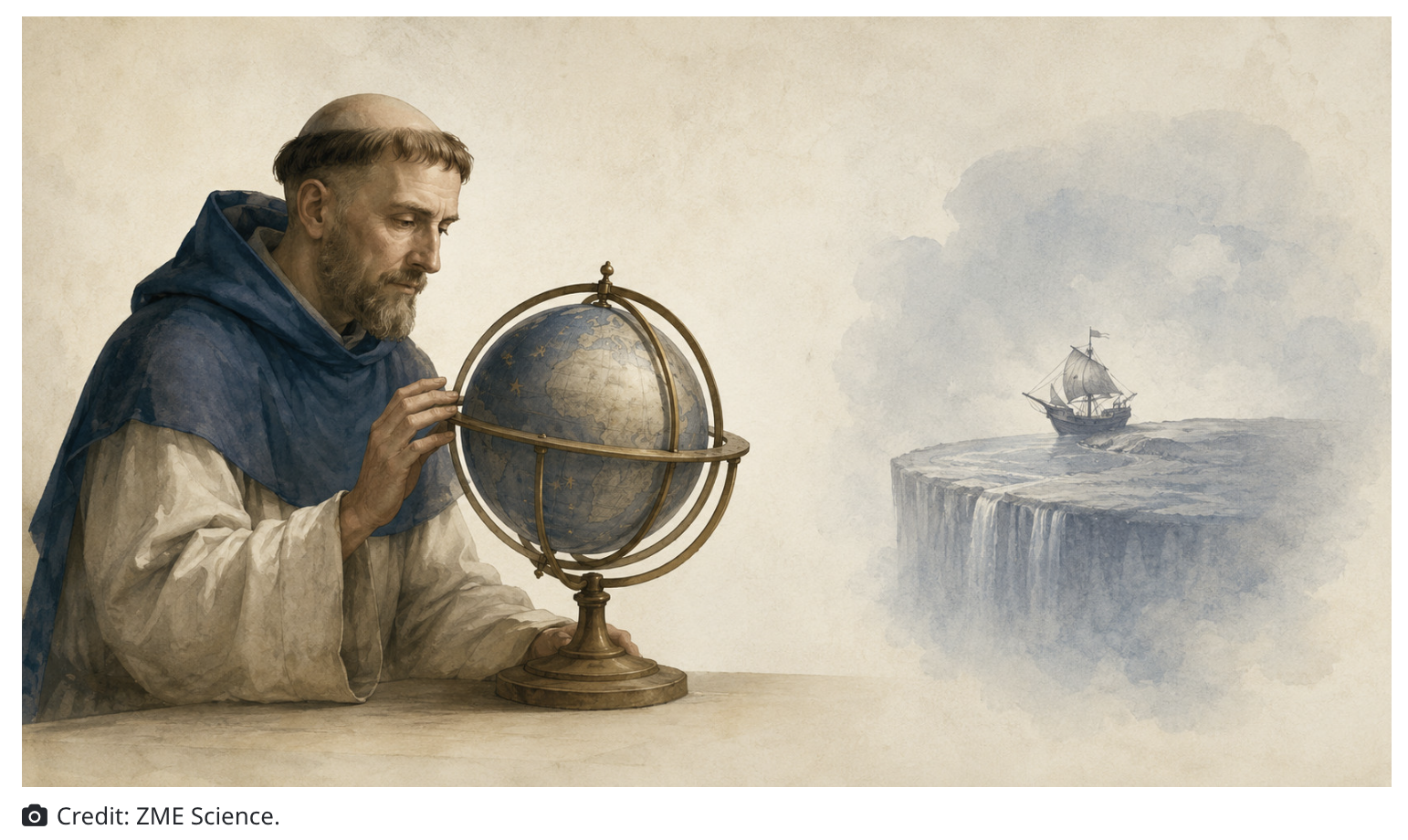
In 1828, Washington Irving published The Life and Voyages of Christopher Columbus, a book of fiction that many later took as historical fact. Among the book’s chapters, Irving gave readers a scene they could not forget: Columbus sitting before King Ferdinand and Queen Isabella’s learned men, facing down monks, theologians, and scholastics who supposedly clung to Scripture while he alone saw the truth of a round world.
In this version of alternate history, Columbus set sail on his epic voyage to the Americas to prove to the world that the Earth was not flat.
It’s an appealing myth that even made its way into some school textbooks. But it’s false.
Educated Europeans during the Renaissance and before that in the Medieval Age already knew the world was round. Aristotle had argued for that nearly 1,800 years earlier. Eratosthenes had measured the planet’s circumference in the third century BCE. Medieval scholars such as Bede, Thomas Aquinas, Roger Bacon, Albertus Magnus, and Johannes de Sacrobosco all worked within a spherical-Earth tradition, and used it to explain eclipses, daylight, climate and the motion of stars.
The myth that “medieval people thought the world was flat” says less about the Middle Ages than about the modern world that invented the Middle Ages as a foil: dirty, dark, ignorant, credulous and waiting to be rescued by 19th-century science.
Educated Europeans during the Renaissance and before that in the Medieval Age already knew the world was round. Aristotle had argued for that nearly 1,800 years earlier. Eratosthenes had measured the planet’s circumference in the third century BCE. Medieval scholars such as Bede, Thomas Aquinas, Roger Bacon, Albertus Magnus, and Johannes de Sacrobosco all worked within a spherical-Earth tradition, and used it to explain eclipses, daylight, climate and the motion of stars.
The myth that “medieval people thought the world was flat” says less about the Middle Ages than about the modern world that invented the Middle Ages as a foil: dirty, dark, ignorant, credulous and waiting to be rescued by 19th-century science.
Round Earth Was Figured Out Thousands of Years Ago
By the fourth century B.C., Aristotle had gathered several lines of evidence that suggested the world was spherical. During a lunar eclipse, Earth cast a round shadow on the moon, he observed. Travelers moving north or south saw different stars. Ships vanished hull-first over the horizon.
Then, around 240 B.C., Eratosthenes, working in Alexandria, did something much more ambitious. He estimated the size of the planet using the shadow cast by a stick as a ruler.
He had heard that in Syene, near modern Aswan in southern Egypt, the sun behaved strangely at noon on the summer solstice. It stood so high overhead that sunlight reached the bottom of a deep well and a vertical stick cast little or no shadow. Farther north, in Alexandria, the same thing did not happen. At noon on the same day, a vertical stick still cast a shadow.
Sunlight travels to Earth in nearly parallel rays. So, if the sun stood directly overhead in Syene but not in Alexandria, the ground itself had to be curving away between the two cities. Eratosthenes measured the angle of the Alexandrian shadow at about 7.2 degrees. That is one fiftieth of a full circle.
From there, the logic was simple and brilliant. If the distance from Syene to Alexandria covered one fiftieth of Earth’s curve, then the full circumference of Earth must be 50 times that distance. Ancient surveyors put the distance between the cities at about 5,000 stadia or 5,000 Greek stadiums (800 to 925 kilometers). Eratosthenes multiplied 5,000 by 50 and arrived at roughly 250,000 stadia for Earth’s circumference.
The exact modern equivalent depends on how long his “stade” was, and historians still debate that unit. But using a common estimate, his figure comes out to about 39,000 to 40,000 kilometers. Modern calculations put Earth’s circumference at about 40,008 kilometers around the poles and about 40,075 kilometers around the equator. In other words, Eratosthenes came surprisingly close to the true figure more than 2,000 years ago using a stick and his wit alone.
When the centralized Roman government fell, this vital knowledge did not vanish. It was inherited by the Medieval fractured kingdoms that came after. In the East, Islamic scholars preserved, translated, and refined classical Greek texts. Those people were much smarter than we often give them credit for, and so they were also convinced that the earth was a sphere.
What Medieval Scholars Actually Said
Educated Medieval people inherited this knowledge and even explained it at length in some of their writings.
The Venerable Bede, the English monk and scholar, wrote around 723: “The reason why the same days are of unequal length,” he wrote circa 723 CE, “is the roundness of the Earth, for not without reason is it called ‘the orb of the world’ … It is, in fact, a sphere set in the middle of the whole universe. It is not merely circular like a shield [or] spread out like a wheel, but resembles more a ball, being equally round in all directions.”
By the 13th century, this was standard teaching. Johannes de Sacrobosco’s De sphaera mundi, written around 1230, became one of Europe’s most influential astronomy textbooks. It described Earth as a sphere and used familiar evidence: stars visible at different latitudes, eclipses observed at different times, and the way sailors could see farther from the top of a mast. The work was copied in manuscripts, printed in many editions and studied for centuries in pre-Copernican universities.
Thomas Aquinas, Albertus Magnus, Roger Bacon and other major medieval thinkers accepted a spherical Earth. They were wrong about many things by modern standards. For instance, most accepted a geocentric cosmos, with Earth fixed at the center. But few scholars of merit claimed the Earth was flat.
Even Dante’s Divine Comedy assumes a spherical planet. Dante and Virgil pass through the center of Earth, where gravity reverses, and emerge toward the opposite hemisphere. That scene makes no sense on a flat disc.
So Why Do Medieval Maps Look Flat?
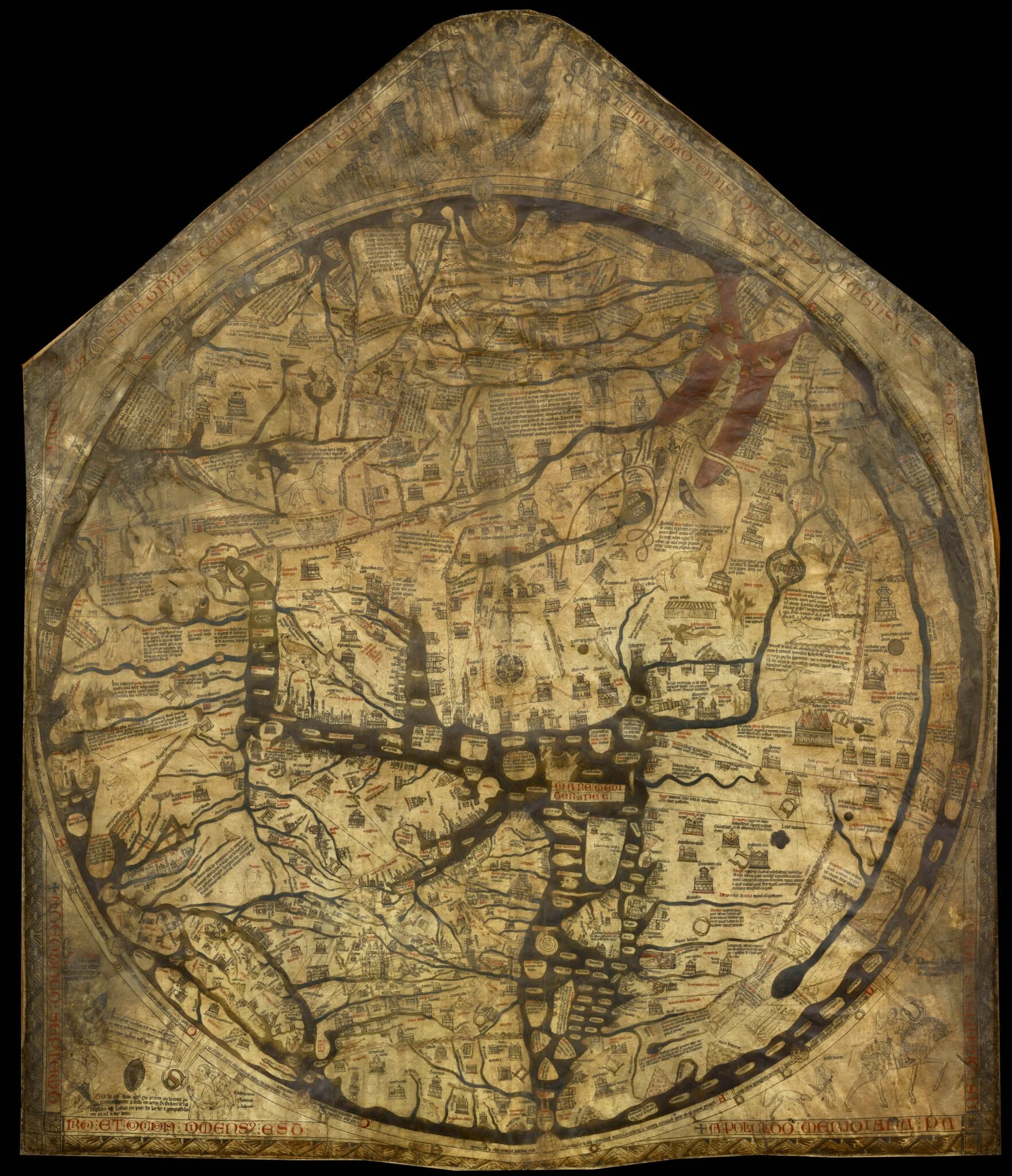
The Hereford mappa mundi, a map of the world with Jerusalem at its center. Credit: Wikimedia Commons.
One reason the myth may have taken off was that Medieval world maps, or mappae mundi, often show the known world as a circle. To some eyes, that can look like the people who drew them ascribed to a flat-Earth geography.
But these maps were not meant to be used for navigation or to make a scientific point.
The Hereford Mappa Mundi, made around 1300, was a religious and encyclopedic manuscript. It placed Jerusalem near the center and filled the world with biblical scenes, mythical beasts, peoples and cities. This map and others like it from the Middle Ages were based on theology.
However, a circular drawing of the known world at the time by its maker does not mean the artist thought the planet was a pancake.
Because faith drove their worldview, medieval Europeans accepted the Ptolemaic model of the universe. This system placed the Earth — and specifically Jerusalem — at the center of all creation. The planets, the sun, and the stars all revolved around humanity. While factually incorrect, this Earth-centric model required a deep understanding of predictable planetary movements. Essentially, it entirely relied on the Earth being a sphere.