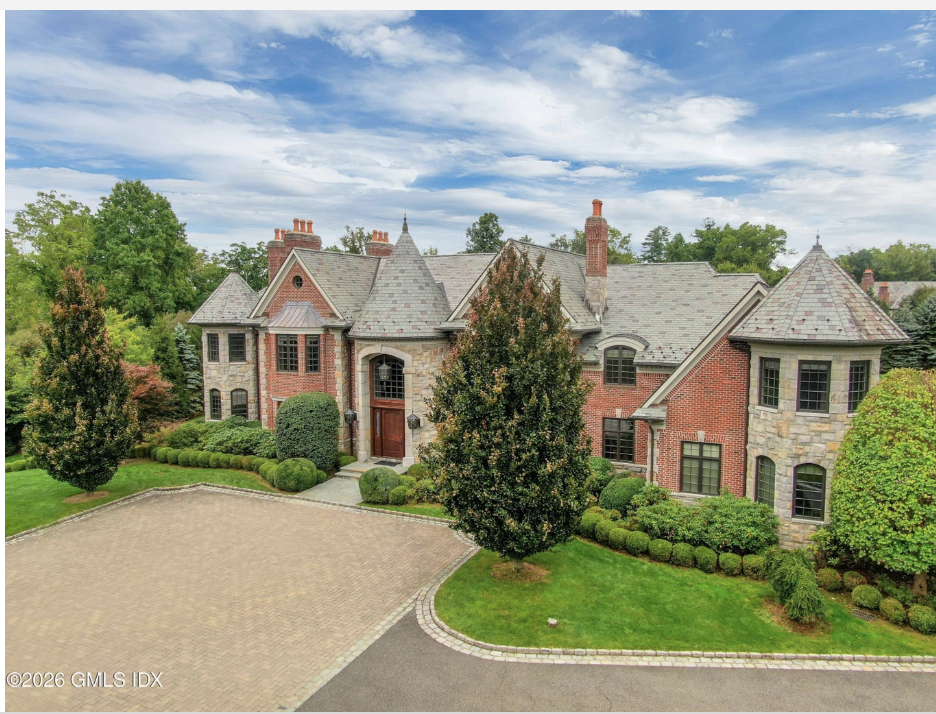
Old Greenwich Sale

I have to do what?

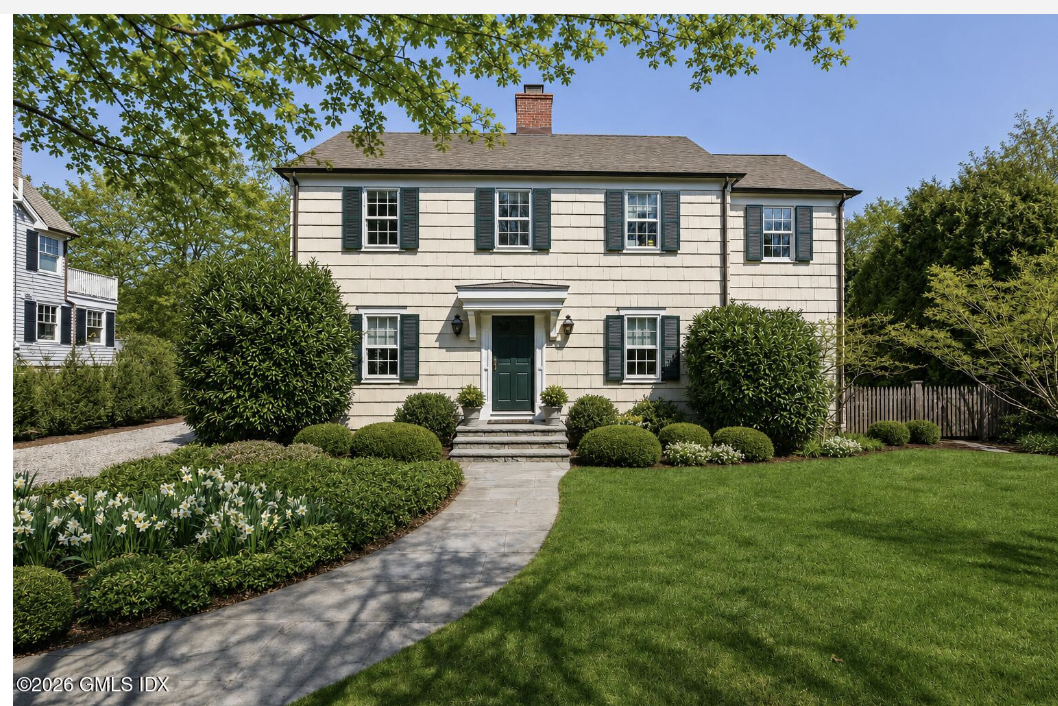
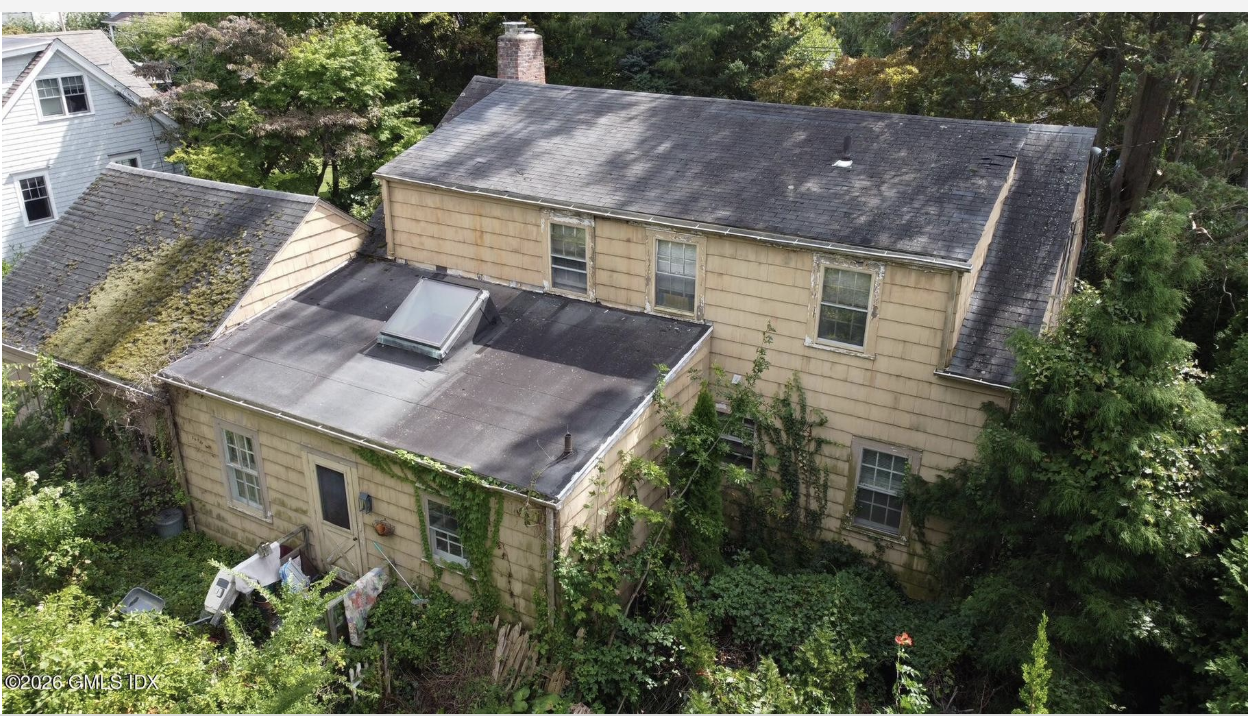
13 Mortimer Drive, $2.3 million, $2.495 asked. Seems like plenty for a 1921, 2,228 sq. ft. house on 0.12 of an acre in the AE Zone, no garage, a basement that flooded most recently during Hurricane Sandy, and flood zone requirements that will compel the owner to jack the place up another 10 feet into the air should he wish to make any improvements.

Sold to Upper East Side transplants.

Socialist paradise, but at a cost. And don’t tell Bernie Sanders, but ...

A depressing percentage of the population truly believes that the “free” stuff promised by their political leaders will be truly free to them, and to the question of who will pay for all of it, they answer, “someone else”. It doesn’t work that way, even in Sweden.

And there’s this: the Swedish social welfare system was based on a homogeneous population of people with a strong work ethic who produced as well as consumed. That model is failing as third world immigrants have flooded in, many of whom, even after two, even three generations among the fjords, have neither assimilated nor progressed beyond being mere conumers of others’ efforts. That can’t last.

Fact check*, per ChatGPT:

Sweden has both a VAT (called "moms") and a personal income tax. They are separate taxes that apply to different things.

Here's how the system works.

1. VAT ("moms")

VAT is a consumption tax, much like sales tax, except it's collected at every stage of production. The final burden falls on the consumer.

The standard VAT rate is 25%, and it applies to most goods and most services.

That means the 25% VAT is typically charged on things like:

  • Clothing

  • Electronics

  • Furniture

  • Haircuts

  • Legal services

  • Accounting services

  • Plumbing

  • Electrical work

  • Auto repairs

  • Most professional consulting

So if a plumber quotes you 2,000 SEK (before VAT), you'd normally pay:

  • Labor: 2,000 SEK

  • VAT (25%): 500 SEK

  • Total: 2,500 SEK

2. Are there exceptions?

Yes. Sweden has reduced VAT rates and some exemptions.

Item

Typical VAT

Most goods & services 25%

Restaurants 12%

Hotels 12%

Books, newspapers, passenger transport 6%

Healthcare Exempt

Education Exempt

Banking & insurance Exempt

(As of 2026, Sweden has temporarily reduced the VAT on many grocery food items to 6%, but restaurant meals remain at 12%.)

3. What about rent?

This is an interesting exception.

Residential rent is generally exempt from VAT.

If you rent an apartment, you normally do not pay VAT on your monthly rent.

Commercial real estate is different. Businesses renting office space may sometimes pay VAT depending on how the property owner has elected to treat the property for tax purposes.

4. Is there also an income tax?

Yes.

Every worker pays income tax in addition to VAT.

Sweden's income tax has two main layers:

  • Municipal income tax, paid by nearly everyone (roughly around 30%, though it varies by municipality).

  • National income tax, which applies only to higher incomes.

So a typical employee:

  • earns a salary,

  • pays income tax on that salary,

  • then spends what's left,

  • and pays VAT when buying most goods and services.

Suppose someone earns the equivalent of $100.

  1. They pay income tax.

  2. They take home perhaps $70 (very roughly).

  3. They spend some of that.

  4. Purchases are subject to VAT.

So Sweden's tax system has three major layers that people often confuse:

  1. VAT (moms): paid by consumers on most goods and services.

  2. Income tax: paid on wages and salaries.

  3. Payroll/social security contributions: paid largely by employers to fund pensions, health insurance, and other social programs.

Together, these taxes finance Sweden's extensive public services and social safety net.

Q 2: is it true that Sweden has more billionaires per capita than the US?

Yes—using Forbes’ 2025 billionaire count, Sweden had substantially more billionaires per capita than the United States.

  • Sweden: about 45 billionaires among roughly 10.6 million people → about 4.2 billionaires per million residents.

  • United States: about 902 billionaires among roughly 341 million people → about 2.6 billionaires per million residents.

That makes Sweden’s per-capita rate roughly 1.6 times the U.S. rate. This accords with a Financial Times analysis describing Sweden as having about 1.5 times as many billionaires per capita as the U.S.

The qualification is that billionaire lists are estimates, and comparisons can differ depending on whether a source classifies people by citizenship, residence, or primary business location. But under a consistent Forbes-style comparison, the claim is broadly true.

One reason this can coexist with Sweden’s high taxes is that Sweden taxes labor and consumption heavily, but abolished its general wealth tax in 2007 and its inheritance and gift taxes in 2004. Consequently, Sweden can simultaneously have a large welfare state and relatively favorable treatment of accumulated capital and inherited fortunes.

*The 180% tax on cars cited in the illustration is not accurate: Swedes pay the standard 25% VAT tax on purchase, while Denmark was the country that until recently taxed cars @180% — it’s since been lowered, according to Chat.


Learing centers

Future barista

The Disastrous Failure of 'Gender Studies' in Higher Education

Ward Clark, RedState:

…. A recent piece from Campus Reform documents that, at least at one midwestern university, the enrollment in these programs is crashing and burning. …. Northeastern Illinois University’s enrollment in its gender studies degree program has remained below 10 students for five years running, the school’s data shows.

The university maintains a page tracking five-year enrollment trends every spring. The data reveals that gender studies is not a popular major at the school.

In spring 2021, only two students were enrolled in the Women’s, Gender and Sexuality Studies Bachelor of Arts. That number rose to six students in spring 2022 before declining to five students in 2023 and four students in both 2024 and 2025.

The university had an enrollment of 3,749 undergraduate students in spring 2025, which means that 0.11 percent of the student body was enrolled in the Women’s, Gender and Sexuality Studies degree.

That's an encouraging statistic, although it begs one primary question: Why is Northern Illinois University still offering this corral's litter to be taught?

[Because there are 15 professors and 29 administrators in these departments, and where else would you place your graduates? — FWIW]

Women's, Gender and Sexuality Studies aren't the only garbage degree this university offers - and it's not the only one with enrollment in single digits. There are nine others, among them "Urban Community Studies," "Latina/o/x & Latin American Studies," and "Global Studies." These are, again, enormous outpourings of the kind of stuff one finds in small heaps in pastures where cattle have been grazing. And the electives may be even more ridiculous.

A description for “Feminist Activism” says that students will “create and participate in activist projects during the semester.”

Options for electives include “Contemporary LGBTQ+ Literature,” “Studies In Women’s Literature,” “Re-Thinking Race And Gender,” and “Latina/x Feminisms & Social Media.”

It's not just Northern Illinois University that is seeing its numbers in these programs crash and burn. Campus Reform has more:

A Campus Reform public records request revealed in July that the University of North Carolina Wilmington’s gender studies minor had 42 enrolled students for the 2025–2026 academic year out of almost 20,000 students at the school.

The low-enrollment programs come as some universities are raising tuition or reducing staff while citing broader enrollment declines.

Temple University announced a 3.4 percent tuition increase and staff reductions in July due to low enrollment.

Good. That's how it should be. 

Of all these horse squeeze programs, though, it's hard to imagine one that would be more useless than Gender Studies. It's not completely impossible that someone who took a Latin American Studies degree may find employment, say, as a low-level staffer in the United States embassy to Nicaragua. But Gender Studies? The only possible hope for employment that doesn't involve a Starbucks apron might be getting a job teaching Gender Studies, and, given the crashing university enrollment, that seems one of the longest of long shots.

Still, for all the microscopic enrollment, there are, according to one source, still 123 universities offering bachelor's degree programs in Gender Studies, another 93 offering bachelor's degrees in Gender & Sexuality Studies and possibly another 276 offering similar curricula in bits and pieces. 

But the crashing and burning in enrollment may be changing all that. Already, several institutions, including Georgia State University, the New College of Florida, and Wichita State, have already round-filed their Gender Studies programs, mostly due to catastrophically low enrollment.

Oh, the HUMANITY!

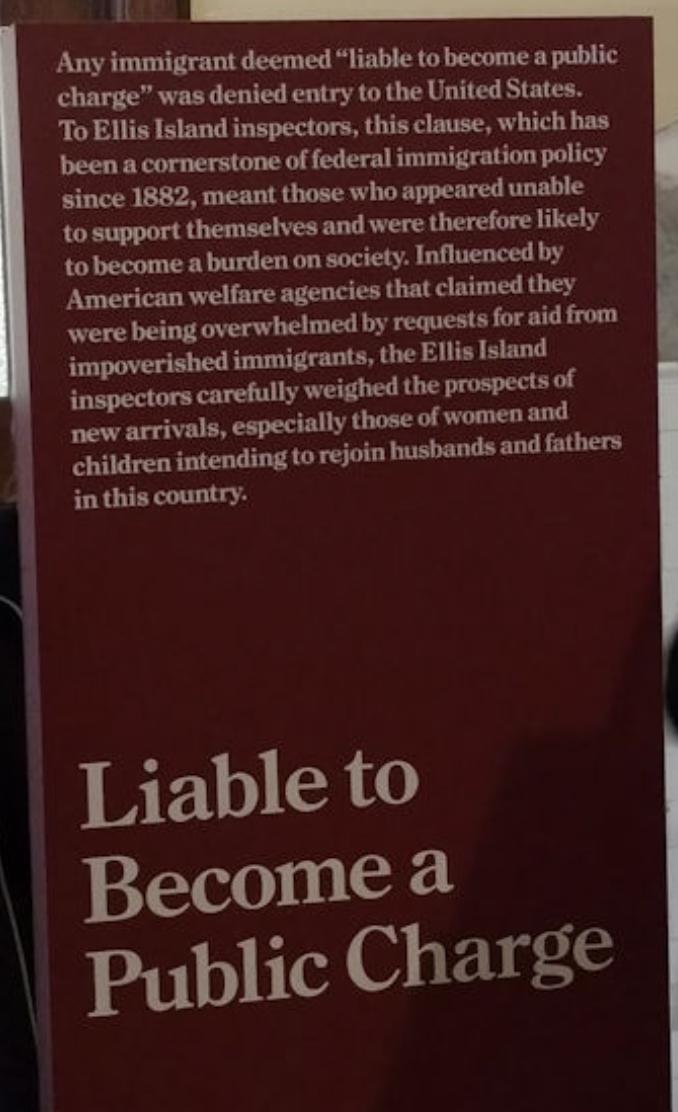
ellis island

In a move that will place hundreds of thousands of green card applicants under broader scrutiny each year, the Trump administration is allowing immigration officers to consider whether some applicants have used taxpayer-funded benefits — including Medicaid, food stamps and housing assistance — when determining whether they qualify for permanent legal status.

The Department of Homeland Security is poised to rescind a 2022 Biden-era regulation narrowing how officers apply a long-standing "public charge" test — an immigration screening tool used to determine whether applicants are likely to rely on government support — according to U.S. Citizenship and Immigration Services officials.

The change may directly affect hundreds of thousands of people applying for green cards from inside the U.S. each year. It could trigger a broader ripple effect if immigrant families avoid health care, food, or housing assistance — even when they or their U.S.-citizen children legally qualify — out of fear that tapping into those benefits could ultimately hurt their immigration cases.

I voted for this

Runs from (below) the border? Lettuce eschew cheap jokes and bad puns during this crisis

A Lettuce Recall Brings ‘Run for the Border’ Back for All the Wrong Reasons

Federal investigators traced a five-state cyclospora outbreak to shredded iceberg lettuce served at Taco Bell restaurants in Indiana, Kentucky, Michigan, Ohio, and West Virginia.

More than 1,644 people who reported eating at Taco Bell became ill, 94 were hospitalized, and no deaths have been reported so far. Among 190 Michiganders whose meals were studied in detail, 90% said they ate iceberg lettuce.

Taylor Farms de Mexico supplied the lettuce; the company recalled iceberg products sourced from central Mexico and distributed from June 29 through July 16 across 27 states. The list includes food-service products and Marketside iceberg salad and shredded lettuce sold at select Walmart stores.

(update)

One hundred billion dollars and counting: Useful idiots and the unions and politicians who deploy them

One hundred billion in hospice fraud; another hundred — or more — in non-existant day care centers, then there’s the food stamp fraud, the medical equipment fraud, the $4.7 trillion flwoing out of the treasure with the Treasury Account Symbol (TAS) fied left blank, thereby making it impossible to trace back to the original Congressional appropriation programs, hundreds of millions paid as block grant slush funds to individual politicians in cities like Hartford and New Haven), and on and on and on.

The question is, why are Democrat senators, congressmen, governors and attorney generals fighting so fiercely against efforts to expose these frauds? The answer is obvious.

(cont.)

RFK JR: "We shut down 800 hospices. You know what a hospice is? Where you're going to dieTypically, if you go to a hospice, you leave within 18 days because your dying is terminal."

"We started looking at these hospices in Los Angeles, and the people never died. Two or three years later they were there, and we're paying $6,000 a month."

"We found a hotel room with 29 hospices in it. I mean a hotel, every room was a hospice, and none of them had any patients. They were just addresses."

"The guys who own them, they were Estonians and Armenians and people from Eastern Europe who were getting the patient numbers. They were stealing them from doctors' offices."

"They were also going into poor neighborhoods in Los Angeles and they'd say to the people, 'We'll give you this $375 flat-screen TV. You give us your patient number and we're going to enroll you in this hospice. You don't ever have to go. We're just going to enroll you,' and then we'll charge Medicaid $6,000 a month forever. And the guy never dies, of course, because he was never sick."

"We didn't get a single call from a congressman or from a business owner saying, 'Oh, you shut down my hospice and all these patients are on the street.' None of them, because they were all crooked and they knew they were crooked."


“Republicans decided to cut Medicaid by around a trillion dollars — the only reason they did that was to pass along tax cuts for their billionaire and corporate friends — and the first impact of that is that people lose coverage,” said Senator Chris Murphy (D-CT). “When fewer people have insurance, and when the rates are lowered, health care institutions, hospital wards, hospitals, clinics, and nursing homes are going to close their doors. Your community hospital, the nursing home that you send your mother to, the maternity ward you’re planning to deliver your baby at, they are closing at an alarming rate, and that’s the consequence of the decision that Republicans made.”

AI Overview

Democratic lawmakers have largely opposed the Department of Health and Human Services (HHS) fraud investigations led by the Trump administration and congressional Republicans. They criticize these probes as politically motivated partisan attacks aimed at blue states, and they have expressed strong privacy and independence concerns regarding broad government anti-fraud data-sharing initiatives. [1, 2, 3]

Political Targeting and Funding Freezes
Democrats argue that the administration’s aggressive fraud probes are weaponized against Democrat-led states. [1]

  • Medicaid Crackdowns: The administration has frozen or threatened to pull federal Medicaid funding in states like New York, California, Minnesota, and Colorado, citing alleged fraud. Democrats argue that the administration focuses solely on blue states and relies on flawed or exaggerated data to justify the freezes. [1, 2, 3]

  • Boycotts: Democratic lawmakers on the Senate Homeland Security Committee largely boycotted a GOP-led hearing on emerging fraud threats, criticizing the event as a politically driven spectacle. [1]

Privacy Concerns
In the House, Democrats raised significant privacy concerns regarding legislation aimed at expanding federal anti-fraud efforts. They cautioned that data-sharing provisions pushed by the GOP could result in the collection of highly sensitive information across government agencies, functionally creating a massive, unauthorized database on American citizens. [1]

Standard Time is Good Time

Because what else do they have to do?

House Passes Legislation to Make Daylight Saving Time Permanent

I agree with the argument that moving our clocks back and forth twice a year is stupid, but the answer is to just stay with standard time, and consign our first Progressive, Woodrow Wilson’s brilliant WW1 experiment to the dustbin of history. Congressmen may still be abed with comely staffers at 9:00 AM, but the rest of us have lives, places to go, things to do before then, and it sucks having to do that in early morning darkness. Besides, this has been tried before, with exactly the result you’d (should) expect:

AI Overview:

The 1974 year-round daylight saving time experiment failed primarily because of dangerous winter morning darkness and a lack of actual energy savings.

President Richard Nixon signed the Emergency Daylight Saving Time Energy Conservation Act in response to the 1973 OPEC oil embargo. The law pushed clocks forward on January 6, 1974, for a planned two-year trial to reduce evening electricity demands. While initially backed by 79% of Americans, public approval plummeted to 42% within three months.

Why the Experiment Failed

  • Pitch-Black Morning Commutes: In many major regions, the sun did not rise until after 8:00 AM or even 9:00 AM. Millions of workers and schoolchildren had to commute in total winter darkness.

  • Schoolchildren Fatalities: Public panic erupted following heavily publicized tragedies, including eight children killed in traffic accidents in Florida while walking to school or waiting for buses in the dark.

  • Negligible Energy Savings: The U.S. Department of Transportation analyzed data from the 10-month period and found no meaningful fuel or electricity conservation.

  • Severe Practical Disruptions: Groups like farmers and outdoor construction workers faced immense difficulties starting their workdays blindly in freezing, dark mornings.

The Prompt Repeal

Faced with overwhelming public backlash, Congress aborted the trial early. President Gerald Ford signed a reversal amendment, and the nation returned to standard time on October 27, 1974, abandoning the experiment after less than a year.

Here’s some fun background material on time zones:

Time Zones Are Based on Longitude Overruled by Political Geography

….[L]ongitude is to a significant extent a matter of time. Historically, every town kept its own time based on its longitude. Wherever you found yourself, “noon” was the moment when the sun reached its highest point, with the other hours of the day set around that time. Travelers reset their watches as they came into new towns if moving east or west, but there were no “time zones” as there are today. When railroads were developed in the mid-1800s, allowing much faster travel, local timekeeping made it almost impossible to schedule the arrival and departure of trains. In response, uniform time-zones were established at one-hour intervals.

The entire world was eventually divided into 24 time zones, one for each hour of the day. As there are 360° of longitude around the Earth (180° west and 180° east of the Prime Meridian), and as 360 divided by 24 is 15, geographical units of one hour of time are equivalent to swaths of 15° degrees of longitude. Modern time zones are thus theoretically centered on lines of longitude in multiples of 15 (15°, 30°, 45°, 60° and so on), extending 7.5° to the east and west of those central meridians.

But as can be seen on the first map posted below, time zones are only structured this way in the uninhabited polar regions. Everywhere else, geopolitical considerations intrude. On land, time zones almost never follow the lines of longitude on which they are ideally based. Even in the open ocean, they often deviate from them to group islands and archipelagoes with other places. In the north Atlantic, for example, Jan Mayen is in the time zone commonly called GMT +1* (one hour ahead of Greenwich Mean Time), whereas by the logic of longitude it would be in time zone GMT -1 (one hour behind of Greenwich Mean Time). Not surprisingly, Jan Mayen is in the same time zone as Norway, the country that controls it. But note that western Norway would be in a different time zone (GMT 0) if longitude were the only factor.

And Maine being Maine …

In The 1880s, Bangor Ran 25 Minutes Ahead Of Its Neighbors

Bangor Mayor Frederick A. Cummings was a fierce holdout in 1883 when railroad companies came up with the four time zones that we in the Continental U.S. know today — Eastern, Central, Mountain and Pacific. Prior to that, the country had a baffling hodgepodge of more than 50 time zones. Rail passengers had to reset their watches five times between Boston and Washington.

Cummings balked at the push for standardization, arguing it was contrary to God’s will. The position of the sun in the sky dictated the time, according to Cummings.

“It is one of the immutable laws of God that the hours of noon, sunrise and sunset should occur at different periods of the day at different localities on the Earth’s surface,” Cummings wrote in January 1884. “The law was undoubtedly established at the creation and has remained upon Nature’s statute book since that day. I do not believe that any municipal regulation or railroad laws have power to change it.”

When Nov. 18, 1883 rolled around and the majority of towns and cities across the U.S. embraced Standard Time, Bangor did not because Cummings had vetoed the city council resolution that would have adopted it. The council tried again on Jan. 1, 1884, and Cummings, a Democrat, again vetoed it.

Yet two of those clocks were in churches and were changed to Eastern Standard Time, despite the mayor’s threats. The other two remained 25 minutes ahead — on Cummings time.

Which clocks were right? Which were wrong? It was all very confusing.

“The whole performance is supremely ridiculous, as those who are engaged in it will realize before long,” declared an editorial in the Bangor Daily Commercial.

Down the coast, the Rockland Free Press had snarkier things to say about Cummings’ effort to keep solar time in Bangor. Its editorial board took the opportunity to take potshots at the Democratic Party.

“The new time table is likely to be adopted, on trial at least, all over the state, except at Bangor, where the Democratic mayor has vetoed it,” it wrote. “Perhaps he doesn’t like the idea of it interfering with the four and eleven o’clock customs of his party in that city of free rum.”

In March 1884, Cummings was up for reelection. March 5, The New York Times noted that he was being challenged by Republican Samuel Humphrey and that Cummings’ stance on time change was controversial. Too controversial, apparently. Cummings lost. Or, you could say that he simply failed to get with the times.

Nevertheless, Bangor’s anti-Standard Time supporters kept their fight alive. And for the next three years there continued to be a 25-minute disagreement between the town’s two church clocks and its other two public clocks.

The dispute continued until 1887, when the state legislature adopted Eastern Time for the whole state.

That wasn’t the end of Maine’s time zone disagreements, though. The idea of Maine’s jumping ahead an hour to Atlantic Standard Time, like in New Brunswick and Nova Scotia, has been bandied about for years. In fact, a bill to switch to Atlantic Time passed the Maine House last year.

The state Senate didn’t vote on it, so the legislation never reached Gov. Paul LePage. That didn’t stop the governor from weighing in. The bill was “insane,” he said, adding that its supporters needed “therapy.”

So, 134 years after Bangor’s clocks battled with each other, time is still a matter of opinion.