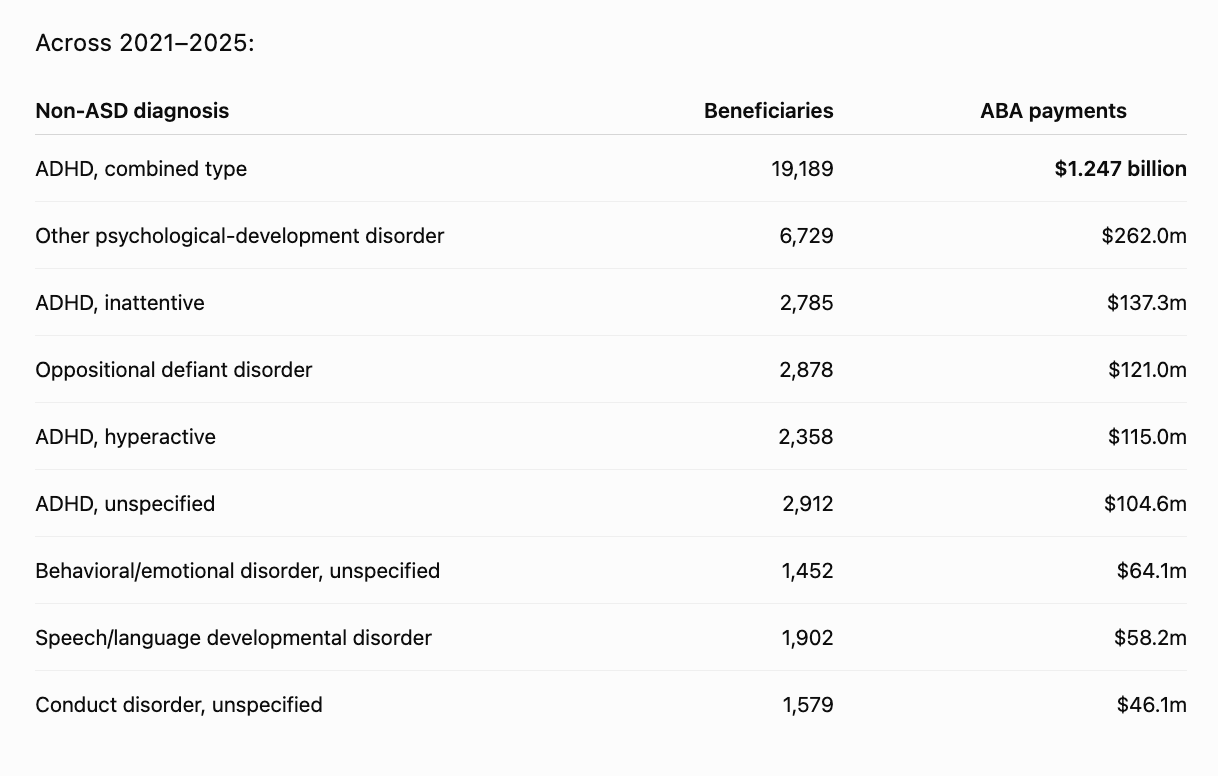
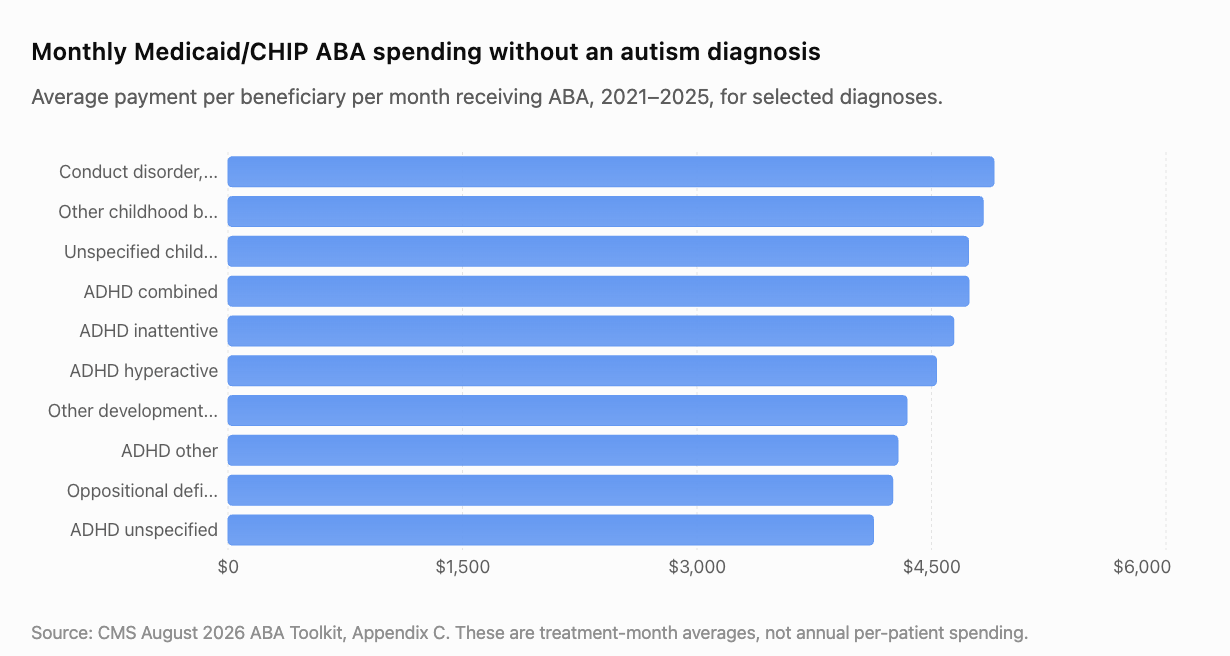
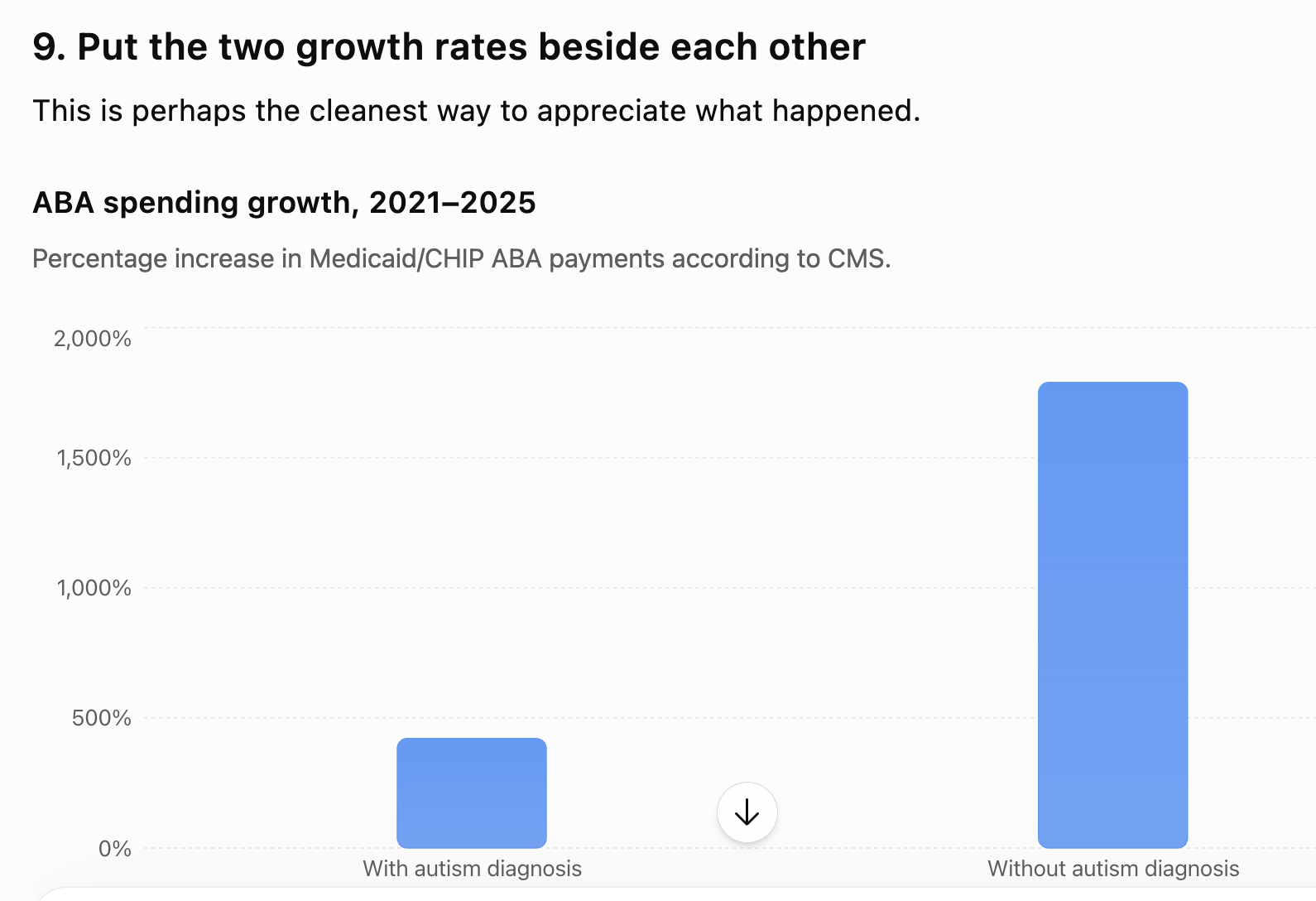
This tells us something important about the 1,789% increase. It isn't merely that Medicaid is occasionally reimbursing a behavior analyst for an ADHD consultation. Some of these patients are receiving extremely intensive—and expensive—ABA.
4. And geographically, the phenomenon is astonishingly concentrated
This may be the biggest red flag in the entire appendix.
CMS reports:
Florida alone paid more than $2.1 billion for ABA delivered to beneficiaries without an autism diagnosis during 2021–2025.
The next-highest state?
Colorado: just over $375 million.
So Florida spent more than 5½ times Colorado's total.
That is very difficult to explain as a nationwide change in medical science. ADHD obviously isn't five times more amenable to ABA in Florida than elsewhere.
It strongly suggests that state reimbursement rules, provider markets, billing practices, benefit interpretation, or some combination thereof are major explanatory variables.
Notice also what this means arithmetically. The entire United States was spending only $77.6 million annually on non-ASD ABA in 2021. Yet Florida alone accumulated more than $2.1 billion over the ensuing five-year period.
That deserves serious scrutiny.
6. The service quantities make it even more interesting
CMS gives another variable: service quantity.
ADHD combined-type beneficiaries accounted for:
98,228,671 units of ABA service during 2021–2025.
There were only 19,189 beneficiaries in that diagnostic category.
The most commonly used ABA CPT codes are generally billed in 15-minute units.
You have to be careful about dividing those numbers directly, because the CMS beneficiary count and service-quantity measures cover multiple years, people enter and exit treatment at different times, and not every CPT code represents identical direct-treatment time.
Nevertheless, the sheer scale is worth noticing:
98.2 million billed units for fewer than 20,000 ADHD-combined beneficiaries.
That's roughly 5,119 service units per unique beneficiary over the five-year observation period.
If they were all 15-minute treatment units—which they aren't necessarily—that would correspond to approximately 1,280 hours per beneficiary.
So these aren't trivial claims.
8. And we already know the broader ABA claims environment has serious integrity problems
HHS-OIG isn't merely expressing theoretical concern. It has conducted a series of state audits.
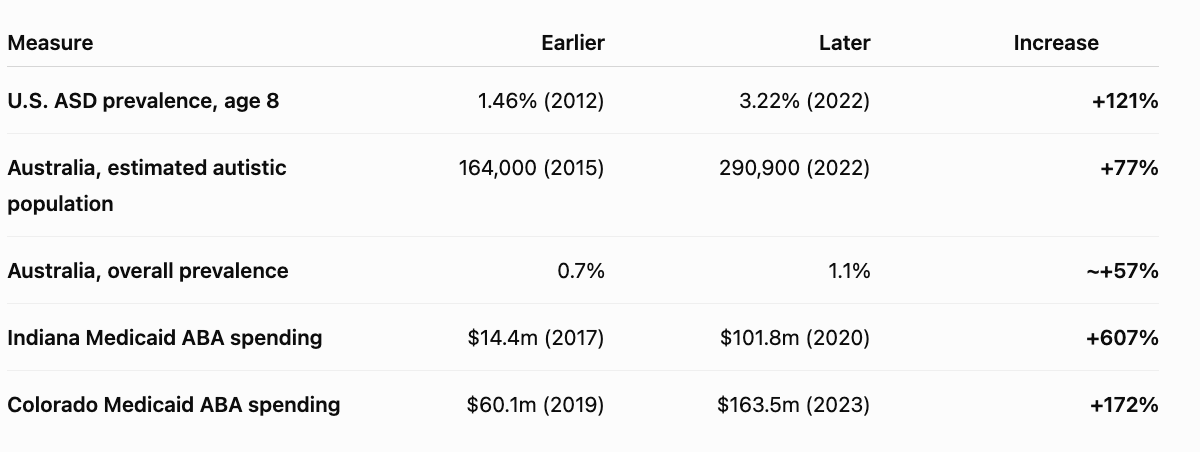
In Colorado, ABA fee-for-service payments rose from $60.1 million in 2019 to $163.5 million in 2023. OIG's sample found that all 100 sampled enrollee-months contained at least one improper or potentially improper claim line. OIG identified at least $77.8 million in improper payments and another estimated $112.5 million federal share requiring further review.
Wisconsin's audit likewise found at least $18.5 million in improper ABA payments, again with every one of its 100 sampled enrollee-months containing at least one improper or potentially improper claim line.
Indiana: at least $56 million improper. Maine autism-related services: at least $45.6 million improper. HHS-OIG now has an ongoing multi-state ABA audit program specifically because federal and state agencies have identified questionable billing and payments for unallowable services.
Again, an "improper payment" is not synonymous with fraud. It includes documentation and compliance failures. But the error environment is clearly real.