Autism: if you spend it, they will come
/
I read an article in HotAir this morning:
The 'Rorting' of a New Australian Entitlement
(What is "rorting" you ask? It's Australian slang for fraud or, in this case, ripping off the system.)
Back in 2012, Australia's Labor Prime Minister Julia Gillard pushed through a new entitlement called the National Disability Insurance Scheme (NDIS). The basic idea is that the Australian government would provide direct funding to individuals with disabilities. Those individuals would then choose how to spend the money to provide for their own support.
…. But the program grew much more quickly than expected and cost much more as well. Within two years of it going nationwide, there was concern that the program had been heavily infiltrated by organized crime. This story is from 2022:
According to a study by the Australian National University, there's been a 32% increase in the prevalence of autism since the NDIS was introduced. Experts, however, say the explanation for this is simple...
One of the other criticisms of the scheme has been that providers have gamed the system, offering unnecessary and expensive services.
"Where there's government money, there have been over-servicing and over-charging and shonky providers," says Shorten. "Many are good providers, but some are bad. That's the nature of a government scheme: people will hone in on it and try and slice off amounts for themselves."
Hmm: subsidize something and you get more of it. Counterintuitive, at least to a liberal mind, but I asked Chat GPT about it, asking it to compare Australia’s experience with our own. It complied, but then came up with a fascinating observation on its own: in the US, while autism diagnoses and “treatment” costs have soared, that increase is dwarfed by another branch of ABA (Applied Behavior Analysis), not classified as a “severe developmental disability”: Attention Deficit Disorder. That merits another post, which will follow. Here’s (some of) the report on autism — masochists can find the full report at the link:
Yes. The rise is very large, but the cleanest data suggest two different stories: autism identification has roughly doubled in U.S. child-surveillance data over a decade, while some categories of autism-treatment spending have risen several-fold faster than diagnoses.
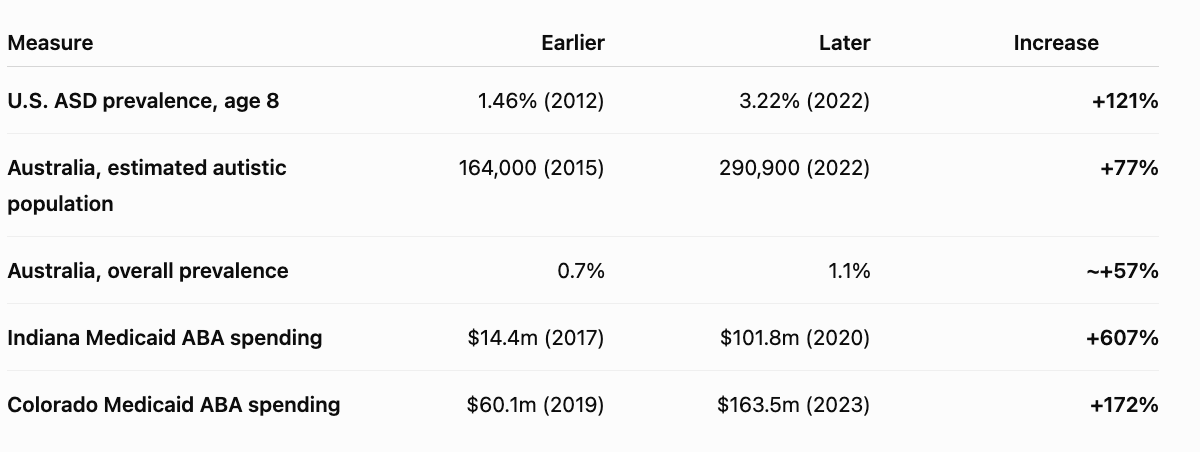
In the United States, the CDC’s comparable ADDM surveillance found autism in 14.6 per 1,000 8-year-olds in 2012 (1 in 68) and 32.2 per 1,000 in 2022 (1 in 31). That is a 121% increase in measured prevalence in ten years—about 2.2 times the 2012 rate. Importantly, this is identified prevalence, not proof that the underlying biological incidence doubled. Changes in screening, diagnostic practice, access to evaluation, diagnostic substitution and ascertainment all contribute. The CDC also reports a further 22% rise just from 2020 to 2022 among comparable surveillance sites.
Indiana Medicaid fee-for-service ABA payments went from $14.4 million in 2017 to $101.8 million in 2020—a 607% increase in three years. Colorado went from $60.1 million in 2019 to $163.5 million in 2023—up 172%. Wisconsin rose from $39.9 million in 2018 to $53.7 million in 2022, about 35%. CMS itself said in its August 2026 ABA toolkit that Medicaid and CHIP are seeing rapid growth both in ASD diagnoses and in use of ABA and other behavioral interventions.
Australia shows similarly remarkable growth in identification. The Australian Bureau of Statistics estimated 164,000 autistic Australians in 2015, or about 0.7% of the population. By 2022 it estimated 290,900, or 1.1%. Thus, in only seven years, the estimated number increased 77%, while population prevalence rose by roughly 57% (0.7% → 1.1%). The increase is especially concentrated among younger cohorts: for 10–14-year-olds, prevalence went from 2.8% in 2015 to 4.4% in 2022, an increase of about 57%. For ages 20–24 it went from 1.2% to 2.7%, a 125% increase.
So, in compact form:
The 32% comes from a 2026 peer-reviewed Journal of Health Economics paper by Maathumai Ranjan and Robert Breunig at Australian National University. Their result is that introduction of the NDIS itself caused an estimated 32% increase in reported autism prevalence and accounts for an estimated 47% of new autism diagnoses since the scheme's introduction.
…[T]here really does appear to be evidence of an incentive effect on diagnosis, independently of outright billing fraud.
…..
Now compare that with money
This is where the divergence gets striking.
The newly released U.S. CMS figures say Medicaid/CHIP spending on autism therapy increased more than fivefold between 2021 and 2025, reaching $10.1 billion in 2025. CMS explicitly says spending grew much faster than the number of patients receiving treatment.
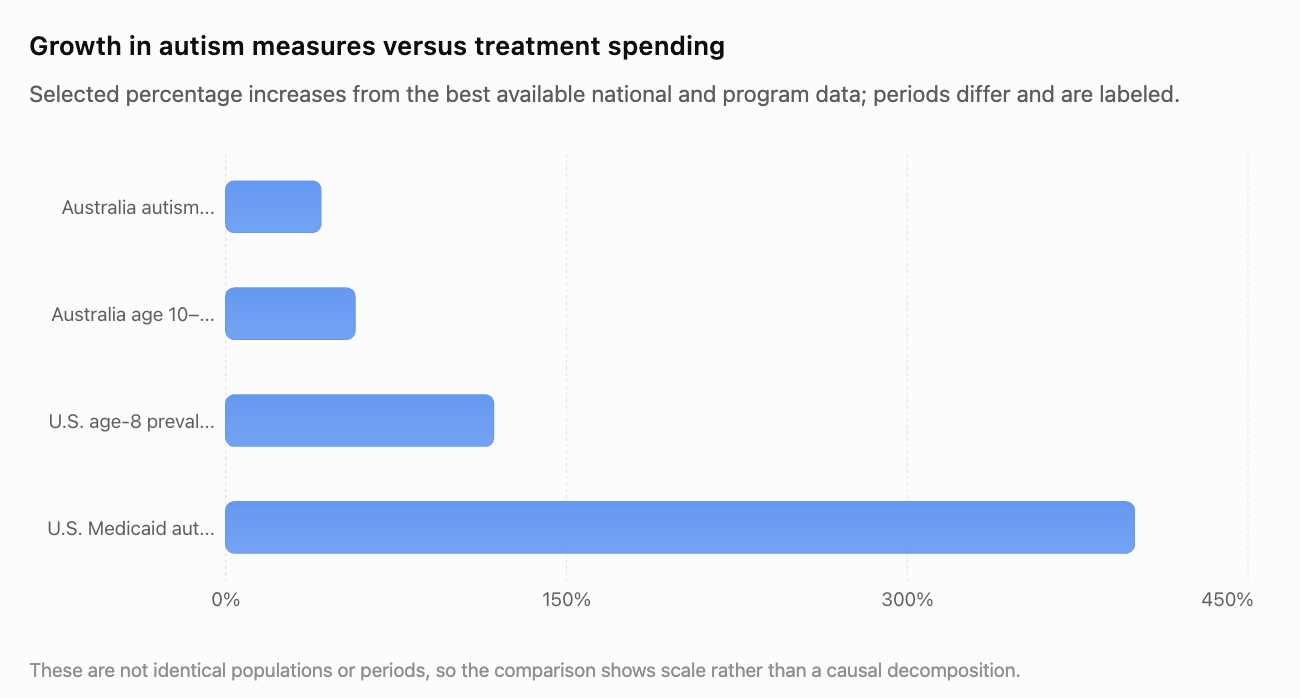
I've put the U.S. spending bar at +400% as a conservative floor because the source says "more than fivefold": five times the original amount corresponds to a 400% increase. The actual increase is therefore somewhat greater.
Australia gives another useful within-program comparison. In FY2022, NDIS paid A$5.27 billion to participants whose primary disability was autism. One year later that was A$6.73 billion—+28% in a single year. There were 214,880 such participants by June 2023, representing 35% of everybody in NDIS.
That doesn't prove the extra 28% was waste: increased enrollment, inflation, service intensity and changing participant composition matter too. But it illustrates why the financial incentives are worth investigating.
After reading the source behind your article, I would actually modify the framework I gave you earlier. There are three, rather than two, phenomena to keep distinct:
1. Genuine/ascertainment growth. Better recognition, changing criteria, diagnostic substitution and identification of people previously missed clearly account for some increase. ABS itself explicitly warns that awareness and diagnostic criteria contribute to its rising prevalence figures.
2. Incentive-induced diagnosis. This is not necessarily fraud. The ANU natural experiment provides evidence that making a valuable government benefit conditional on disability recognition changes diagnostic behavior. Their central estimate is +32% autism prevalence caused by NDIS, with 47% of post-introduction new diagnoses attributable to the program. Their evidence favors a lowered recognition threshold over simply finding previously missed cases.
3. Fraud, over-servicing and improper billing after diagnosis. Australia estimates 6–10% of NDIS payments are currently lost to inflated invoices, organized crime or ineligible payments; criminal-intelligence officials have suggested the problem could be substantially larger. In the U.S., CMS has now reacted to the extraordinary growth in ABA spending with recommendations specifically addressing fraudulent/abusive billing, conflicts where diagnosis and treatment are financially connected, provider ownership and very high treatment hours.
The distinction between #2 and #3 is critical. A clinician could sincerely decide that a borderline child meets today's ASD criteria because obtaining that diagnosis unlocks useful services. That can increase measured autism prevalence without anyone committing fraud. Once billions of dollars are contingent upon the label, however, the system creates incentives at both the diagnostic and treatment stages.
And the Australian study is unusually valuable because it moves this beyond speculation about incentives: the staggered NDIS rollout gives researchers something approaching a natural experiment showing that the entitlement itself changed autism diagnosis rates.
That makes the Australia/U.S. parallel considerably more interesting than merely observing that both countries have experienced more autism diagnoses.
Normalizing by the number of people actually receiving services changes the picture substantially—and reveals a notable difference between the U.S. and Australia.
For the U.S., CMS now gives us exactly the ingredients we need. Medicaid/CHIP ABA spending for beneficiaries with an autism diagnosis rose from $1.86 billion in 2021 to $8.58 billion in 2025, while the number of autistic beneficiaries receiving ABA rose from 94,338 to 272,426. Dividing one by the other gives the following average expenditure per treated autistic beneficiary:
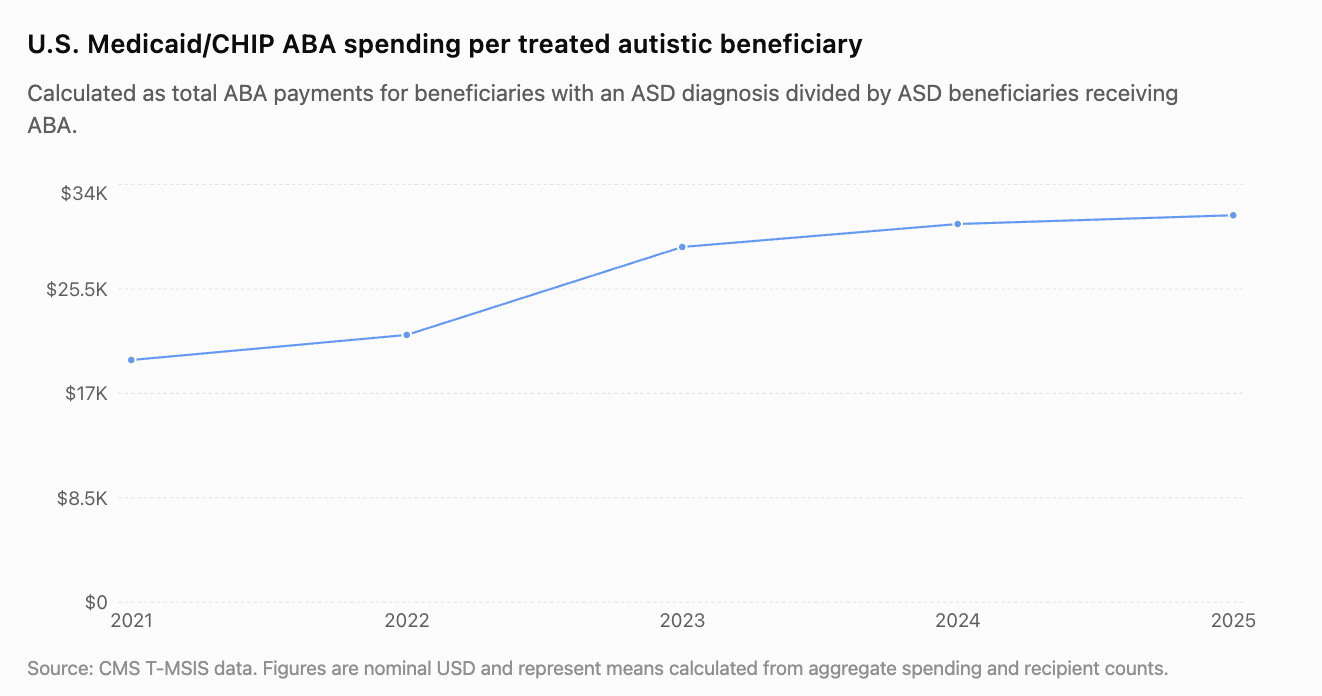
So the U.S. decomposition is:
ABA-treated autistic beneficiaries: +189%
ABA spending on autistic beneficiaries: +361% [Corrected later on by Chat to 421%]
Average spending per treated autistic beneficiary: +60%, from about $19,700 to $31,500
…………
1. What exactly is the $1.47 billion?
CMS examined Medicaid and CHIP claims nationwide for the eight ABA-specific CPT codes 97151–97158. It then separated beneficiaries according to whether they had an autism-spectrum diagnosis—F84.0, F84.5, F84.8 or F84.9—in the claims data.
Among people without one of those ASD diagnoses, payments went:
2021: $77.6 million → 2025: $1.47 billion
That's 18.9× as much money in four years, or +1,789%.
This isn't somebody's extrapolation or an advocacy-group estimate. It's CMS's analysis of T-MSIS claims and encounter data covering all 50 states, D.C., Puerto Rico, USVI and Guam, including both fee-for-service and managed-care encounters.
And by 2025, non-autism cases constituted 14.5% of all Medicaid/CHIP ABA spending.
That is remarkable because ABA remains overwhelmingly associated with autism treatment.
2. What were they being treated for?
Here is where it gets much more interesting.
CMS actually tabulated the diagnoses attached to this non-autism ABA population. The dominant diagnosis wasn't another severe developmental disability.
It was ADHD.
(And SO ON TO THE NEXT POST ….)