A humorous history of Christmas greenery, from Twitchy
/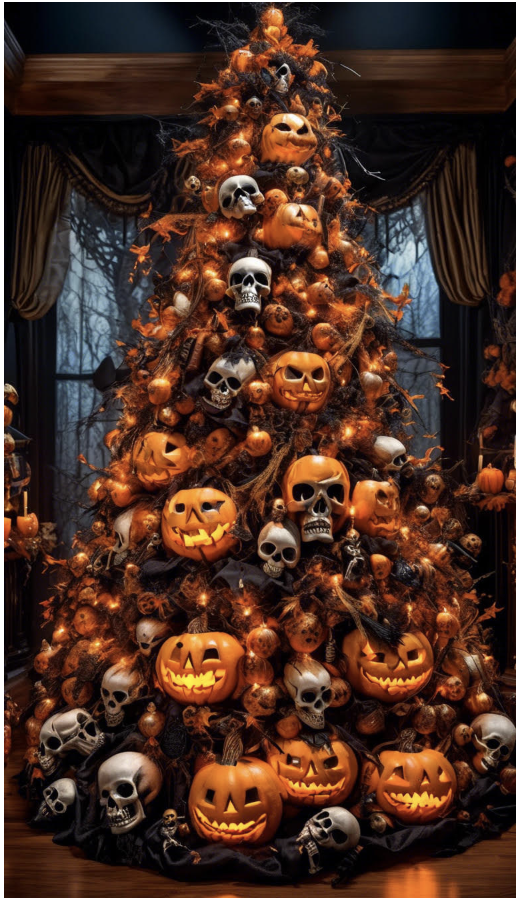
getting an early start on the holiday (courtesy of Chatbox AI — I’m beginning to enjoy this thing)
Over on Twitchy, a history of Christmas greenery (despite the headline, there really are ties to the German barbarians, but it’s … complicated)
Debunking the Myth: Your Christmas Tree Is Not Pagan
For almost every picture of a Christmas tree, there is a post from an atheist killjoy harping that there is no God and that Christmas is a pagan holiday.
Mostly, these folks are nuttier than fruit cake, and their Christmas pagan trope is just as stale. Misery enjoys company, and the atheist sect is as miserable as they come.
The two prevailing arguments for linking Christmas trees and Christmas itself to paganism are the holiday's proximity to the winter solstice and the fact that pagans used evergreens in their celebrations.
Both are true, and it's no coincidence. Old traditions were woven into the faith from St. Patrick to the Spanish missionaries in the Americas. It's where jack-o-lanterns and sugar skulls come from at Halloween. Communities gathered at the winter and spring solstice, which provided missionaries like St. Paddy with large groups of potential new converts to preach to. So, it makes sense that these times of the year remained important as Christianity grew.
Pagans did indeed use forms of evergreens in their celebrations. The Norse would decorate their homes with woven evergreen that may have resembled wreaths or boughs of holly. They even hung mistletoe near the winter solstice. There was probably not much kissing, as mistletoe was associated with the death of Baldur, the God of Light. There was nothing resembling what we would think of as a Christmas tree.
The evergreen also had a practical use. Winters were long and harsh, and being stuck indoors with no indoor plumbing could be unpleasant. A few well-placed wreaths could add color to a home and possibly have been an Iron Age air freshener.
The Romans and Celts had similar traditions.
Early Romans marked the solstice with a feast called Saturnalia in honor of Saturn, the god of agriculture. The Romans knew that the solstice meant that soon, farms and orchards would be green and fruitful. To mark the occasion, they decorated their homes and temples with evergreen boughs.
In Northern Europe the Druids, the priests of the ancient Celts, also decorated their temples with evergreen boughs as a symbol of everlasting life. The Vikings in Scandinavia honored the evergreen mistletoe for its role in the death of the Balder, a god of light.
“It would seem that the scented trees that hang from rearview mirrors are more connected to our pagan ancestors than Christmas trees.’
Modern-day Christmas trees originated in Germany but were not initially intended for Christmas. The trees, adorned with apples, were first used to represent the Tree of Knowledge from the Garden of Eden on the feast day of Adam and Eve, which is celebrated on December 24th.
Martin Luther is credited with first adding candles to light Christmas trees.
It is a widely held belief that Martin Luther, the 16th-century Protestant reformer, first added lighted candles to a tree. According to a common version of the story, walking home one winter evening, Luther was awed by the stars twinkling amidst evergreens. To recapture the scene for his family, he erected a tree in the main room and wired its branches with lighted candles.
The belief of pagan connections to Christmas persisted. In 1659, Massachusetts made decorations and any observance of December 25th illegal.
…. In 1659, the General Court of Massachusetts enacted a law making any observance of December 25 a penal offense; people were fined for hanging decorations. That stern solemnity continued until the influx of German and Irish immigrants in the 19th century undermined the Puritan legacy.
Everything changed in 1846, thanks to Queen Victoria.
In 1846, the popular royals, Queen Victoria and her German Prince, Albert, were sketched in the Illustrated London News standing with their children around a Christmas tree. Unlike the previous royal family, Victoria was very popular with her subjects, and what was done at court immediately became fashionable—not only in Britain, but with fashion-conscious East Coast American Society. The Christmas tree had arrived.
Much more at the link, and well worth going over to the site to read the whole thing.
And it includes (real) pictures, like these:

Do you think Joe will get some Trump Cologne in his stocking?