Before you panic and move from Old Greenwich to Riverside over these results, consider this:
/
GreenwichWise has the story itself, but there’s more to it than that: we have different sections of town, with different student populations, but Old Greenwich and Riverside are essentially identical in their makeup, so are their respective rankings merely a distinction without a difference? I wrote to Dear ChatBox, asking how two schools, side-by-side, same wealthy demographics, could rank #1 and #32 respectively; why the difference? As I suspected, the answer, boiled down, is that they’re not.
(Which is not to say that the presence or absence of certain students can’t affect these kinds of metrics: when the Fountain Boyz were pushed out of Riverside and down the street to Eastern Junior High, Riverside’s scores soared, while Eastern’s plummeted. But we were the exception, and we’re long gone. In any event, here’s the Q&A with ChatBox)
Q: U.S. News and World Reports has just released its 2027 best CT Elementary schools rankings, and show my own old school and where my children attended, Riverside School as #1. No surprise there, the kids all come from upper middle-class (middle class in my own and my children's time; uber-rich today) families, with parents who place great importance on education, there are no gang fights in the hallways to disrupt learning, and so forth. But what I'm curious about is that Old Greenwich School, which borders Riverside - literally across the tidal creek I and my children grew up on, same demography, same wealthy parent base, even pretty much the same date buildings (I think they both went up in the 1930s) ranks only 32nd. U.S. New describes its methodology, but I'm still at a loss to understand why there's any difference at all.
ChatGTP:
Here are two elementary schools separated by a tidal creek, serving essentially the same affluent community, operating under the same Greenwich school district, with the same curriculum, salary schedules, and broad educational policies. Yet one is ranked #1 in Connecticut and the other #32.
That sounds like a substantial difference in educational quality. But is it?
My suspicion is that the difference is considerably smaller than the rankings make it appear, and that the explanation lies primarily in standardized test scores, how those scores are distributed, and the mathematical machinery U.S. News uses to turn them into rankings.
There's an important change in the 2027 methodology that makes your question particularly interesting.
What U.S. News is actually measuring
According to the methodology described in U.S. News' October 20 announcement, the rankings are based on four components, each worth approximately one-quarter of the overall score:
Component
Weight
Mathematics achievement
25%
Reading/language arts achievement
25%
Mathematics performance relative to demographic expectations
25%
Reading performance relative to demographic expectations
25%
Student-teacher ratios are used to break ties, not as a substantial independent measure of quality.
Notice what's missing: teacher experience, quality of instruction, parental satisfaction, music and art programs, school culture, and just about everything else one might consider important in an elementary school.
And here's the interesting wrinkle: half the score is based on how well a school performs relative to what its student demographics would predict.
In other words, the ranking isn't simply asking which school has the highest-scoring children. It's also asking which school scores higher than a statistical model expects it to.
That creates an opportunity for two apparently identical schools to receive surprisingly different rankings.
Now, here's the revealing part: the actual test scores
I found Connecticut's 2024–25 test results reproduced by an independent school-data website. They provide a much more illuminating comparison than the U.S. News rankings themselves.
2024–25 proficiency rates
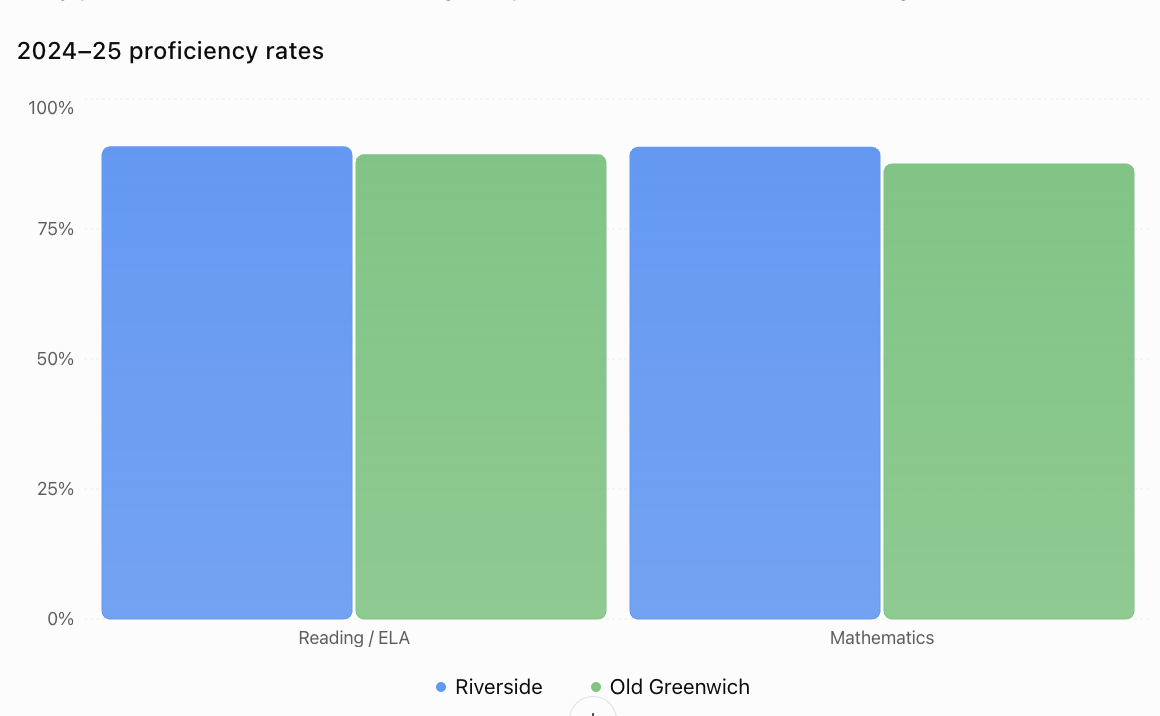
Look at that. Riverside's advantage is just 1.5 percentage points in reading and 3.2 points in mathematics.
Those differences are real in the reported results, but they're hardly the chasm one might imagine between the state's first-ranked and 32nd-ranked schools.
There's another revealing comparison: using its own scoring methodology, that independent website ranks Old Greenwich fourth in Connecticut and Riverside fifth on the same 2024–25 data.
So we have one ranking system placing Riverside first and Old Greenwich 32nd, and another placing Old Greenwich fourth and Riverside fifth.
That is quite a demonstration of how much the choice of methodology matters.
Why a small difference can become 31 ranking positions
There are three plausible explanations.
First: ranking compression. At the upper end of Connecticut's elementary school performance distribution, there are many extremely high-achieving schools. Differences of just a few percentage points can separate dozens of schools. Being 32nd doesn't mean Old Greenwich is 31 units worse than Riverside; ranks are ordinal positions, not measures of educational distance.
Second: demographic adjustments. Even though the two neighborhoods appear nearly identical economically, the formula doesn't know their history or geography. It uses school-level demographic data. Small differences in the proportions of economically disadvantaged students or particular student groups can alter the model's expected performance, and therefore a school's adjusted score.
I haven't established whether those differences actually explain the Riverside–Old Greenwich gap.
Third: the new scoring system. For 2027, U.S. News began incorporating more detailed achievement levels, rather than simply distinguishing between students who met proficiency standards and those who didn't.
Consider two hypothetical schools, each with 90% of students meeting proficiency standards. One has considerably more students in the highest achievement category. The new methodology can distinguish between them, even though their headline proficiency rates are identical.
This is particularly relevant to affluent Greenwich schools, where so many children already clear the basic proficiency threshold.
One more interesting finding
Old Greenwich's academic results aren't consistently inferior across different years.
For example, SchoolDigger reports that Old Greenwich's 2025–26 third graders achieved 92.5% proficiency in mathematics. But its fifth graders achieved only 74.1% in mathematics that year.
That's a substantial difference between cohorts within the same school. [FWIW: I’ll point out that those 5th graders were victims of the COVID shutdown years. Remember AFT union head Randi, “Kids are Resilient” Weingarten? She was wrong, and she knew it.]
It suggests another possible explanation: a few particularly strong or weak classes can materially change the results for a relatively small elementary school.
And there's an important distinction here. These are different cohorts, not evidence that children lost ground as they progressed from third to fifth grade.
What I would conclude — and what remains unanswered
Your original intuition appears well supported: the schools are far closer academically than their U.S. News ranking positions suggest.
But I can't yet establish exactly how much of the 31-place difference comes from raw achievement, how much from demographic adjustment, and how much from the distribution of scores across achievement levels. I could verify the published 2027 methodology and independent test results, but U.S. News blocked direct access to its detailed school profiles.
…. And there's a broader question I think your example raises.
When a school serves children who arrive with enormous educational advantages, is the school itself producing extraordinary academic results, or is it primarily benefiting from the advantages its students bring with them?
U.S. News attempts to address that question with its demographic adjustment. But a statistical adjustment cannot fully separate the contributions of teachers, parents, inherited advantages, peer groups, and everything else that influences children's achievement.
The most striking finding here is that another ranking of the same two schools, using the same state's test data, actually reverses their order — and places them adjacent to each other.
That makes me considerably more skeptical of the apparent significance of Riverside's #1 versus Old Greenwich's #32 than of either school's educational quality.