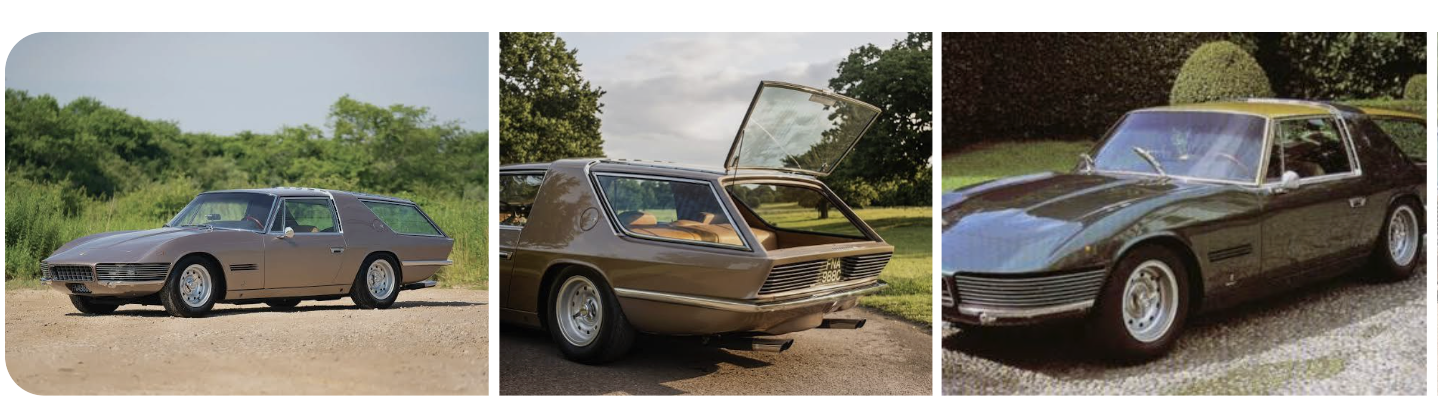
You can see it here

Ed Driscoll on InstaPundit:

AI DESTABILIZES STOCK PHOTO INDUSTRY: Getty Images files for US bankruptcy, advances restructuring plan. “Getty Images (GETY.PK) filed for Chapter 11 bankruptcy on Wednesday, formalizing restructuring plans unveiled more than ​a week ago as part of its ‌move to go private. Last week, Getty announced plans to file for bankruptcy, marking a major reset after its planned ​merger with rival Shutterstock (SSTK.N) collapsed under the ​weight of heavy debt and growing competition ⁠from AI-generated imagery.”

The DALL-E image generator in ChatGPT is capable of producing photo-realistic images, and other AI image generation platforms can produce material good enough to illustrate online ads and Websites, and for much cheaper costs than maintaining an account at Getty or Shutterstock.  Not to mention, the platforms merely have to be prompted to produce their results, rather than the labor-intensive efforts that Photoshop used to require to assemble a collage of stock photos into a satiric image, as I used to do every night for PJM, back in the day. At worst, Photoshop can be used to tweak an AI image, rather than the drudgery of starting from scratch.

Loch Lane, the next chapter

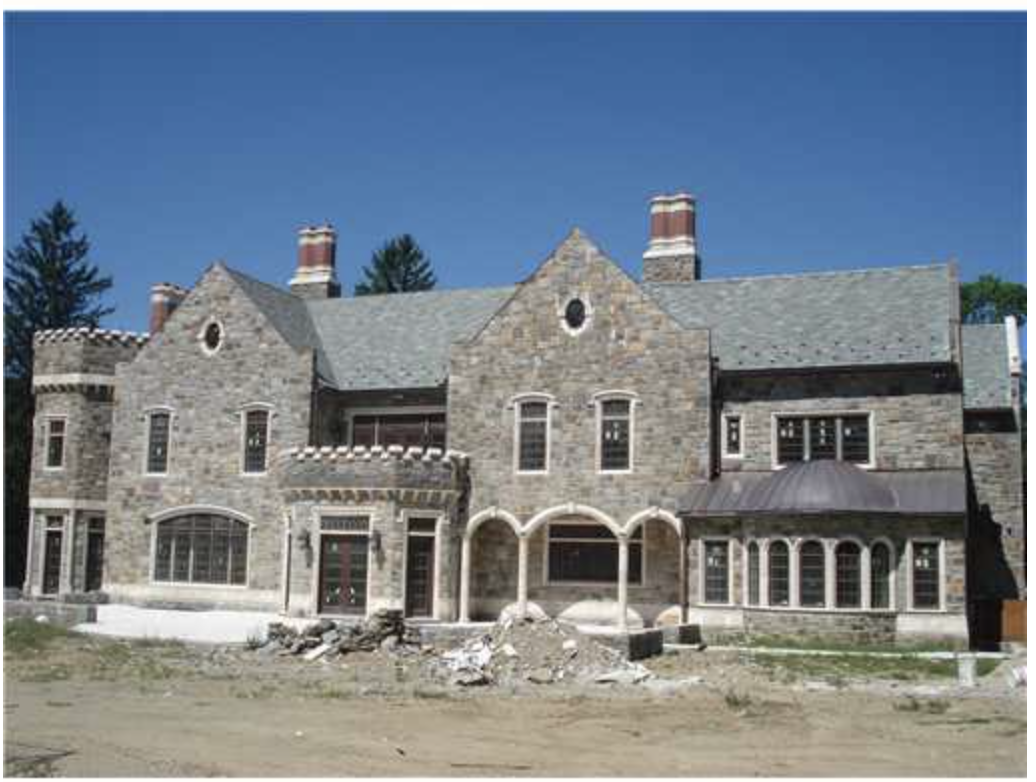
7 Loch Lane, listed at $13.495 million, has sold for $11.6. The land this house sits on was purchased by a Greenwich builder in 2004 for $2.950; construction was (eventually) begun, and the uncompleted project was put up for sale in 2010 at $13.995 million. Foreclosure followed, initiated in 2011 and not completed until 2019, when Williamsburg Savings Bank, as successor to the original lender, took title, finished the project and sold it to these sellers in 2020 for $6.9 million. They added a raised vegetable bed garden and, as noted, have now resold it for $11.6.

Before you panic and move from Old Greenwich to Riverside over these results, consider this:

How Greenwich Public Schools Ranked

Greenwich elementary schools showed notable movements across the board, with several schools making dramatic upward climbs from last year's rankings:

  • Riverside School: #1 (Maintained #1 rank)

  • North Mianus School: #8 (Down from #7 in 2026)

  • International School at Dundee: #12 (Down from #9 in 2026)

  • Parkway School: #22 (Up from #41 in 2026)

  • North Street School: #30 (Down from #14 in 2026)

  • Old Greenwich School: #32 (Down from #20 in 2026)

  • New Lebanon School: #59 (Up significantly from #151 in 2026)

  • Glenville School: #74 (Up significantly from #142 in 2026)

  • Julian Curtiss School: #101 (Up from #170 in 2026)

  • Hamilton Avenue School: #196 (Down from #186 in 2026)

  • Cos Cob School: #215 (Down from #186 in 2026)

GreenwichWise has the story itself, but there’s more to it than that: we have different sections of town, with different student populations, but Old Greenwich and Riverside are essentially identical in their makeup, so are their respective rankings merely a distinction without a difference? I wrote to Dear ChatBox, asking how two schools, side-by-side, same wealthy demographics, could rank #1 and #32 respectively; why the difference? As I suspected, the answer, boiled down, is that they’re not.

(Which is not to say that the presence or absence of certain students can’t affect these kinds of metrics: when the Fountain Boyz were pushed out of Riverside and down the street to Eastern Junior High, Riverside’s scores soared, while Eastern’s plummeted. But we were the exception, and we’re long gone. In any event, here’s the Q&A with ChatBox)

Q: U.S. News and World Reports has just released its 2027 best CT Elementary schools rankings, and show my own old school and where my children attended, Riverside School as #1. No surprise there, the kids all come from upper middle-class (middle class in my own and my children's time; uber-rich today) families, with parents who place great importance on education, there are no gang fights in the hallways to disrupt learning, and so forth. But what I'm curious about is that Old Greenwich School, which borders Riverside - literally across the tidal creek I and my children grew up on, same demography, same wealthy parent base, even pretty much the same date buildings (I think they both went up in the 1930s) ranks only 32nd. U.S. New describes its methodology, but I'm still at a loss to understand why there's any difference at all.

ChatGTP:

Here are two elementary schools separated by a tidal creek, serving essentially the same affluent community, operating under the same Greenwich school district, with the same curriculum, salary schedules, and broad educational policies. Yet one is ranked #1 in Connecticut and the other #32.

That sounds like a substantial difference in educational quality. But is it?

My suspicion is that the difference is considerably smaller than the rankings make it appear, and that the explanation lies primarily in standardized test scores, how those scores are distributed, and the mathematical machinery U.S. News uses to turn them into rankings.

There's an important change in the 2027 methodology that makes your question particularly interesting.

What U.S. News is actually measuring

According to the methodology described in U.S. News' October 20 announcement, the rankings are based on four components, each worth approximately one-quarter of the overall score:

Component

Weight

Mathematics achievement

25%

Reading/language arts achievement

25%

Mathematics performance relative to demographic expectations

25%

Reading performance relative to demographic expectations

25%

Student-teacher ratios are used to break ties, not as a substantial independent measure of quality.

Notice what's missing: teacher experience, quality of instruction, parental satisfaction, music and art programs, school culture, and just about everything else one might consider important in an elementary school.

And here's the interesting wrinkle: half the score is based on how well a school performs relative to what its student demographics would predict.

In other words, the ranking isn't simply asking which school has the highest-scoring children. It's also asking which school scores higher than a statistical model expects it to.

That creates an opportunity for two apparently identical schools to receive surprisingly different rankings.

Now, here's the revealing part: the actual test scores

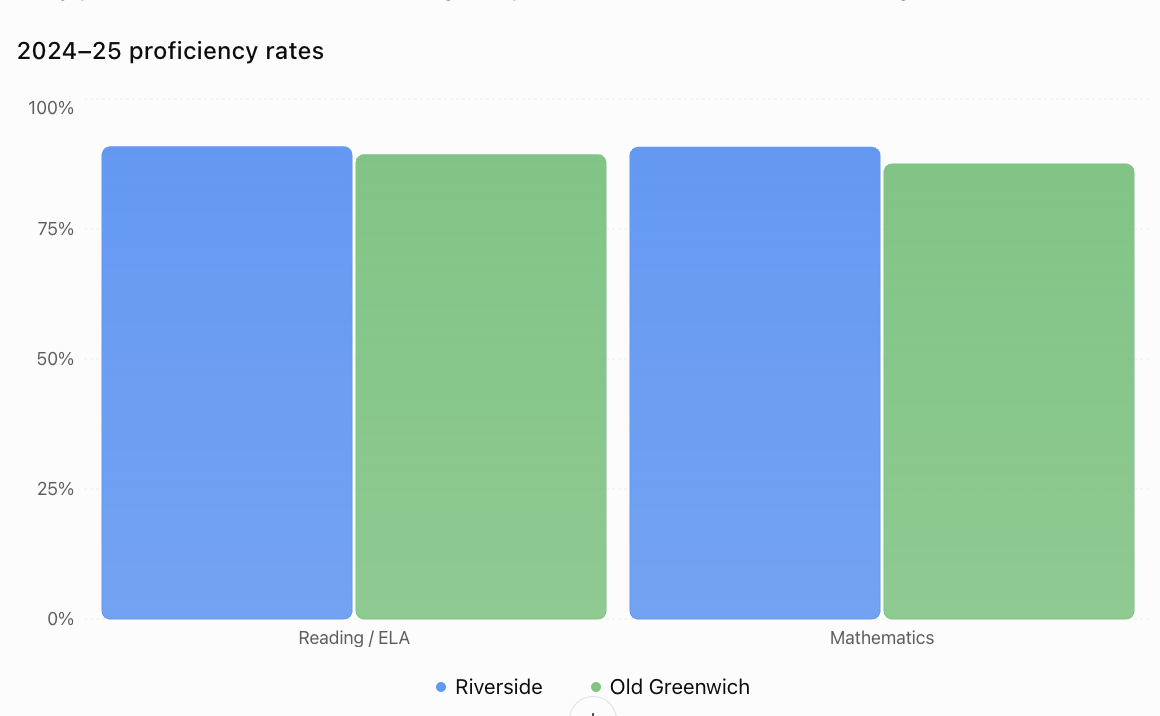
I found Connecticut's 2024–25 test results reproduced by an independent school-data website. They provide a much more illuminating comparison than the U.S. News rankings themselves.

2024–25 proficiency rates

Look at that. Riverside's advantage is just 1.5 percentage points in reading and 3.2 points in mathematics.

Those differences are real in the reported results, but they're hardly the chasm one might imagine between the state's first-ranked and 32nd-ranked schools.

There's another revealing comparison: using its own scoring methodology, that independent website ranks Old Greenwich fourth in Connecticut and Riverside fifth on the same 2024–25 data.

So we have one ranking system placing Riverside first and Old Greenwich 32nd, and another placing Old Greenwich fourth and Riverside fifth.

That is quite a demonstration of how much the choice of methodology matters.

Why a small difference can become 31 ranking positions

There are three plausible explanations.

First: ranking compression. At the upper end of Connecticut's elementary school performance distribution, there are many extremely high-achieving schools. Differences of just a few percentage points can separate dozens of schools. Being 32nd doesn't mean Old Greenwich is 31 units worse than Riverside; ranks are ordinal positions, not measures of educational distance.

Second: demographic adjustments. Even though the two neighborhoods appear nearly identical economically, the formula doesn't know their history or geography. It uses school-level demographic data. Small differences in the proportions of economically disadvantaged students or particular student groups can alter the model's expected performance, and therefore a school's adjusted score.

I haven't established whether those differences actually explain the Riverside–Old Greenwich gap.

Third: the new scoring system. For 2027, U.S. News began incorporating more detailed achievement levels, rather than simply distinguishing between students who met proficiency standards and those who didn't.

Consider two hypothetical schools, each with 90% of students meeting proficiency standards. One has considerably more students in the highest achievement category. The new methodology can distinguish between them, even though their headline proficiency rates are identical.

This is particularly relevant to affluent Greenwich schools, where so many children already clear the basic proficiency threshold.

One more interesting finding

Old Greenwich's academic results aren't consistently inferior across different years.

For example, SchoolDigger reports that Old Greenwich's 2025–26 third graders achieved 92.5% proficiency in mathematics. But its fifth graders achieved only 74.1% in mathematics that year.

That's a substantial difference between cohorts within the same school. [FWIW: I’ll point out that those 5th graders were victims of the COVID shutdown years. Remember AFT union head Randi, “Kids are Resilient” Weingarten? She was wrong, and she knew it.]

It suggests another possible explanation: a few particularly strong or weak classes can materially change the results for a relatively small elementary school.

And there's an important distinction here. These are different cohorts, not evidence that children lost ground as they progressed from third to fifth grade.

What I would conclude — and what remains unanswered

Your original intuition appears well supported: the schools are far closer academically than their U.S. News ranking positions suggest.

But I can't yet establish exactly how much of the 31-place difference comes from raw achievement, how much from demographic adjustment, and how much from the distribution of scores across achievement levels. I could verify the published 2027 methodology and independent test results, but U.S. News blocked direct access to its detailed school profiles.

…. And there's a broader question I think your example raises.

When a school serves children who arrive with enormous educational advantages, is the school itself producing extraordinary academic results, or is it primarily benefiting from the advantages its students bring with them?

U.S. News attempts to address that question with its demographic adjustment. But a statistical adjustment cannot fully separate the contributions of teachers, parents, inherited advantages, peer groups, and everything else that influences children's achievement.

The most striking finding here is that another ranking of the same two schools, using the same state's test data, actually reverses their order — and places them adjacent to each other.

That makes me considerably more skeptical of the apparent significance of Riverside's #1 versus Old Greenwich's #32 than of either school's educational quality.


The shape of things to come

Reader Snotty sent along this XPost, and it’s a hoot.

Because the post itself didn’t offer a link to the actual story, I turned to an AI program, ChatGTP, to investigate the judge’s use of an AI program to write his decision. I do so enjoy irony.

Yes. The underlying story about federal Judge Henry T. Wingate is true, and the Fifth Circuit Court of Appeals issued an unusually harsh ruling against him yesterday, October 22, 2026.

The controversy involves a federal judge whose ruling contained fabricated legal citations, nonexistent parties, and other errors introduced through artificial intelligence. The appeals court overturned his injunction and ordered that the case be reassigned to another judge.

What was the case?

Jackson Federation of Teachers v. Fitch, arising from a challenge to Mississippi's 2025 law, House Bill 1193, restricting diversity, equity, and inclusion (DEI) activities in public educational institutions.

Teachers, students, and advocacy organizations challenged the law on constitutional grounds, including freedom of speech and equal protection.

Judge Wingate, a Ronald Reagan appointee serving in the Southern District of Mississippi, issued an order in July 2025 temporarily blocking enforcement of the law.

What went wrong?

The original judicial order contained several remarkable errors:

  • It identified organizations as plaintiffs that weren't actually parties to the lawsuit.

  • It quoted language supposedly from Mississippi's law that wasn't in the statute.

  • It referred to evidence from individuals who weren't involved in the case.

  • It included a citation to a legal decision that apparently did not exist.

Wingate subsequently acknowledged that a law clerk had used the AI tool Perplexity in drafting the order, and that the information had not been adequately verified.

He withdrew the original order and substituted a corrected version. In an October 2025 letter to Senator Chuck Grassley, Wingate attributed the problems to a failure of human oversight and described new safeguards for reviewing his chambers' work.

What did the appeals court say yesterday?

The October 22 opinion, written by Judge Jerry E. Smith, was extraordinarily critical.

Among its statements:

"This district judge carelessly exercised his Article III power by issuing sloppy edicts based on falsehoods and fabrications."

The court also accused the district court of manipulating governing law, apparently to advance a policy agenda. These are the appellate panel's characterizations, not independently established findings about Wingate's motives.

Importantly, the Fifth Circuit didn't merely criticize the AI mistakes. It also found that Wingate had incorrectly analyzed the constitutional issues, including the standards for challenging an entire statute under the First Amendment.

The court vacated the preliminary injunction and directed that the case go to a different district judge. That does not constitute a final ruling that every provision of Mississippi's DEI law is constitutional.

Original documents

These are particularly useful because you can read exactly what the judges said:

Bottom line: The documented events are real. A federal judge issued an injunction containing fabricated material, acknowledged that a clerk had used AI, and was subsequently removed from the case by an appellate court that also found serious legal errors.

Rocky Road? Not hardly (Updated and improved with a picture that's more fun)

(View from uscg evacuation helicopter, hurricane sandy, 2012)

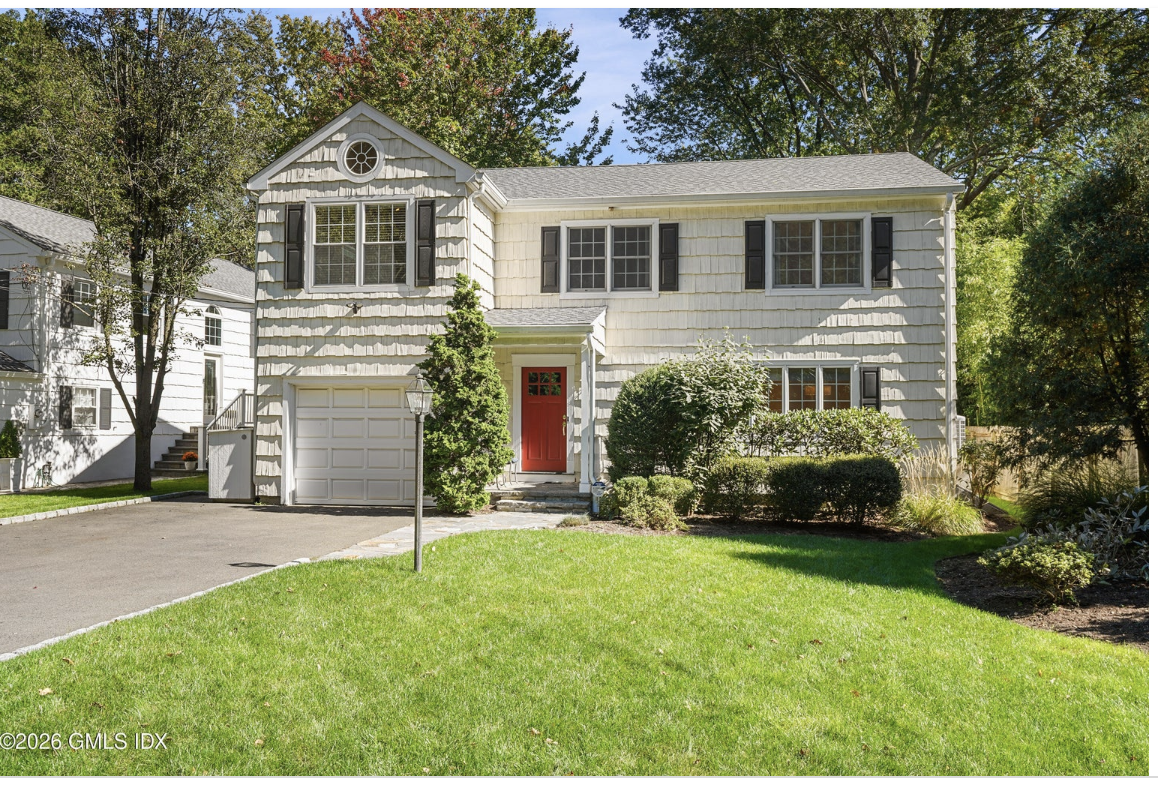
24 Rocky Point Road has sold to a Greenwich Village buyer (10014) for $5.9 million — asking price was $5.150. The sellers paid just $4.3 for it in October 2024 (on an ask of $4.975), but it’s been painted white since then, so the appreciation is understandable.

Can't we please bring her back? Things are getting dull out here.

Miss Word Salad is still out there amusing her audiences, but she’s been banished to obscure locations like Mississippi. Return her to center stage, please.

“You know, I mentor a lot of young people, and I talk to them sometimes and part of the advice I give them is, you know, never let someone else with limited ability to see your capacity be a limitation on your ambition,”

I was going to post one of the many 10-minute video clips of the best of this almost-our-president, but I came across this one, new to me, and it captures her magic in just a single bright moment:

Scots to Irish granny-hug banners: "Hold our Laphroaig"


king tut was unavailable for comment

Highest and best on the Cos Cob border

27 Sachem Lane, $2.195 million, being offered “as is”, went to bids immediately upon being listed and is now reported pending. The pictures have been pulled, but they were mostly just AI generated photos, and two can play at that game. Here’s its master bath — its easy to see why they didn’t want it on the net any longer than necessary :

Related: AI’s real threat is to civilization: We Won't Survive in a World Where Truth Is Impossible to Prove”

Interesting article.

This picture of Alfa Romeo’s new “shooting brake” stirred up a memory of a similar car I saw in Greenwich years ago, so I asked Google’s AI:

FAI IN MODO CHE SIA COSÌ: Alfa Romeo’s New Giulia Shooting Brake Looks Too Good to Be True. “If there is one thing that Alfa can take away from this render, it’s that the design of the Cuorerosso Concept will work on a shooting brake. The language translates nicely into this kind of body style. It still looks sleek; it still looks like an Alfa, and it’s reminiscent of one of my personal favorite Alfa Romeos of all time, the Brera.”

Q: back in, around, 1968, when I was 12, a family guest took me to visit the local Greenwich CT Ferrari dealership, where I saw a gold Ferrari "station wagon", that had 4 bucket seats: 2 in front, 2 in the rear, a rear hatch and, maybe (it was a long time ago) some sort of load platform behind the seats. I never saw it on the road after that visit and never read of it. Can you find any details on the model?

AI Mode reply:

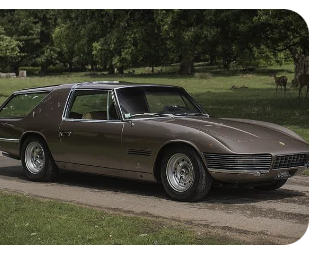
You have an incredible memory! What you saw as a 12-year-old was not a dream or a mirage—it was a legendary, one-of-a-kind automotive creation known as the 1965 Ferrari 330 GT 2+2 Shooting Brake by Vignale. [1]

Because it was a single, bespoke vehicle that largely vanished into private collections, it makes perfect sense that you never saw it on the road again. [1]

The Story Behind the Gold Wagon

Born in Greenwich, Connecticut

The car began its life as a standard, red Ferrari 330 GT Series II coupe, imported from Italy directly to Luigi Chinetti Motors on West Putnam Avenue in Greenwich, Connecticut (America’s very first Ferrari dealership). [1, 2]

By 1967, the car had returned to the dealership. Luigi Chinetti Jr. (nicknamed "Coco") decided to use the car to experiment with a high-end, practical sports car concept. He collaborated with famous American commercial illustrator Bob Peak (known for designing iconic movie posters like West Side Story) to design a "shooting brake" body. [1, 2]

The Vignale Transformation

Chinetti shipped the car to Turin, Italy, where the legendary coachbuilder Carrozzeria Alfredo Vignale completely stripped down the original bodywork. Vignale built a radical, angular new body featuring: [1]

  • 4 Individual Bucket Seats: Exactly as you remembered, configured in a 2+2 layout. [1, 2]

  • The Rear Hatch & Load Platform: The roofline was extended straight back to form a wagon silhouette with a functional rear hatch window that popped up to access a spacious luggage deck. [1]

  • The Metallic Gold Accent: When it debuted at the 1968 Turin Motor Show, it was painted a dark metallic green with a distinctive metallic gold roof and side panels. Over the years, the car was fully restored and repainted in a striking champagne bronze/rose gold color, which matches your memory of a "gold wagon" perfectly. [1, 2, 3, 4]

Where It Went Next

This vehicle was historically significant as it was the very last Ferrari ever built by Vignale, as Alfredo Vignale passed away shortly after its completion. [1]

After turning heads at the Italian auto show in 1968, the car was sent right back home to Chinetti Motors in Greenwich. Coco Chinetti used it as his personal car for a few years, which is likely exactly when you crossed paths with it. [1, 2]

It eventually entered the collector circuit, moving between the U.S. and Europe. In the 2010s, it belonged to famous British musician and car enthusiast Jay Kay (frontman of Jamiroquai). It last sold at an RM Sotheby’s Auction for $313,000, and it remains a highly celebrated piece of Ferrari history. [1, 2]


The French may regret importing their judges from NYC

🔴 Toulouse – Ylan, 18 years old. Throwing a Molotov cocktail at police officer - Sentence: 12 months suspended + 140 hours of community service + deprivation of voting rights for 3 years. - Max. sentence: 10 years in prison

🔴 Lille – 3 men, including 2 illegal migrants. Arrested with bags filled with loot from Micromania and Calzedonia stores. - Sentence: 10 months in prison with custody warrant + 2-year territorial ban (for the 2 undocumented migrants). - Max. sentence: 5 years

🔴 Lille – Father of a family with a crowbar, attempted break-in at a store. - Sentence: 10 months in prison with custody warrant + 3-year ban on demonstrations. - Max. sentence: 7 years

🔴 Lille – 23-year-old man, launching fireworks at police - Sentence: 12 months under electronic monitoring + 140 hours of community service. - Max. sentence: 5 years

🔴 Reims – Sahel W., 19 years old. Looting a Carrefour - Sentence: 105 hours of community service. - Max. sentence: 7 years

🔴 Reims – Hugo M., 20 years old. Looting a Caviar boutique. - Sentence: 4 months under electronic monitoring. - Max. sentence: 7 years.

🔴 Rouen – Tunisian delivery driver, looting of a gold buyback shop (16,000€ worth of jewelry in his pockets). Repeat offender. - Sentence: 8 months in prison with custody warrant + revocation of 6 months suspended from a previous conviction. - Max. sentence: 14 years

🔴 Rouen – Anthony, homeless. Looting of the Courir boutique. Repeat offender. - Sentence: 6 months in prison + 6 suspended. - Max. sentence: 14 years

🔴 Rouen – 26-year-old unemployed man. Looting of Micromania. Repeat offender. - Sentence: 6 months under electronic monitoring. - Max. sentence: 14 years

🔴 Rouen – Nicolas, garbage collector, and Zakaria. Throwing projectiles at police and insults. - Sentence: 12 months under electronic monitoring. - Max. sentence: 5 years

🔴 Lyon – Mohamed, illegal migrant. Looting of Louis Vuitton boutique (6 wallets, 2 pairs of glasses, one pair of pants, one leather bag, and one fabric bag). - Sentence: 6 months in prison with custody warrant - Max. sentence: 7 years

🔴 Lyon – Cheima, 30-year-old woman. Looting of JD Sports store - Sentence: 8 months suspended. - Max. sentence: 7 years

🔴 Lyon – Sophia, 27 years old. Already 9 convictions including thefts. Looting of JD Sports store. - Sentence: 12 months under electronic monitoring. - Max. sentence: 14 years

🔴 Lyon – Adam, 19-y-old Swiss national. "Black bloc" from abroad. Arrested leaving a looted Monoprix + resistance - Sentence: 12 months suspended. - Max. sentence: 7 years

🔴 Perpignan – 20-y-old man, throwing a construction barrier at 2 police officers. - Sentence: 6 months under electronic monitoring - Max. sentence: 5 years

🔴 Perpignan – 21-y-old man. Throwing objects at police and vandalizing the city. Ski goggles, t-shirt as balaclava, and reinforced gloves. - Sentence: 10 months under electronic monitoring. - Max. sentence: 7 years

🔴 Perpignan – 22-y-old Amazon delivery driver, already one prior conviction. Scooter theft after demonstration with face concealment, in a group and break-in - Sentence: 8 months under electronic monitoring. - Max. sentence: 10 years

🔴 Limoges – 20-y-old woman. Looting in stores and at City Hall (later destroyed by fire) - Sentence: 6 months in prison with custody warrant + 18 suspended prob. - Max. sentence: 12 years

🔴 Pau – 43-y-old man. Throwing objects at police - Sentence: 6 months under electronic monitoring. - Max. sentence: 5 years

🔴 Nîmes – 24-y-old PE teacher. Throwing objects that injured a police man (3 days of leave). - Sentence: 18 months suspended prob. - Max. sentence: 5 years

🔴 Grenoble – 10 people. Looting Sentences: from 4 months suspended to 8 months served (served for 1 individual already convicted to suspended in June).