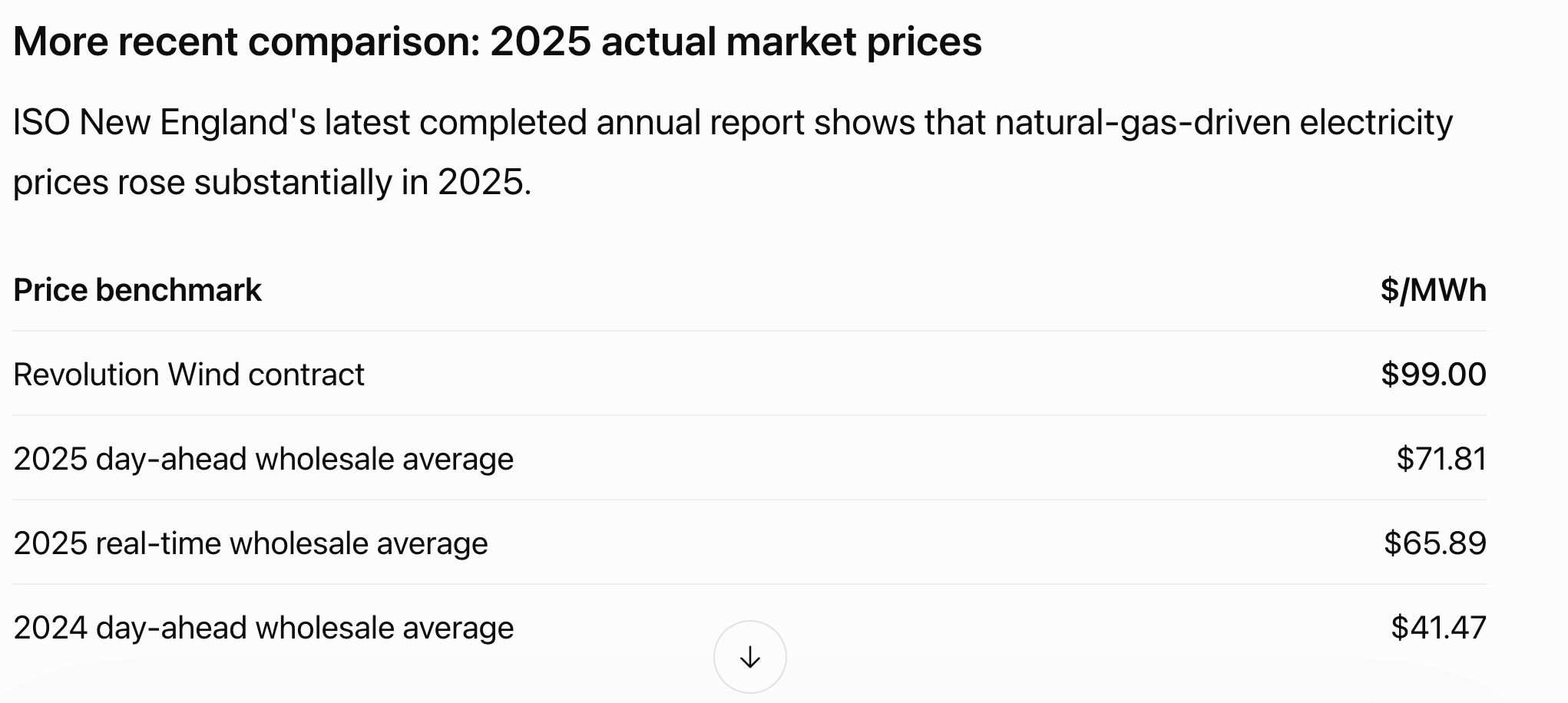
Using that benchmark, Revolution Wind's contract price is:
2.39 times as high, or approximately 139% more expensive.
$57.53 more per MWh than the 2024 wholesale average.
This comparison is useful but imperfect: the wholesale average includes electricity from natural gas, nuclear, hydro, wind, and other sources, while the wind contract also includes renewable energy credits. [Meaning it’s even more expensive than these figures show — ED]
More recent comparison: 2025 actual market prices
ISO New England's latest completed annual report shows that natural-gas-driven electricity prices rose substantially in 2025.
Against the more recent 2025 day-ahead market price, Revolution Wind's contract was 38% more expensive, rather than 139% more expensive using 2024 prices.
For a direct natural gas generation comparison, the U.S. Energy Information Administration reports that Connecticut power plants paid an average of $6.21 per million BTU for natural gas in 2025. At an illustrative combined-cycle heat rate of 7.5 million BTU/MWh, that translates into approximately $46.58/MWh in fuel costs alone, excluding plant operating expenses and capital recovery.
What ratepayers actually pay
There is another important accounting distinction.
Connecticut's contract is structured so that electricity and renewable energy credits are sold into the market. Ratepayers cover the difference when their combined market value is below $99/MWh, but receive a credit when it exceeds $99/MWh.
For example, if the combined market value were $70/MWh, the additional contract settlement would be approximately $29/MWh. That is not an additional $99 charge on top of the market electricity price.
DEEP projects that the contract could ultimately save Connecticut ratepayers $150–$200 million over 20 years, but that is a forecast, not a measured result.
Bottom line: Connecticut's contracted Revolution Wind price is $99/MWh, versus approximately $66–$72/MWh in New England's 2025 wholesale energy markets. Natural gas generation can be cheaper, particularly when fuel prices are low, but it is subject to substantial price volatility.
What is not yet established from the public information I found is Revolution Wind's actual cumulative MWh delivered since startup, together with the actual monthly net settlement paid by Connecticut ratepayers. Those figures would be needed to calculate the realized cost to ratepayers per MWh rather than relying on the contract price and historical market comparisons.