"Don't blame us, we were promised it would never snow again — and besides, the world ended in 2012, so this isn’t really happening."
/
Snow and cold scrambled CT’s power grid. Here’s how it stayed up. (Spoiler alert: nuclear, oil, and gas)
As more than a foot of snow fell on parts of Connecticut in the early hours of Jan. 25, a massive shift was taking place within power plants across New England.
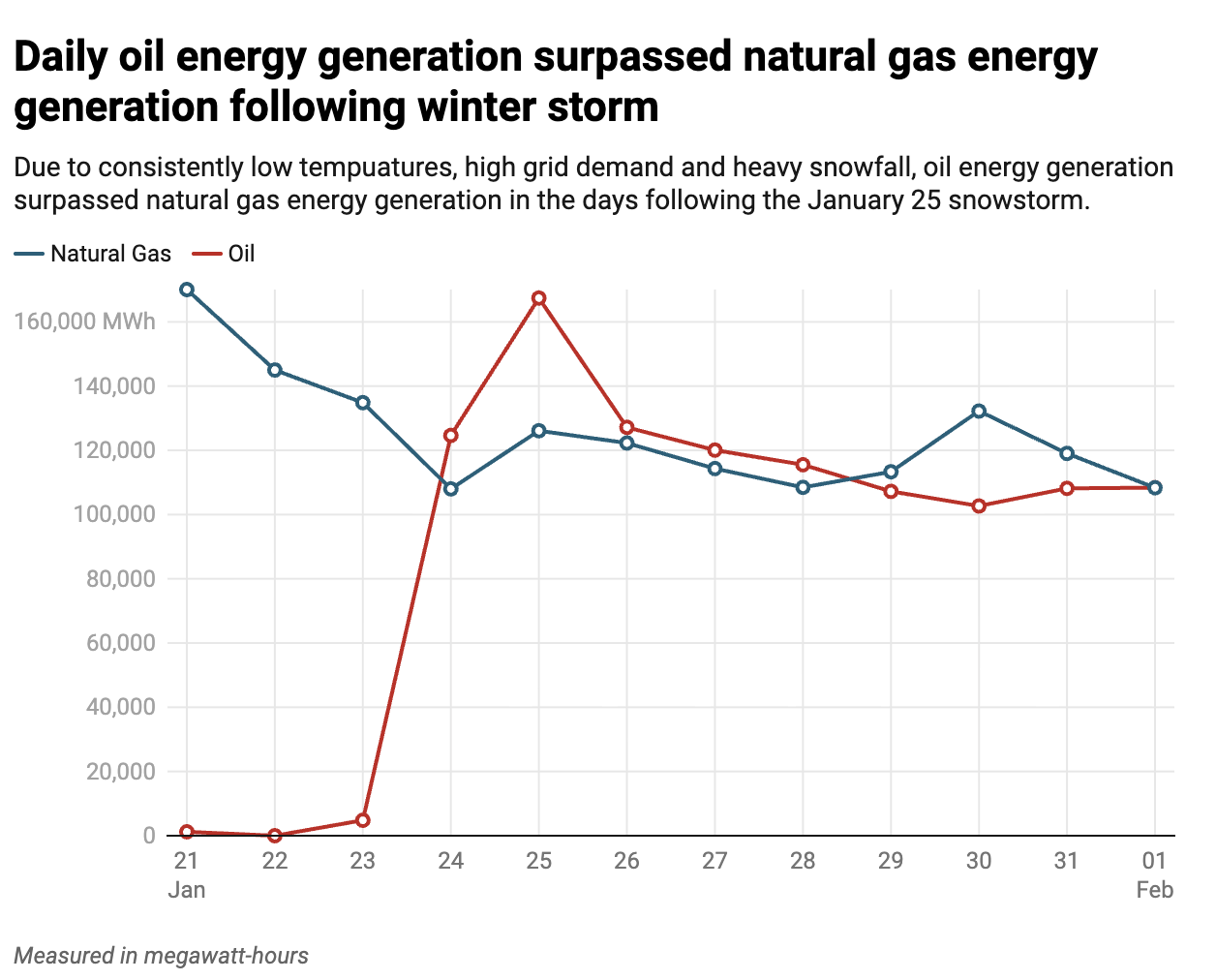
Oil-fired “peaker” power plants, left to idle for much of the year, were turned on as the need for power surged and the region’s fleet of gas-fired plants was unable to keep up with demand. At other dual-fuel plants, gas turbines were switched to run off stockpiles of oil, which is dirtier and typically more expensive to burn than gas.
Peak demand hovered around 19,000 megawatts for 10 straight days from late January into February. Matt Kakley, a spokesperson for the regional grid operator ISO New England, said it was the first time in nearly a decade the region saw such a stretch of high wintertime demand.
During that time, the region relied heavily on oil to produce electricity — a phenomenon that is not unusual for the occasional New England cold snap. But data shows that oil reliance lasted far longer than normal.
Frigid temperatures also prevented snow from melting off of solar panels, further scrambling the mix of resources needed to power the grid.
“I think what was kind of atypical is how long it went on,” Kakley said. “That level of long-duration cold snap we probably haven’t seen in New England since 2017-2018. And so what we’ve kind of been saying is that this is the most stressed the system’s been since then, so almost a decade.”
Others said that the sheer scale of the weather system — which at its peak stretched across 2,000 miles — made an impact unprecedented in recent memory.
“This has been the most logistically strained situation to get the right supplies to power plants that I have seen in my career,” said Dan Dolan, the president of the New England Power Generators Association. Dolan has worked in the industry for two decades.
Low temperatures pummeled the energy grid — in more ways than one
Throughout most of the year, New England relies heavily on natural gas brought in by pipelines to fuel its power generation. Whenever temperatures drop below freezing, however, the availability of that gas becomes constrained as it is burned in furnaces to keep homes and other buildings warm.
As a result, gas prices increase, making it less economical as a fuel source for power plants. That’s when the demand for oil kicks in.
Dolan said one of the unique challenges from this period of cold is that it affected power plants all along the Eastern Seaboard, not just in New York and New England.
As plants exhausted their supplies of oil to keep up with grid demand, they had to compete against other facilities in states like Maryland and North Carolina for fresh deliveries of oil via barge, trucks and tanker ships, Dolan said. Power plants in Connecticut typically utilize two types of oil: lighter, distillate oil is used by new dual-fuel plants, while older peaker plants tend to rely on heavier, tar-like oil also known as “bunker fuel.”
…. The spot market price for wholesale electricity in Connecticut skyrocketed multiple times during the winter storm, driven up by high demand and the compilation of constraints facing the grid. For example, on Jan. 24, the marginal price of electricity during one five-minute interval reached a peak of $872 a megawatt hour, more than five-and-a-half times the monthly average of $155. (Supply rates in electric bills are typically established through longer-term contracts for electricity, so customers are insulated from such price spikes).
Well, no one expected this. Snow in New England? Wow!
Data from ISO New England shows that the situation was compounded by the low functionality of solar panels. Extremely low temperatures curbed snow melt and stunted solar energy generation for days following the storm.
Mike Trahan, the executive director of Connecticut Solar & Storage Association, said such situations do pose a challenge for the industry, even though they are rare.
“Snow followed by cold can be problematic, especially for rooftop systems that sit flat on the roof. Those are the last ones to shed snow and reach their full efficiency,” Trahan said. “I think it’s accurate to say that this most recent cold snap was uncommon, and we probably haven’t had this kind of weather, based on what I read, in a decade.”
…
“The cold weather will drive natural gas prices high, and so that will make oil more economical. At the same time, demand on the system is higher because we’re not seeing as much as we did a week before from solar panels, because they’re covered in snow,” Kakley said. “We can see very cold weather without any snow, and that’s not going to impact the solar panels very much. But this was kind of a two-fer, so to speak.”
Not all renewable and clean-energy sources suffered as much as solar during the storm and subsequent cold weather. Nuclear performed at a near-constant output, meeting about one-quarter of the region’s demand.
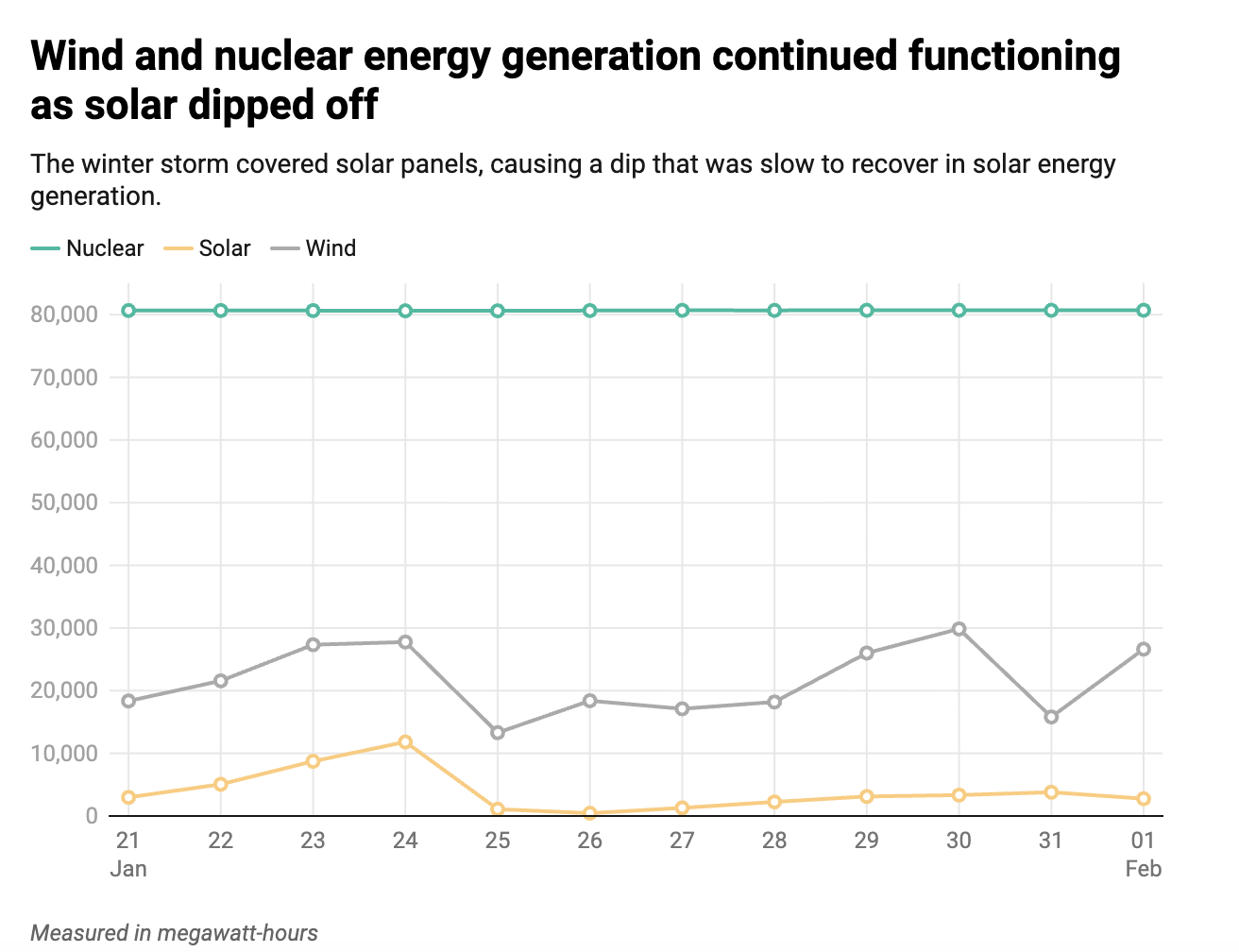
For obvious reasons — it would show oil-powered generation dwarfing both wind and solar production — oil’s contribution is left out of the picture above. Here:
Planning ahead
The complications paired with the storm bring up multiple questions, as well possible solutions for dealing with similar winter weather events in the future.
More battery storage — yeah, that’s the ticket!
For solar, Trahan said the impact from snow usually dissipates once it melts in a few days. Building more battery facilities to store that power for times of need would help the grid withstand temporary losses in solar production. He also said that would help to eliminate the need to burn oil during the coldest days of the year.
[See below — battery storage can supply 2, 4 hours of electricty, at most; not days, not weeks.]
Kakley said that ISO New England conducts rolling 21-day-ahead forecasts of weather and fuel supplies to ensure that generators have the resources necessary to keep their plants running.
“When you see this period of cold weather, if you get adequate replenishment of oil, you can kind of keep running the system that way for a long time,” Kakley said. “But where is that going to go? Are you going to use the oil faster than it can be replaced?
Dolan said there is “no silver bullet.” He said every little bit of extra energy generation helps, including renewables and new imports of hydroelectricity from Canada.
Why is there shortage of natural gas? Because throughout the east, state governments have blocked the construction on new pipelines, even, in New York State’s case, banned the importation of gas from neighboring Pennsylvania’s fracking fields, blocked the construction of CNG terminals in our ports, and shut down nuclear, coal, and natural gas power plants.
Batteries, eh?
These are results for how much battery storage would be required to supply New England and New York's electrical needs for a week,and how much presently exists?
AI Overview
Based on current energy consumption data and projections, supplying New England and New York’s electrical needs for a full week solely with battery storage would require a massive, multi-terawatt-hour (TWh) infrastructure, which is significantly beyond current or immediate planned capacity.
Required Battery Storage for One Week (Estimated)
To power both regions for one week without any generation (wind, solar, nuclear) during a "dark/cold" week, the requirement is immense:
New York (approx. 140 GWh/day): A one-week, 7-day outage would require roughly 980 GWh to 1,000 GWh (1 TWh) of storage capacity just for New York State.
New England (approx. 117,000 GWh/year): Assuming similar usage patterns to NY, New England would require a similar, if not higher, amount of storage.
Total Need: Combined, to cover a 7-day, 100% renewable/storage scenario, the region would need upwards of 2,000 GWh to 3,000 GWh of total energy capacity.
Note: Current battery technology is mostly 2-4 hour duration. A "week-long" supply requires "long-duration energy storage" (LDES) of 10-100+ hours, not standard lithium-ion batteries.
Present Battery Storage (As of early 2025–2026)
Currently installed capacity is focused on short-duration, 2-4 hour balancing, not week-long storage:
New York: As of early 2025, NY has around 445 MW of operational battery storage, with goals to reach 3 GW of bulk storage by 2030.
New England: Roughly 1,820 MW (1.8 GW) of battery storage cleared in the latest ISO-NE capacity auction for 2027/2028, with a much smaller amount currently operational.
Total Combined: The combined, currently operational capacity in both regions is well under 5 GWh, which is roughly 0.2% to 0.5% of the amount needed for a full 7-day backup.
Future Outlook and Planned Storage
New York has over 11 GW of planned battery projects in their interconnection queue as of February 2026.
New England requires 10-12 GW of long-duration (10+ hours) storage by the 2040s to meet decarbonization goals.
Regional Need: Experts indicate that to maintain reliability, the region needs 23 GW of multi-day storage by 2050.
The current strategy relies on short-duration batteries for grid stability and keeping natural gas or nuclear plants for long-duration, week-long outages (cold snaps).