Back in the 80s, Microsoft had zero lobbyists in Washington. Clinton's DOJ sued them on anti-trust grounds, and by the time the dust cleared, the company had 100 + lobbyists in the swamp
/
Stephen Green:
The AI 'Pause' Might Not Be What You Think it Is
Anthropic co-founder Dario Amodei shocked the world this weekend with an essay arguing that "We must slow the pace" or even "pause" AI development, including a call for government regulation "focused on keeping capabilities in balance with safety." More shocking was that Amodei's call was echoed by OpenAI CEO Sam Altman and X owner Elon Musk.
But I wasn't shocked. I've heard this tale before — from the other side.
In the waning weeks of the Biden Cabal, billionaire investor Marc Andreessen described administration efforts to effectively cartelize the AI industry, putting it tightly in Washington's grip.
According to Andreessen, Biden officials told him that "AI is going to be a game of two or three big companies working closely with the government."
"We had meetings in DC," he went on, "and the meetings were absolutely horrifying. They said, look, AI is a technology basically, that the government is going to completely control. This is not going to be a startup thing. They, they actually said flat out to us, don't do AI startups like, don't fund AI startups. It's not something that we're going to allow to happen."
So far, so fascist. But it gets worse.
Andreessen also said, "I'm paraphrasing, but we're going to basically wrap them in a government cocoon. We're going to protect them from competition, we're going to control them, we're going to dictate what they do."
The most powerful software in the world, under the control of a multitrillion-dollar Deep State.
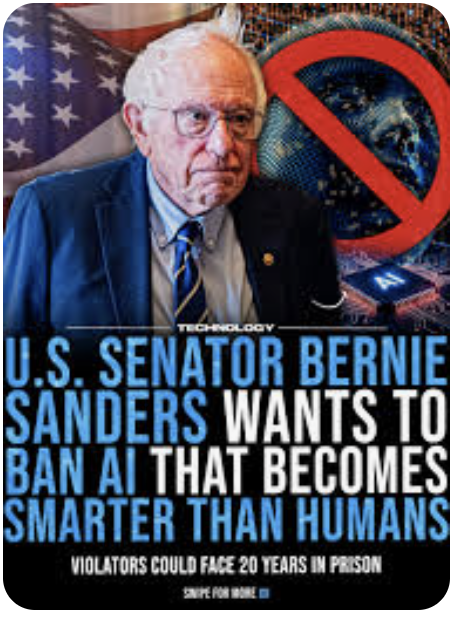
…. That isn't to say there aren't dangers inherent in AI, or that some regulation isn't called for. What I am saying is that you don't want it under the control of unelected bureaucrats working hand-in-hand with the likes of Sen. Bernie Sanders (CPUSA-Vt. Oblast) or up-and-comers like Abdul El-Sayed.
…. But in AI terms, 2024 was at least a decade ago, and the industry has troubling new powers and — believe it or not — some seemingly insurmountable challenges. The one challenge readers here should already know about is AI's insane and never-ending capital requirements. Capital expenditures on the data centers and everything else amounted to about $450 billion in 2025, are projected to reach roughly $700–870 billion this year, and are forecast to reach a trillion or more in 2027.
ONE. TRILLION. DOLLARS.
You might think that kind of spending would generate massive returns and lock-in from customers, sometimes called a "moat." Think of the difficulties involved in switching from iPhone to Android or vice-versa — data, apps, subscriptions... ugh, what a pain. That's the moat encircling Apple and Google's competing operating systems.
In AI, however, not only are there no moats, you can increasingly roll your own.
And Another Thing: You should see how Rahm Emanuel got roasted in the replies and in the Community Notes to this post claiming, "I can tell you when the last time a CEO or an industry at large asked to be regulated: never." Except that it happens all the time, going at least as far back as railroads in the 19th Century using federal regulations to guarantee their profits.
….. According to investor "Ayush" on X, Latham & Watkins is "building an in-house AI stack" to run on world-class Nvidia servers that they now own. As a result, the company will soon have "open-weight models it can fine tune," along with "infrastructure only Latham employees can access."
Worse than "robbing" some big AI firm of all that revenue, Latham & Watkins will also deny them the data they need to help build next year's models.
Anthropic lost an estimated $5.2 billion last year, even before companies like Latham & Watkins started rolling their own. What Anthropic needs is a moat, and those usually come courtesy of Big Government. Think of taxi medallions, franchise laws, or pretty much any profession requiring a government license. All are examples of regulatory capture, where private interests use government to feather their nests.
So when I see the chiefs of a money-losing industry begging to be regulated, it makes me think less of the dangers of rogue AI's, and more about the dangers of private interests entrenched by government fiat.
Beware AI. But beware even more a "partnership" between AI and DC.
The combination of China funding the protests against data centers and now this current anti-AI hysteria while building its own systems as fast as they can steal them, socialists like Bernie Sanders, Obama, and Mamdani clamoring for a government takeover, and the largest AI players demanding their industry be regulated by Washington so that their lobbyists can go to work, the actual risks of AI pale in comparison.