How'd she ever drive there from Florida?

But she did get a free tow back home

But she did get a free tow back home

WALHALLA, S.C. — A South Carolina woman who police say was driving drunk will not be cited with a DUI because her vehicle of choice was a toy truck.

News outlets quote police as saying that instead they charged 25-year-old Megan Holman with public intoxication.

They say they spotted her cruising down the road in a Power Wheels electric toy truck after a caller reported a suspicious person on the street.


Our tech masters are gearing up to shut down opposition before the 2020 election

fahrenheit-451-ray-bradbury-throw-blankets.jpg

Following in the footsteps of Facebook and Twitter, and YouTube, Pinterest is now shutting down conservative voices. The latest to fall is PJMedia. PJMedia would in a normal world be considered a slightly conservative site; no conspiracy theories, no white power screeds merely a refusal to follow the dictates of New York Times editorial writers.

The crazies are determined to never let a Trump happen again, and they’ve been waging an all-out war against him since the election, using traditional mainstream media. But we rubes are still being corrupted by insidious messages communicated via social media, and so the battle has shifted there (as well as refinements in the censorship power of traditional news outlets; I’ve noticed an increasing tendency for online branches of newspapers to block comments on “sensitive” subjects, like the massive swarm of African refugees who have invaded Portland, Maine, for instance, and gun control, just as two examples). Here’s most of the PJMedia report:

This week we learned from a brave whistleblower that Pinterest, a site known primarily for recipes and home decorating ideas, is blocking content from websites that their Orwellian-monikered Trust and Safety team in San Francisco find offensive—by dishonestly labeling them as po*n sites. PJ Media is one of several conservative sites being blocked by the platform.

What was revealed at Pinterest this week, however, is just the tip of the censorship iceberg—and things will likely only get worse as our nation becomes increasingly polarized and the Big Brothers of Big Tech become more emboldened and less secretive about their hostility toward conservatives.

First, let's review what we learned this week. Project Veritas highlighted the blacklisting issues involved, which include:

 Insider: Search Term “Christian” Won’t Auto-Complete, Others Can’t Trend, No Notifications, or Recommendations

 Pinterest Blacklisted Pro-Life Group LiveAction.org, Classified as “Pornography,” Cannot Link to Site

 Leaked “Sensitive Terms List” Includes “bible verses” and “christian easter”

 Ben Shapiro Commentary Censored in “zero tolerance moment,” Slack Messages Reveal

 Planned Parenthood Undercover Videos Marked as “harmful” Conspiracy

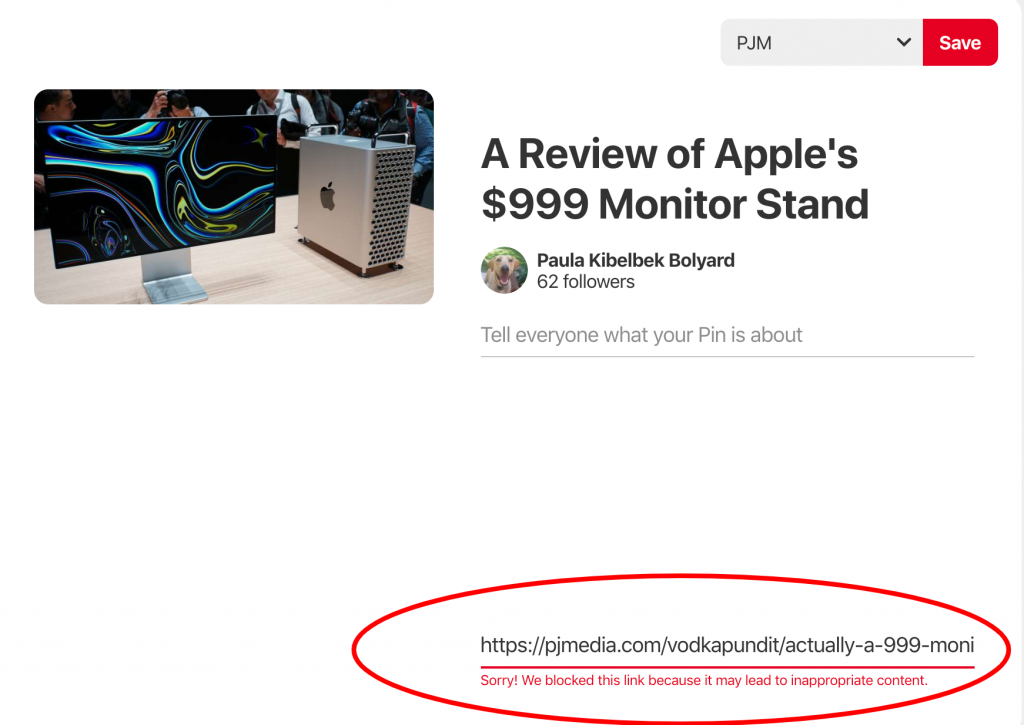
I navigated over to Pinterest—which went public in April of this year, raising $1.5 billion in its initial offering—to find out if PJM has been blacklisted and indeed it appears it has. I tried to "pin" several of our articles there, including Stephen Green's completely innocuous and apolitical review of Apple's new monitor stand and sure enough, Pinterest blocked it due to "inappropriate content."

apple review.png


PJM's Debra Heine tried to post a link to a PJM article about a Trump rally and got the same message: 

pinterest block.png

Worse, when I tried to add an image to the pin and clicked "save from site," which ordinarily brings up images from the website you're linking to, I got this message:

Screen Shot 2019-06-14 at 5.10.29 PM.png

Of course, we don't allow nudity on PJM—in fact, it is our editorial policy to blur it out when it appears in an image that is necessary to explain a story. We are not a po*rn site either, although we do write about it from time to time, most often in the context of pointing out its deleterious effects on the culture and on the relationships between men and women. That doesn't stop the Big Brothers of Big Tech from categorizing us that way in order to shut us up.

PJM reached out to Pinterest for an explanation but received no reply.

If you think Pinterest is alone in this dishonest blacklisting of conservative sites, I've got some swamp land to sell you. As we've seen in report after report after report after report, the social media platforms—owned and run almost exclusively by far-left ideologues who think "conservative" is a synonym for Hitler—are quietly working behind the scenes to silence opinions they find detestable, and like Pinterest, they're using sneaky little coded labels to keep conservatives off their platforms. On the front lines of the war to control the marketplace of ideas are the issues of abortion and LGBTQ rights. The cultural and sexual revolutionaries will brook no dissent on these two issues, believing that those on the conservative side deserve not only censure but exclusion from the marketplace. 

I see that Greenwich Library has selected “Fahrenheit 451” as the community book read starting this fall. That could lead to some interesting, if heated, discussions on censorship.

Large sale on Clapboard Ridge, and a quick one

190 clapboard.jpg

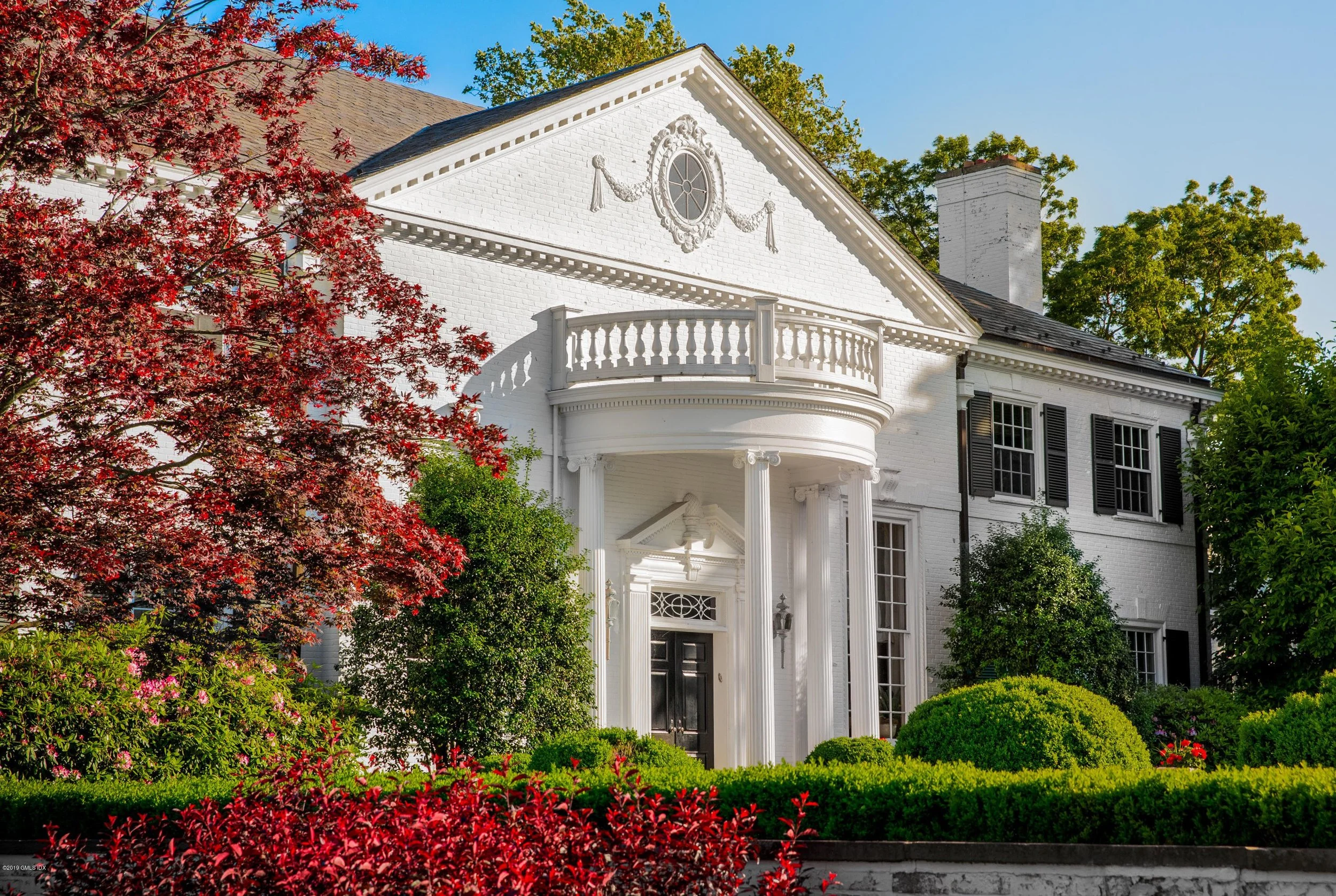
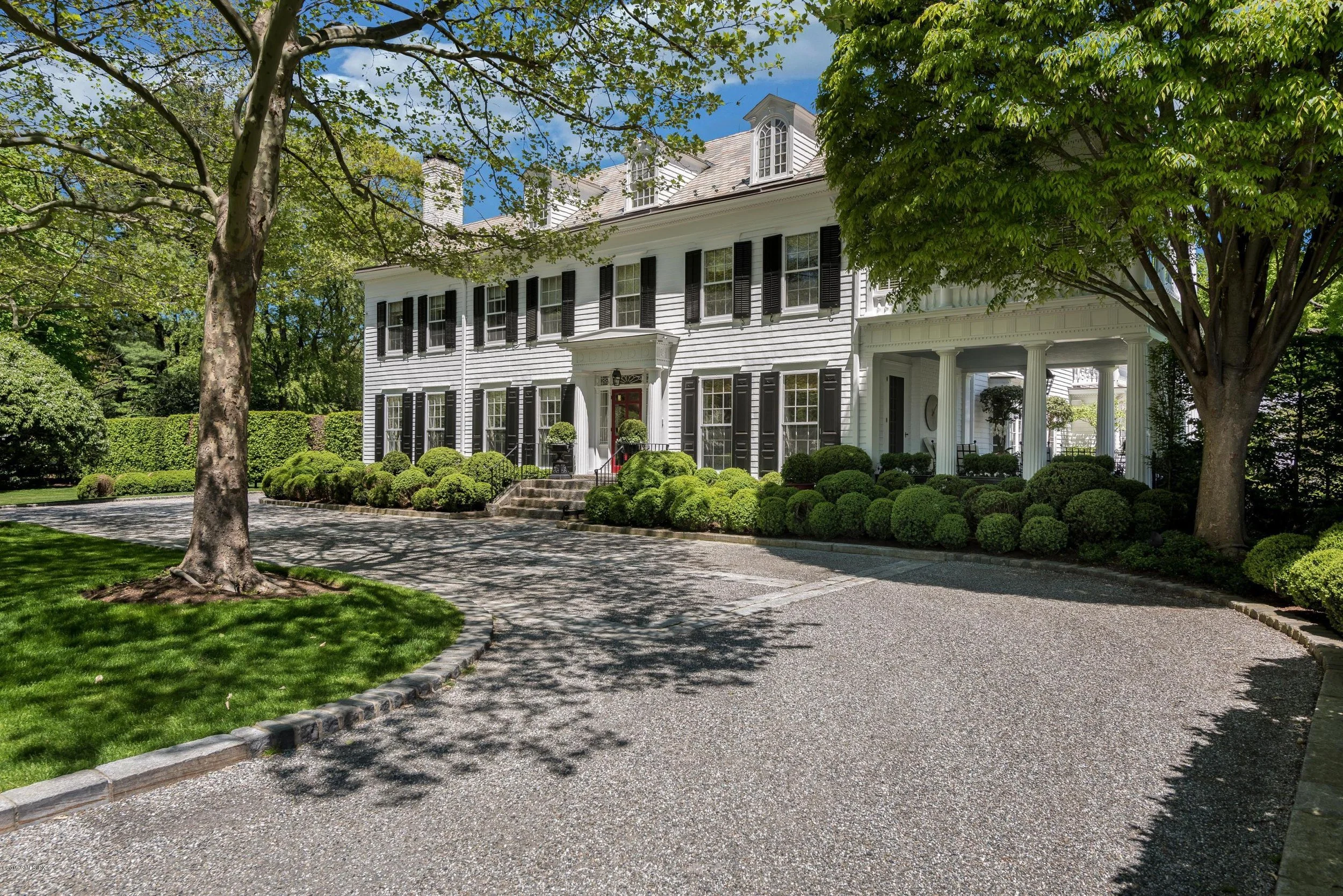
Who’d have guessed? 190 Clapboard Ridge (the Round Hill side) has sold for $6.6 million, almost its $6.790 asking price, and after just 18 days on the market. Built in 2012, this house’s design baffles me, and the interior design motif of bare wood leaves me cold, but someone obviously likes both, and bless her heart, was willing to spend a lot of money to prove it.

kitchen sink.jpg
kitchen.jpg

By golly, you can still sell a building lot in Conyers Farm

1073 Lake.jpg

1073 Lake Avenue has sold for $6.050 million, a disappointment, perhaps, to the seller, who originally listed this for $12.9 million, but a sale nonetheless. I‘m having a bit of trouble deciphering the listing: it’s officially two lots, with two separate building sites, but the listing seems to imply that the owner who builds here will want to use both to build one home. And how much of its 45 acres is underwater?

Whatever. Here’s a promo film featuring the listing agent and builder Matt Mathews, who over the past two or three decades built many of the houses in Conyers; he builds a quality home, and knows the territory.

Will anything ever be built here? Who knows? Conyers land buyers seem to change their mind about building after plans are drawn up, but this one may buck that trend.

Close the book on this chapter

lake.jpg

We’ve been following the fortunes of 781 Lake Avenue (nee 16 Old Mill Road) since it hit the market in 2015 at $17,350 million, and recently reported it as pending, when it was asking just $8.450. It closed today at $7.6.

The owner of 205 Round Hill Road, who put her own, somewhat similar house up for sale yesterday at $15.950 million, might want to reflect on this one’s fate; I’m guessing she’s off the market by ten million, too.

In today's political climate it might be wise not to mention the connection

21 vista.jpg

The Donald’s “starter home” at 21 Vista Drive is back on the market again, this time priced at $38.5 million. These owners have been trying to unload it, off and on, since 2009, when they asked $50 million. They raised it to $54 in 2014, and when that, somewhat surprisingly, didn’t work, dropped it to $45 million. It’s a great piece of waterfront property; not so sure about the house itself.

Town and Country has a spread, including a picture of the young Donald standing on the grand stairway with the house as he liked it. I’m sure most of us would, but these owners, sadly, have stripped the gold flake and otherwise toned things down a bit.

This may take a while

205 round hill rd.jpg

205 Round Hill Road is new to the market today, priced at $15.950 million. Parts of it were built in 1820, and all of it’s been decorated to reflect that era; that’s not a popular look, these days.

There haven’t been many sales in the $15 million, non-waterfront market in the past years, but 547 Lake Avenue did sell for $14.9 in August, 2015. The buyer for 547 Lake is very much not the buyer for 205 Round Hill.

Taxes on 205 are “only” $49,000, because the town assesses it at $6,189,200. Someone, either this owner or the tax department, is confused.

Here are some interior shots of 547 Lake Avenue, by the way. They remind me of Phil Sheridan’s comment about Texas: “If I owned Texas and Hell, I’d rent out Texas and live in Hell”. The general said that before the introduction of air conditioning, so perhaps his opinion of 547 might be more positive were he to see that the place has central air.

Screen Shot 2019-06-12 at 5.31.19 PM.png
Screen Shot 2019-06-12 at 5.24.10 PM.png
Screen Shot 2019-06-12 at 5.23.53 PM.png
Screen Shot 2019-06-12 at 5.24.24 PM.png

"Isn't it cute, dear? The peasants are recyling!"

lightbulb.jpg

Alexandria Ocasio-Cortez and her fellow socialists’ wet dream: Venezuelans are repairing lightbulbs.

Venezuelans turn to reusing, repairing old items to survive economic crisis

Each day, González sits at a market kiosk in Caracas and repairs broken light bulbs for people who can’t afford new ones in the crisis-torn nation.

“I feel that with this I help the community, because these light bulbs are super expensive nowadays. I help myself as well,” said González, who learned how to disassemble and rewire a bulb while spending several years in prison for theft.

According to her calculations, a new compact fluorescent bulb can cost the equivalent of several dollars in Venezuela’s nearly worthless currency — or about a month’s wages. Even so, the quality is so poor they could last as little as a week.

It’s an Associated Press report, so of course there’s no mention of what on earth could have happened to this once-prosperous country to reduce it to such ruin. But the AP did manage to find one person who saw a silver lining in the dark cloud of disaster:

For Elizabeth Cordido, a social psychologist at Metropolitan University in Caracas, attempts by Venezuelans to survive by recycling items that would otherwise be thrown out is, in one sense, positive.

But she said “it is very negative that it’s through poverty and the increase of poverty that we have arrived at this.”

Well yes, that’s a negative.

Did you notice? The Internet ended one year ago today

No more Internet!

No more Internet!

Except somehow it didn’t.

I & I Editorial

It’s been a full year since the FCC repealed “net neutrality.” And how have the predictions of doom and gloom held up? 

In the short time these Obama-imposed rules were in effect, the regulations suddenly became the only thing standing between a vibrant internet and a hellscape of greedy Internet Service Providers blocking access to sites, creating slow lanes, making it impossible for new entrants to get a foothold.

From every corner of the news media and advocacy world, we heard how repealing these onerous rules “would be the final pillow in (the internet’s) face” (The New York Times), would cause “erosion of the biggest free-speech platform the world has ever known” (ACLU), and would be “end of the internet as we know it” (CNN).

One of the Democratic commissioners on the FCC predicted that the net neutrality repeal would “green light our nation’s largest broadband providers to engage in anti-consumer practices, including blocking, slowing down traffic, and paid prioritization of online applications and services.”

Net neutrality’s advocates were so fearful of the internet’s demise that they staged numerous protests, and even issued death threats to FCC Chairman Ajit Pai.

Thankfully, Pai and the other non-ideologues on the commission prevailed. And the rules imposed by Obama, which had been in effect for all of a year or so, were overturned. That repeal officially went into effect on June 11, 2018.

Well, here we are, one year later. 

The internet is still functioning. In fact, it’s better than ever. Last year, average internet download speeds shot up almost 36%, and upload speeds climbed 22%, according to internet speed-test company Ookla in its latest U.S. broadband report.

There are more users than ever. More videos to watch. More content to consume. More commerce being conducted. No sites are being blocked. No one is complaining that their service is being throttled. And more people are gaining access to broadband.

During President Trump’s first year in office, in fact, the number of people without access to a broadband connection dropped by 18%.

Meanwhile, the 5G era approaches, which will increase speeds — for mobile and fixed broadband — exponentially while injecting more competition among providers.  Elon Musk’s SpaceX has started launching mini-satellites for his Starlink initiative, which will provide broadband internet to subscribers wherever they are on the planet. 

It all means more competition among ISPs for consumers. Since the entire justification for government intervention was the (dubious) claim that there’s no competition among internet service providers, these developments alone doom the case for a heavy-handed scheme of government regulations imposed in the name of the consumer. 

And as to the warnings about free speech: To the extent that free speech is being impeded on the internet, it isn’t coming from the Internet Service Providers like Comcast or Cox, but from Big Tech companies like Facebook, Google, YouTube, and Twitter. They, not the ISPs, are the ones restricting access to content they don’t like, removing it altogether, or making it unprofitable.


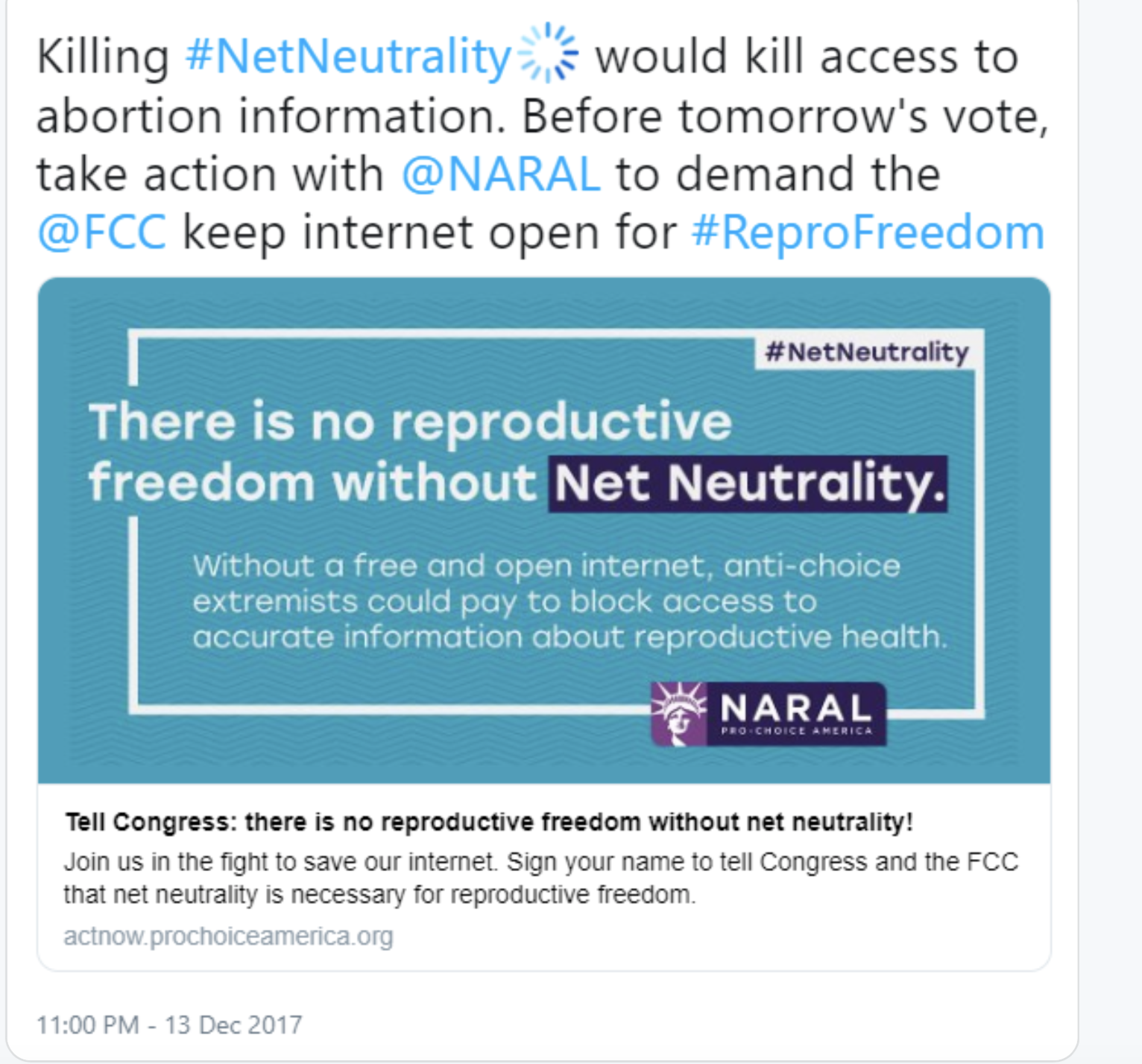
There’s a similar thread here, with lots more dire predictions. This one’s my favorite:

Screen Shot 2019-06-11 at 6.27.13 PM.png