Sad news for any Jaguar enthusiast (ahem) to wake up to on Christmas morn (Christmas Mourn?)

That’s all there is, there is no more

Stupid Stupid Stupid: Jaguar stops production of the last vehicle it will ever sell

Jaguar’s last ever petrol car came off the assembly line at the brand’s Midlands factory on Friday (19 December) ahead of its daring switch to all-electric vehicles next year.

The final Jaguar model with a combustion engine under its bonnet is an £80,000 high-performance F-Pace SVR SUV finished in black paint, according to the Jaguar Enthusiasts’ Club, which was in attendance as the Solihull factory officially signed off its last petrol model.

Under the bonnet is a burbling 5.0-litre supercharged V8 petrol engine – a stark contrast to the first ‘new Jaguar’ that will debut next year, which is a near-silent four-door GT that will cost almost twice as much, with a quoted £120,000 to £140,000 starting price.

While parent group JLR made no official announcement of the event, the Jaguar Enthusiasts’ Club says the final model is being gifted to the Jaguar Daimler Heritage Trust in Gaydon, where it will be retained as a museum piece.

The club said Friday was a ‘quiet, historic full stop’ for Jaguar’s 90-year relationship with the internal combustion engine.

It’s the next logical, albeit final step for a company that produced this ad:

Poor Fella

This should make you angry — it does me

Editor’s note: the Fountain family receives only a small royalty from Messrs. Hssan and Ali for use of our name — we are not otherwise — well, mostly not — certainly, not a whole lot — involved in its operation.

The Bangor Daily News published a weepy opinion column two weeks ago, denouncing Trump and bewailing the curtailment of some of the millions in cash currently being handed out to special-ed professionals. This paragraph, revealing the percentage of children currently diagnosed as “special needs” and the growth of those diagnoses, caught my eye, and caused me to save the article in my draft folder:

In 2021-2022, 33% of Maine children had diagnosed mental, emotional, or behavioral conditions. This is 14% higher than the previous year, 27% higher than 2017-2018, and well above the national average of 24.5%.

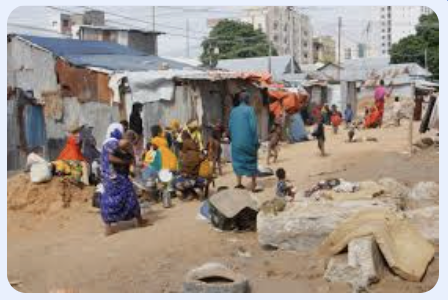
What can explain this huge increase in mental illness among Maine’s children and children across the country? It could be due to too many bowls of Fruit Loops or too much time spent on cell phones, but easy money, and plenty of it, surely plays a part. Even worse, whether the increase is real or not, the amount of cash that’s being shoveled to “treatment centers” with no oversight or accountability is guaranteed to generate fraud on a massive scale. Burning Madoff alerted me to the following article from Minnesota, and, like similar schemes in Maine, it involves Somalis, but they are certainly not the only crooks to spot this unguarded treasure.

The article is about just one phony treatment center that’s scammed $2 million in just two years. Multiply that by hundreds of other cities, thousands of federally and state-funded centers, and the fraud will add up to billions of dollars. And neither the federal government, nor the individual states or flying monkeys of the press paid any attention to the thievery whatsoever until they were finally forced to when the Minneapolis scandal surfaced after years of ignoring and suppressing reports from independent news sources.

Until Trump, and the media and political hacks (looking at you, Chris Murphy) have responded by denouncing the “cruelty” of stopping even a penny of these payouts, and suing to keep the cash flowing.

EXCLUSIVE: Autism center with little on-site activity received $2 million in taxpayer funds 

Excerpts:

A Medicaid-funded autism program has seen an explosion in growth over the past four years, to the point where federal prosecutors say "the fraud has overtaken the legitimate services." DHS confirmed 85 open investigations.

As Minnesota reels from one fraud bombshell after another — autism therapy costs exploding into the hundreds of millions, a $100 million housing program shut down over phantom claims, and new allegations of taxpayer dollars reaching overseas terrorist group Al-Shabaab — Alpha News continues to receive a flood of tips from residents who say something in their community doesn’t look right.

One of those tips arrived over the summer about a taxpayer-funded autism therapy center in Burnsville that has billed the state nearly $2 million since October 2023. Yet a neighboring business owner says the facility is almost always empty, and weeks of surveillance footage reviewed by Alpha News appears to back that up.

Tip about Burnsville autism center

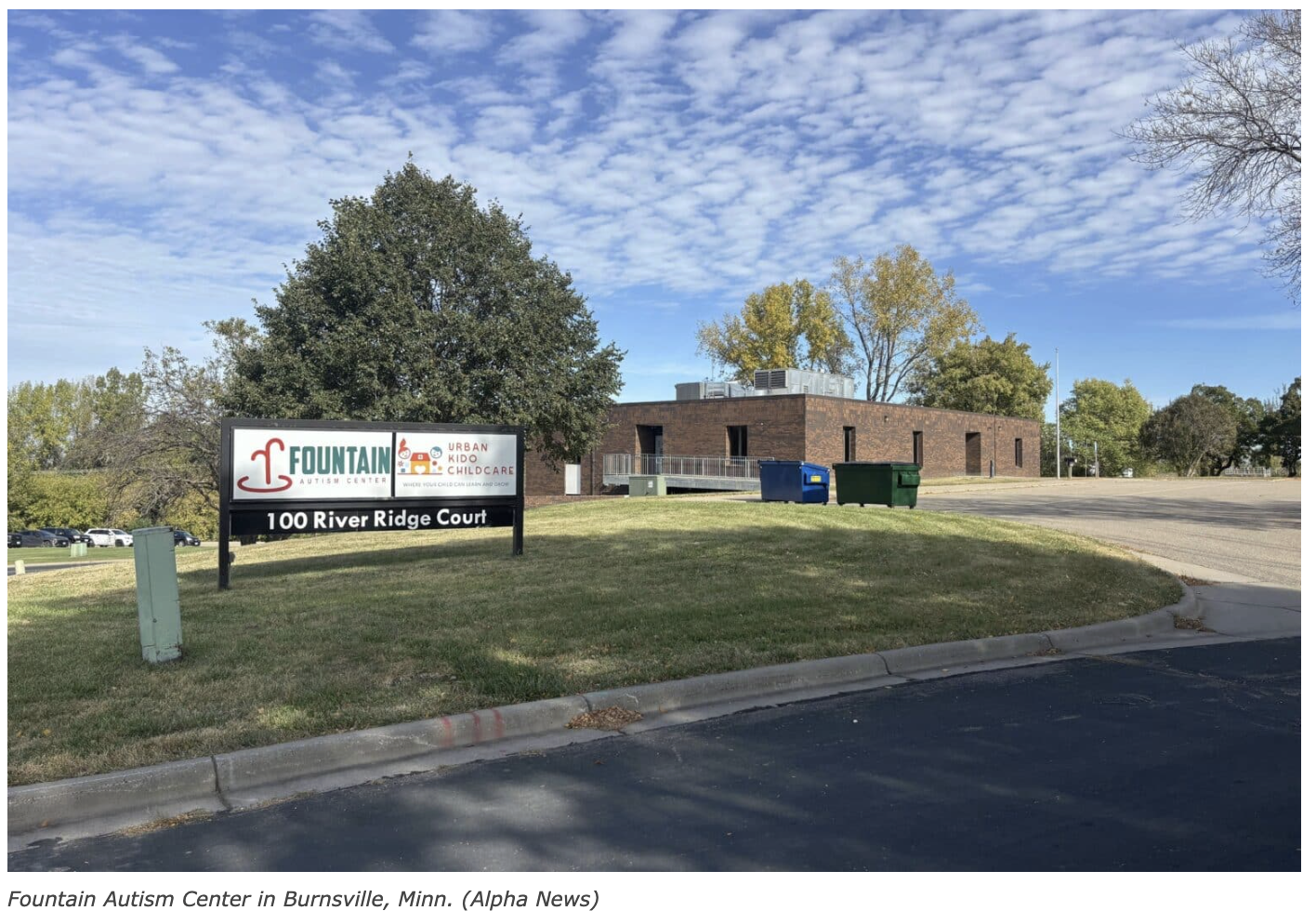
Fountain Autism Center LLC is owned by Sharmake Hassan and Sacdiyo Huruse Abdi Ali. [

The business posts hours of 10 a.m. to 7 p.m. weekdays and 11 a.m. to 6 p.m. weekends, according to signage on its front door, but a neighboring business says it rarely appears open.

“No one is ever there,” a nearby business owner told Alpha News. “It just doesn’t add up when you see how much money they’re getting from the state.”

The business owner, who has owned property near Fountain Autism Center for roughly 20 years and asked to remain anonymous out of fear of retaliation, said he and other nearby tenants have long joked that it’s a “fake business” because of the lack of visible activity.

Alpha News reviewed weeks of video footage of the entrance to the Burnsville autism facility. The video showed only a few cars and individuals ever entering or leaving the center over a span of weeks. The parking lot, which has about a dozen or so spaces, remained mostly empty during normal business hours, according to the video reviewed by Alpha News.

Inside the building 

Alpha News visited Fountain Autism Center during posted business hours and found only one employee present. She offered a brief tour of the facility, which included multiple therapy rooms and a kitchen, but there were no children or additional staff on site.

Asked why the building looked empty, she replied, “Most of them come after school.”

Asked how many clients the center serves, she first said, “A good ten,” then added that “most of them come after school or they do like in-home services.”

However, surveillance footage reviewed by Alpha News from multiple weekdays after school hours did not show an influx of children or staff entering the facility.

The employee also confirmed the center primarily accepts Medical Assistance and UCare clients.

In a follow-up phone call, the same employee said the center currently serves “four” children in person.

No license required despite millions in taxpayer funding

According to public state payment records, Fountain Autism Center has received at least $1,978,763 in taxpayer-funded reimbursements since October 2023.

Yet despite taking in millions, the center does not need a state license to operate. That’s because businesses in Minnesota’s Early Intensive Developmental and Behavioral Intervention (EIDBI) program are not required to be licensed.

The EIDBI program, which provides services to people under the age of 21 with autism spectrum disorder, itself has come under scrutiny amid widespread fraud concerns. The Minnesota Department of Human Services (DHS) told Alpha News there are currently 85 open investigations of EIDBI autism providers. DHS labeled EIDBI a “high-risk” provider type earlier this year.

Felon with four drug convictions helps oversee treatment 

As part of its investigation into Fountain Autism Center, Alpha News learned that one of main clinicians in charge of treatment is a four-time convicted felon, according to public records.

Tracy Lee Doerr is the center’s Qualified Supervising Professional (QSP) — the clinical authority responsible for designing treatment plans and overseeing autism services. He also has a criminal history that includes four felony drug convictions, a misdemeanor conviction for domestic abuse-violate order for protection, and two DWIs.

Asked about his criminal history, Doerr said his convictions should be considered an asset, stating: “Yes, I do have a criminal record, which I believe contributes to my growth and perspective as a clinician. It has helped me develop empathy and a broader understanding of the human experience,” Doerr stated.

“I have no connection to any fraudulent activity, and if Fountain were found to be involved in such issues, I would want to know immediately to reassess my professional associations,” he added.

On his LinkedIn profile, Doerr states that he works with “EIDBI centers as a QSP at numerous centers.” That model is one of the concerns highlighted in a recent DHS report, which warned that Minnesota’s limited pool of QSPs is being stretched across too many agencies.

“The number of QSPs working in the state is not growing at nearly the same rate as the number of provider agencies,” the report stated.

Wider concerns about EIDBI oversight

This case surfaces as questions continue to grow around Minnesota’s rapidly expanding EIDBI autism therapy sector. An X account identifying itself as Minnesota Department of Human Service Employees recently wrote:

“Our internal research is showing that autism fraud (EIDBI) fraud is significantly WORSE than Feeding Our Future.”

A January DHS report speaks to the rapid growth of the EIDBI program, noting that the number of providers has “more than quadrupled over a four-year period from 2020 through 2024:


Plenty, plenty more in the linked-to article. Read the whole thing, but consult your cardiologist first.

A bit truncated, but still a real heart tugger of a tale for a cozy Christmas Eve.

An Amateur Detective May Have Solved Six of California's Most Notorious Murders

John Sexton has the story over at HotAir. It’s a bit lengthy, so let’s cut to the chase:

“A pretty interesting story from the LA Times today suggests that an amateur codebreaker in West Virginia may have solved both the famous Black Dahlia murder, which happened in Los Angeles in 1947 and the Zodiac killings which took place in 1968-69 in northern California. There are a lot of kooks out there calling themselves investigators these days, but Alex Baber seems to have really done it.

“The notorious Black Dahlia killing involved the murder of a woman named Elizabeth Short who was killed and cut in half, apparently by someone with surgical experience. Police suspected a former boyfriend who initially lied about living with her for several weeks. His name was Marvin Margolis. He'd seen some very traumatizing service in WWII and wanted to become a surgeon. He was studying to be a doctor at USC but eventually dropped out.

“Police initially believed that Short had been kidnapped and held by the killer for several days. That timeline gave Margolis an alibi because he'd been seen elsewhere in the days before the murder. He was never ruled out as a suspect, but he eventually moved to Chicago and started going by a different name. Years later he moved back to California.

“In 1968 and 69 a killer calling himself Zodiac murdered five women and left a series of cryptograms for police. One of those allegedly contained his real name.”

The toughest to decipher was the letter he sent in April 1970 to the San Francisco Chronicle, with the words “My name is —” followed by a 13-character string of letters and symbols. It came to be called the Z13 cipher, and its brevity has stymied generations of PhDs and puzzle prodigies.

Alex Baber, a 50-year-old West Virginia man who dropped out of high school and taught himself codebreaking, now says he has cracked the Zodiac killer’s identity — and in the process solved the Black Dahlia case as well...

He became interested in the Bay Area killings when he saw David Fincher’s 2007 film “Zodiac.” He learned that the Z13 cipher is regarded as the Holy Grail of Zodiac studies; the killer sent it to the newspaper after the head of the American Cryptogram Assn. publicly dared him to put his real name in a code.

To attack the problem, Baber used artifical intelligence and generated a list of 71 million possible 13-letter names. Using known details of the Zodiac killer, based on witness descriptions, he cross-checked those names against military, marriage, census and other public records.

“This takes me nine months of working 18-20 hour days,” he said. “I’m starting to kill this onion. I’m starting to eliminate layers: Too tall, too short, or wrong race.”

“Eventually he narrowed the list down to one name: Marvin Merrill. That's the alias that Marvin Margolis starting using after the killing of Elizabeth Short. Baber presented his conclusions to two LAPD homicide detectives both of whom became convinced. They shared the results with crime novelist Michael Connelly who did a podcast about it. For the podcast he brought in a former NSA codebreaking expert to check Baber's work.”

Connelly found Ed Giorgio, a mathematician who served as the chief codemaker and codebreaker for the National Security Agency, and who agreed to check out Baber’s solution to the Z13 cipher...

“All of Alex’s work checked out to me,” he said. To verify his work, Giorgio contacted two other former NSA crypto-mathematicians, Patrick Henry and Rich Wisniewski.

Not only did they endorse the Z13 solution, but Henry discovered another detail cementing the link between the two unsolved cases: the Zodiac code was generated by the key word “Elizabeth.”

The odds that so many interlocking discoveries might be coincidence, Giorgio said, are vanishingly small. “The probability that anything else is correct is orders of magnitude smaller,” he said. “It is the greatest sleuth story ever told.”

Isis-trained Muslims slaughter fifteen Jews, wound forty more, so Australia bans Nazis?

So says the UN, anyway

Robert Spenser, PJ Media:

In Response to Bondi Beach Attack, Australian Province Bans Something Completely Irrelevant

Chris Minns is the premier of New South Wales (NSW), where a father-son team of Islamic jihadis murdered fifteen Jews and injured 40 others on Sydney’s Bondi Beach on Dec. 16. In response to this atrocity, Minns is taking swift and decisive action, banning the Nazi ideology. I could write this in practically every article these days, but here it applies even more than it usually does: This is not a parody. This actually happened.

What does the Nazi ideology have to do with the Bondi Beach jihad massacre? Precisely nothing. Banning it does, however, allow Minns to appear to be doing something to protect Australians, while simultaneously obfuscating the actual motivating ideology behind the Bondi Beach attack and avoiding doing what Minns wants to avoid doing at all costs: losing Muslim votes.

To be sure, Minns also banned the public screaming of chants such as “globalise the intifada,” which is a call for the mass murder of Jewish civilians. Still, as Latham, who was himself once a leader of Australia’s Labor party, points out, he is treating a symptom, not the cause. Latham declared: “Instead of jailing and deporting Islamic hate preachers who radicalise young Muslims like Naveed Akram, we have focused on: banning hate speech, banning protests, banning social media, banning Nazi symbols, and banning free speech in the name of multiculturalism.”

…. Minns just dug the hole he was already in even deeper, saying: "We don't have the same freedom of speech laws that they have in the U.S., and the reason for that is that we want to hold together a multicultural community." 

There you have it. The choice that Australia faces, and that all the countries of what was once known as the free world will ultimately face, is between the freedom of speech and multiculturalism. Politicians’ never-ending quest for votes, and the enticing unanimity of the Muslim voting bloc, will mean that the freedom of speech, which Islam decisively rejects, will be increasingly under threat in the West in the coming years. If it is to survive, and if the free societies it makes possible are to survive, we will need politicians who are considerably stronger than Chris Minns.

In the trade, we — prosecutors and defense — used to call it the "two beer defense; "jus shwon wyne offisher, an it wuz white" is a new one; bold, but perhaps overly ambitious

maria bucci after a spritzer — well, one that she remembers

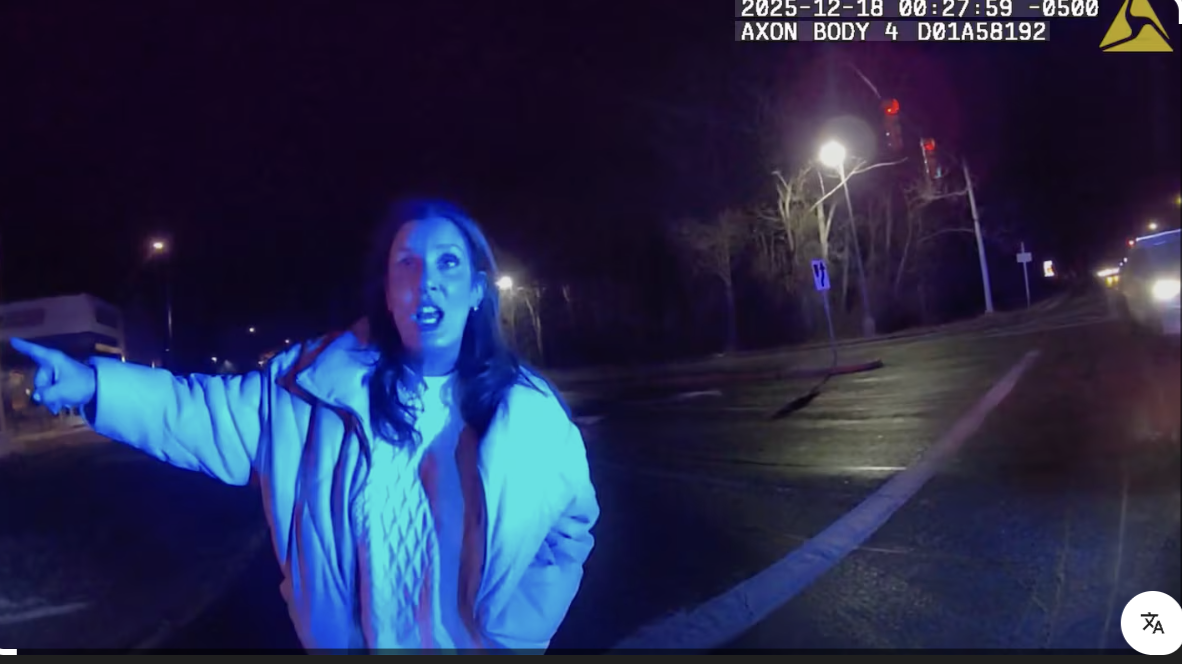
Prominent Rhode Island Dem caught on cam calling cop ‘d–k’ during wild DUI stop: ‘God forbid I was a black person’

“You know who I am?” didn’t work, for some reason, nor did this:

A minute later as one of the cops gave her instructions to walk in a straight line, she shouted at her cousin waiting in her vehicle.

“Call my husband right now, and call the attorney general and everybody else in town,” the former Cranston councilwoman screeched.

“Cause this is disgusting, God forbid I was a black person, I’d be arrested.”

She must have had a change in skin color.

Bucci was ultimately placed in handcuffs after she continued to needle police and ignore instructions, the video shows.

When Bucci was pulled over, police “immediately detected a strong odor of an alcoholic beverage emanating from inside the vehicle,” according to a police report obtained by the Globe.

An officer also alleged in the report that Bucci’s eyes were “severely bloodshot, glassy, and watery.”

“She was slurring and spitting when she was yelling and was extremely confrontational,” according to the report. 

At the start of the stop, Bucci told police she had one glass of wine at a Christmas party, the video shows.

Pro-tip: when you get busted the first time for DUI, it isn’t because you were unlucky, it’s because the luck you did have finally ran out, and the odds caught up with you — you’ve likely driven drunk dozens, possibly hundreds, even thousands of times.

And then there’s this absolutely true story, or it should be:

Man: “The secret of success is, when you fall down, get back up. Fall down again, get up again.”

Cop: “Not during a field sobriety test it isn’t.:”

Go peddle your garbage elsewhere

Why anyone thinks it’s a good idea to make it easier for the denizens of southwest Stamford to travel back and forth to Old Greenwich is a puzzle that I can’t solve, but someone does, and the boondoggle continues to advance.

Greenwich-Stamford Multi-Use Path

From Binney Park to Boccuzzi Park

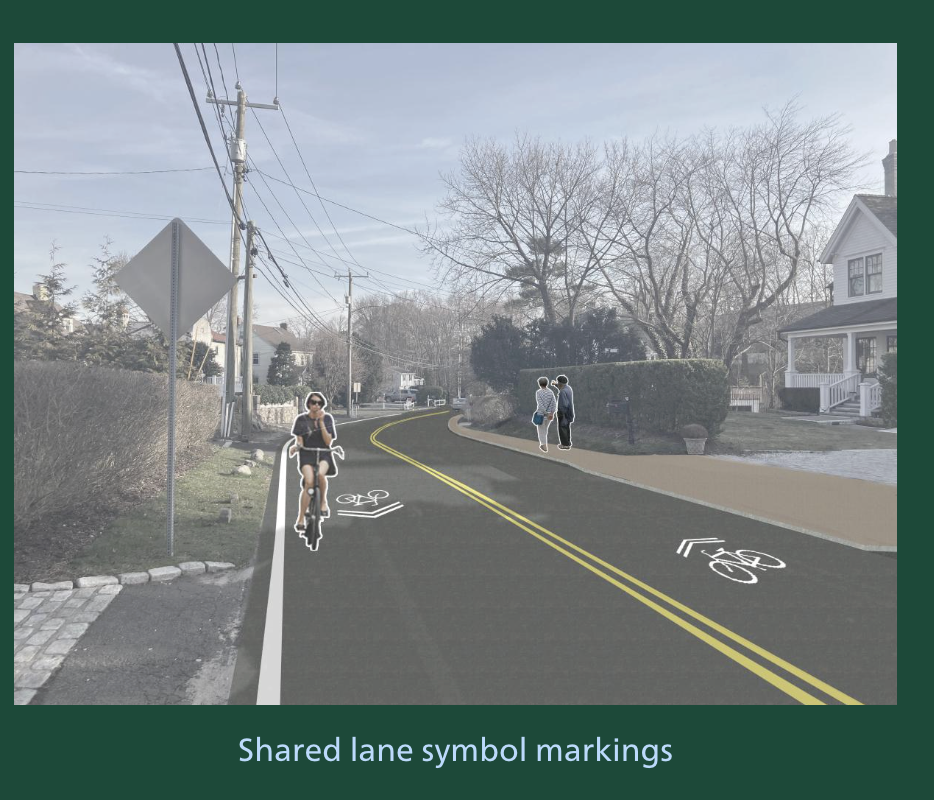
The trail itself will take the form of a 10’ wide paved pathway but also rely on painted bike lanes and shared lane symbol markings within the roadway to fill gaps where a 10’ wide pathway is not practical.

Expensive? Nah, what makes you think that?

Improvements associated with the trail are anticipated to include alterations to roadway geometry, additional public sidewalk construction, standard bicycle and pedestrian improvements, pavement structure improvements, and relocations of drainage and utility infrastructure.

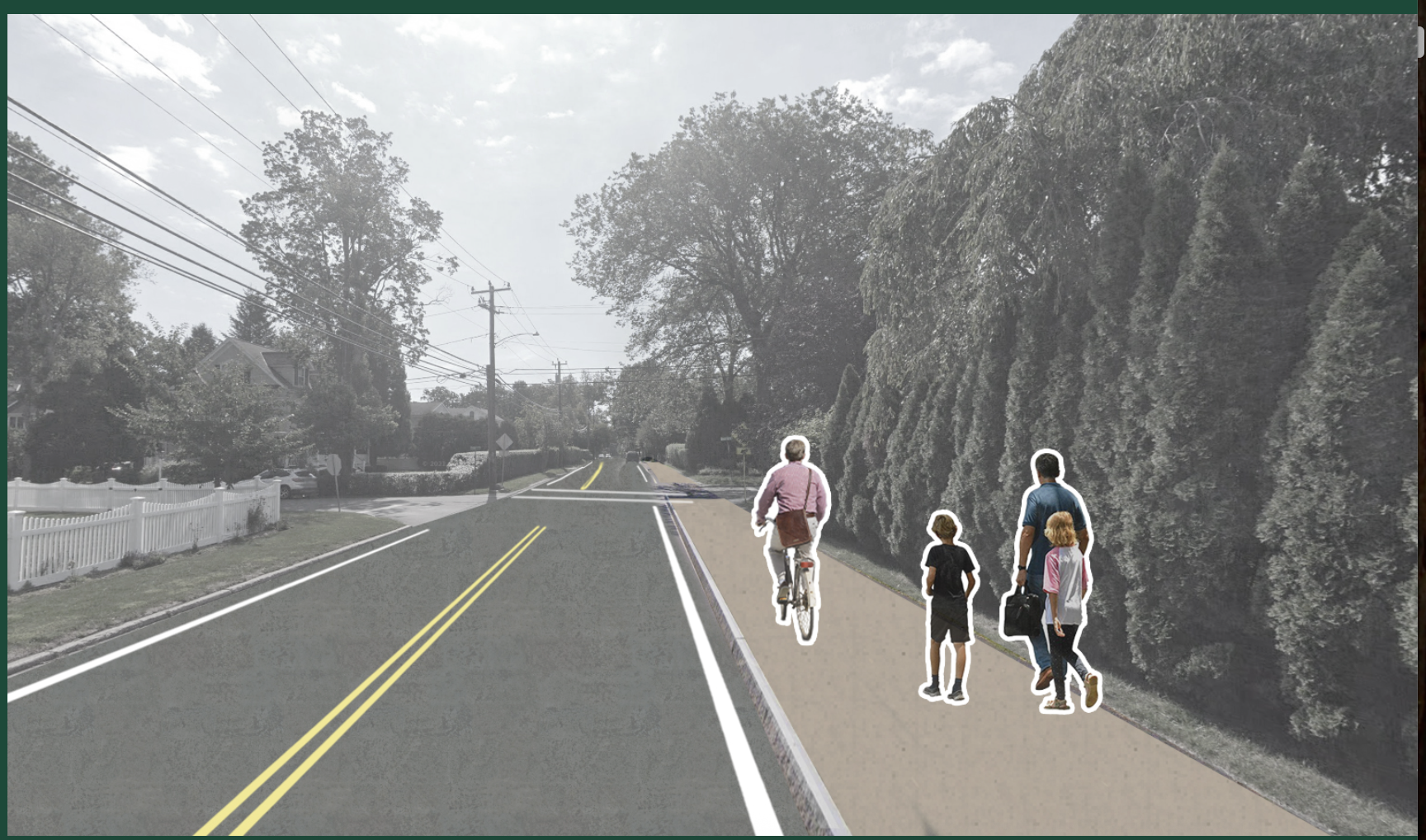
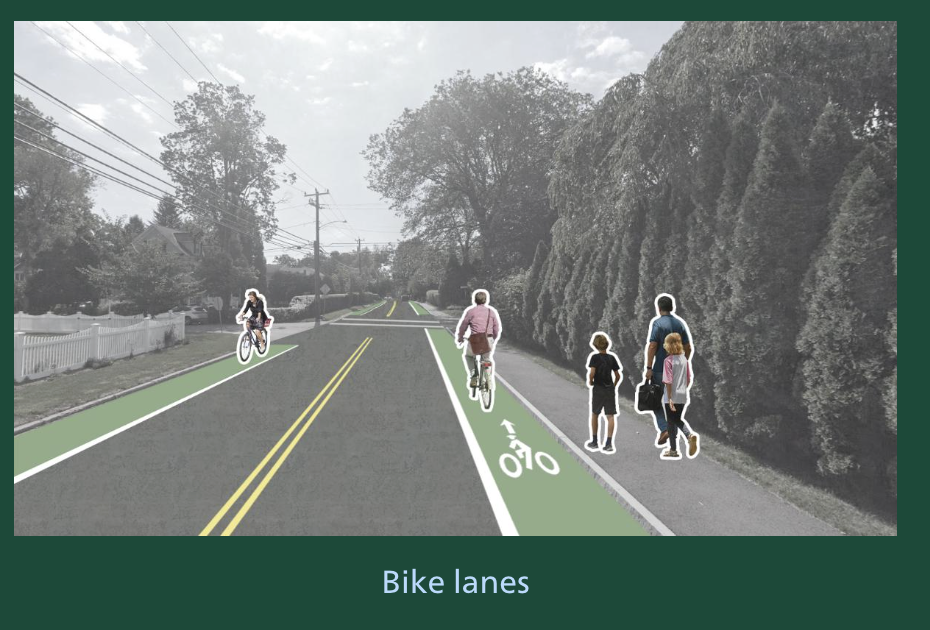
Looking at the four proposed routes, it seems clear that there will be very little construction, for now, of that 10’ wide dedicated bike path the planners mention — there’s just no room to create much of it. That leaves “dedicated bike lanes” and “shared use lanes ” or, in the jargon, “Sharrows”. Illustrations of the three options are thoughtfully provided in the no-doubt-handsomely-paid consultants’ proposal, as shown:

dedicated 10’ wide bike path

Sharrows

As you’ll note, even the “bike lanes” take up an enormous amount of roadway, space that will be coming out of a lot of residents’ front yards, at an expense that will be borne by all. Not good. And the third, cheaper option, marked-lane “sharrows”? They’re useless, if one goes by the experience of this avid bicyclist advocate from San Francisco, and I suspect one should:

People for Bikes

We Were Wrong About Sharrows

The former executive director of the California Bicycle Coalition was a key player in the proliferation of shared lane markings. Twenty years later, he’s disillusioned with them.

It was the late 1990s and I thought we were so clever. We had just convinced the San Francisco Department of Parking and Traffic to incorporate an innovative new design into its bike plan, a bold statement conveying “bikes belong” right there in the middle of the street. I had first seen a shared-use marking, or “sharrow” — a white bicycle painted directly on asphalt — in photos of Paris and Chicago, put there to help bicyclists get through intersections by indicating their path of travel. In 1993, James McKay, a bike planner in Denver, used it on a trial basis to emphasize a bicyclist’s right to ride in the middle of the lane. 

I was the young executive director of the San Francisco Bicycle Coalition. We published a hard-hitting newsletter and organized leaders from businesses, churches, community organizations, youth groups, and more into a coalition that was giving unprecedented voice to the demands of San Franciscans for safer streets. Looking to those examples from Chicago, Paris, and Denver, we pushed to get an improved version of the sharrow design formally included in the city’s bike plan and approved for use by the state of California. Mayor Willie Brown famously painted the first sharrow on Grove Street outside of City Hall, getting some green paint on his fancy suit and laughing it off in his inimitable style. [Did Kamala wipe off the offending liquid for him? With what? Asking for a friend.]

…. San Francisco went on to paint thousands of these symbols all over its bike network, and hundreds of cities followed suit. I thought the sharrow would educate bicyclists to stay out of the “door zone”— the three or so feet of space adjacent to parked cars where motorists opening car doors and bicyclists could collide — and usher in a new era of safer streets, one where motorists would patiently wait behind bicyclists “taking the lane” because this painted symbol made it clear they had the right to do so. Where we couldn’t get a bike lane, I hoped this symbol would effectively convert the mixed-traffic lane into an adhoc bike lane when bicyclists were present.

I was wrong.

It turns out that motorists really don’t like to wait behind someone on a bike, regardless of the paint on the street. Even Oakland’s experiment with the so-called “super sharrow,” where the bicycle path of travel is painted solid green, isn’t enough to get people on bikes to comfortably “take the lane.” Sharrow or no sharrow, most people on bikes dangerously hug the edge of the roadway, squeezing themselves into the door zone to avoid blocking car traffic.

Simply put, sharrows don’t do what we hoped they would. Studies back up that claim.

Early research in San Francisco and Florida showed evidence that behaviors changed slightly on streets with sharrows. For example, some bicycle riders positioned themselves a few inches further from the curb or car doors. A 2010 evaluation of shared lane markings in three separate cities again showed that the markings had some positive impact on behavior. Looking closely at the results, however, it was clear the changes were too minor to make a difference. After Oakland’s experiment with the super sharrow, the Federal Highway Administration announced it would not support future experiments, and Oakland does not plan to continue the treatment when it repaves the street. 

San Francisco still uses sharrows, but for the most part, city officials know better than to expect them to do much for safety. Today, beautiful sharrows point bicyclists along the circuitous path of the “wiggle,” where a right-left-right-left series of turns directs riders on a gentle grade between San Francisco’s steep hills. They are great for navigation and, perhaps, concentrating riders on certain streets — that’s about it.

Bright green arrows are useful for marking the zig-zag path that takes bicyclists across San Francisco while avoiding the steep hills.

It’s been more than 20 years since I had high hopes for the sharrow as a tool for safety. Today, we know so much more about what it takes to make our streets safer for bicycling. We need separate bike paths; we need protected bike lanes on busy roads; and where the lanes are shared, we need actual speeds reduced to 20 mph or slower. Sharrows don’t do any of that.

“Sharrows do, however, accomplish something pernicious which I did not anticipate. They allow officials to take credit for doing something for bicycle safety without impacting car traffic, even though that something is next to nothing. It’s just pretending, and it’s worse than being honest about priorities. It’s insulting to the public to encourage bicycling by painting bike symbols on the street but doing nothing to actually make riding a bike any safer.

Yes, good bike infrastructure can require tradeoffs that are more politically challenging than simply painting a symbol on the street. Now, at PeopleForBikes, I’m part of a team that has successfully helped cities build networks of bikeways that actually get more people riding safely and joyfully. We help city leaders with communications, organizing, and political strategies to overcome the challenges they will surely face in building truly effective infrastructure. 

“We never suggest using sharrows to create a bikeway. We’ve learned our lessons. Now that we know better, it’s time to do more.”

And that, of course, is the danger here: like all good-intentions plans, when one doesn’t work, its advocates never give up, they simply demand more. Hang onto your wallets, because these people will be back. Those 10’ wide bike paths that are too impractical and expensive today? Look for them tomorrow.

It's them against US — "them" being Democrats, champions of the 3rd World

Native born criminals get a free pass so that illegal aliens can skate:

And here’s a good one: this sticker will draw an ICE raid even faster than a “No Guns in This House” sign attracts housebreakers and rapists:

Maine, too has now joined in the rebellion against law enforcement, enacting a law last week prohibiting local police forces to cooperate with ICE or its agents.

Maine’s Democrats have made it clear: they’re on the side of cheap, exploited labor and the companies that hire it; the soon-to-be-replaced American workers must suffer so that new, more docile voters from south of the border can take their place.

A recent sob story from the Bangor Daily News spends its first 22 paragraphs on the terrible injustice being dished out to illegal aliens in the construction industry, before finally getting around to what those people’s willingness to work for poverty wages is doing to Americans; after devoting four paraphs on that, the editors return to the pathos, and pour on another twenty-four paragraphs describing the misery and woe of those who have no right to be here in the first place..

These [illegal] immigrants do one of Maine’s most dangerous jobs. Then came Trump’s crackdown

Roofing has come to rely on immigrant labor even more than the rest of the construction industry, where surveys show that at least a third of workers are foreign-born. A majority of roofers are estimated to be immigrants, many of whom are undocumented, according to a recent  Stateline analysis

The danger of the job has structured the industry in a way that has made undocumented labor an attractive option, said Sergio Chavez, a professor at Rice University in Texas who is writing a book about immigrant roofers and has interviewed more than 350 of them. 

[Because they don’t pay for workman’s compensation insurance and threaten to have injured workers deported if try to claim benefits, as the article eventually admits — ED]

But here’s what’s buried deep within the article: the effect this pool of cheap, illegal laborers and the companies that hire them has on legitimate businesses:

The influx of immigrant crews has frustrated others. Shane Felcher, who owns Right Price Home Solutions in Gardiner, prefers to hire employees directly because he wants to employ local tradesmen and do things by the book, he said. He struggles to compete with the larger companies that cut down on their overhead costs by relying on subcontractors, especially those he suspects will work harder and for less because of their immigration status. 

“I get employers complaining that they can’t find employees and I can see how immigration helps that,” he said. “You’re just willing to take advantage of immigrants willing to work cheaper than the locals. That doesn’t seem morally right to me either.”

Low questioned the moral culpability of the undocumented worker who is breaking the law to feed their family versus the comfortable business owner who hires them. In his view, the federal government seems more interested in holding immigrants accountable than the industries that benefit from their labor. A spokesman for Immigration and Customs Enforcement, or ICE, did not reply to an inquiry about whether the agency had enforced any worksite violations against Maine roofing employers this year.  

“Why would an industry use large numbers of undocumented workers if it didn’t find a self-interest in doing it?” he said. “That is not only in the wages you pay them, but how much they’ll bend over backward to do exactly what [their bosses] say despite the fact that it is already dark and they’re working by the headlights of their trucks.”

But who will clean our toilets? Pick our cotton?

The shift in the federal government’s crackdown has probably been felt more severely by individual roofers than by the industry at large. But that could change over time. Nationally, blue-collar workers are increasingly caught up in the federal government’s immigration dragnet, sending ripples of anxiety through industries that depend on immigrants. 

In August, a national survey by the Associated General Contractors of America found workforce shortages within the construction industry are the primary driver behind project delays. Nearly a third of firms that participated in the survey reported being affected by intensifying immigration enforcement. 

“That’ll be a problem,” said Chavez, the Texas professor. “You’re going to deport people? What’s their plan to address the labor needs of the industry?”

Someone ought to be gettig pretty goddamned mad by now.

Oh, my God, I had no idea this was so. I apologize to each and every one of them, and I'd like to express my gratitude to them for creating this beautiful country

Self-sacrifice: rather stay home and rebuild mogadishu, they came here, to found universities for the poor and establish the rule of law for all. Thank you!

Boston Democrat Mayor Michelle Wu Says Somalis To Thank For City’s ‘Every Achievement.’

Democratic Boston Mayor Michelle Wu said on Monday that Somalis are to thank for “every achievement” that the city has ever had.

Somalis have gained national attention after several were charged with stealing over $1 billion from Minnesota’s social programs, including those intended to feed poor children. Wu claimed that the Somalians are responsible for every positive thing that has happened in Boston.

“You cannot talk about any achievement that the city of Boston has had in safety, jobs, and economic development, in education, without talking about the Somali community that has lifted our city up. We are proud and we are grateful for our Somali community and for our Somali American neighbors. Boston and the country are clear that hate has no place in our society,” Wu said.

“We will use every attack to actually strengthen and expand the services available, to empower and work alongside our community members who are already doing so much good in the world and setting the example for the rest of the country,” Wu continued.

This tender moment really demands a shot of Lulu, no?

Gee, we were discussing flushing rats down the toilet just yesterday

Middlebury developer challenges constitutionality of legislative ‘rat’

A line snuck into state budget blocked a warehouse project

It was a classic “rat,” a legislative favor added without public notice to a massive budget bill at the end of the General Assembly’s 2023 session. The purpose: Block construction of a large warehouse on a bucolic former corporate campus near a legislator’s home in Middlebury.

Two years later, lawyers for the would-be developer allege in a federal lawsuit that the legislation targeting his project and overruling local zoning was unconstitutional, a “brazen” violation of the equal protection clauses of the U.S. and Connecticut constitutions.

The lawsuit filed in U.S. District Court on behalf of Southford Park LLC, the owner of the targeted property, seeks millions of dollars in damages from Middlebury, claiming the Waterbury suburb illegally relied on the unconstitutional language to stop the project and devalue the land’s worth by 90%.

The General Assembly, which generally has immunity against claims for civil damages, is not a defendant, but the behind-the-scenes actions of lawmakers could come under rare scrutiny as the claims against Middlebury are pursued.

“We think that the intent that legislators had and the process that they followed to enact the statute is going to be relevant to those claims,” said David R. Roth, a partner with the law firm, Wiggin & Dana. 

Roth filed the suit on behalf of Southford Park — whose principal is David Drubner — and an adjacent property owner, Route 188 LLC. Assisting Roth is Jed Rubenfeld, a constitutional scholar on the faculty of Yale Law School.

The suit asks the court to consider the “rat,” the colorful term for a favor snuck into an unrelated piece of legislation, an “abuse of the legislative process” that “arbitrarily and irrationally deprived Southford Park and Route 188 of their protected property interests.”

Together, the lawsuit says, damages could exceed $27 million.

Drubner had a contract to sell the site for $25 million, contingent on final zoning approvals for what he called “an intermediate storage warehouse,” to Flint Development of Kansas, a builder and operator of industrial logistics facilities. The rat and Middlebury’s subsequent denial killed the deal, he said.

Neither Drubner nor Flint had a tenant lined up for what opponents had mischaracterized as a distribution center akin to an Amazon fulfillment facility Drubner said.

“They’ve characterized this as a distribution center like the Amazon thing. We specifically do not have approval for that. It’s just an intermediate storage warehouse,” Drubner said.

Defendants in the lawsuit include Middlebury, its Zoning Board of Appeals and zoning enforcement officer, and its new chief elected officer, First Selectwoman Jennifer A. Mahr….

Mahr is being sued only in her official capacity — as are the other individual defendants — meaning any liability rests with the town of 8,000 residents. But she has had a prime role in thwarting Drubner’s project as a founder of the Middlebury Small Town Alliance, a group that sued the town to stop the project.

…. Rep. William Pizzuto, R-Middlebury, acknowledged to the Connecticut Mirror two years ago he sought the legislative intervention as his neighbors and other opponents failed to stop the project through more conventional means, including an appeal of the local planning and conservation approvals in court.

He said Friday he sees nothing wrong in the General Assembly involving itself in a local zoning controversy after local options were exhausted.

“I don’t think anything was done improperly, except to say we’re here to represent the people of this town,” said Pizzuto, who lives about 100 yards from the bottom of the long drive leading to the proposed construction site, the former corporate headquarters of the Timex Group. 

As Pizzuto acknowledges and the plaintiffs’ lawyers assert, the one-sentence rat now ensconced as Section 8-3m of the Connecticut General Statutes was drawn to block Southford Park without naming it. 

“By design, on the date it was enacted into law, the text of § 8-3m fit the Southford Road Warehouse Project like a glove, because the statute was enacted precisely and specifically to block the Project,” the lawsuit reads.

The language bans communities with populations between 6,000 and 8,000, as determined by the 2020 census, from permitting any warehouse or distribution facility exceeding 100,000 square feet on any site that is smaller than 150 acres, has more more than five acres of wetlands and is within two miles of a school.

While the estimated population of Middlebury now could exceed 8,000, the 2020 census pegged it as 7,574. The size of the site and proposed facility fall within the parameters, it had 7.2 acres of wetlands as originally proposed, and is within one mile of a school.

The lawsuit says “the statute arbitrarily combines a hodgepodge of wholly unrelated factors and criteria” with no rational purpose.

It notes the only use banned by Section 8-3m are warehouses and distribution centers, not presumably more impactful things such as “chemical production facilities, pharmaceutical production facilities, bus terminals, truck terminals, pig farms, oil refineries, leather tanning facilities, prisons, commercial dry cleaning facilities, sewage treatment facilities, or even nuclear waste storage facilities.” 

The references to wetlands and a school are similarly suspect, the suit says, as the language ”would permit any of these intensive, dangerous, environmentally hazardous facilities to be approved on property consisting entirely of wetlands located right next door to an elementary school.”

Two sides to every story, allegations are not facts, yadayadayada, but the plaintiffs are represented by Wiggin & Dana, and that’s a firm not ordinarily associated with (completely) frivolous lawsuits, so there’s probably something here. Fortunately, it will be the taxpayers of Middlebury who are exposed to footing the bill for damages here, not the actual government officials and politicians who were merely doing their job. Phew!