May I have your attention please: let's talk about ADHD and Medicaid $ — adult day care, "learing" centers and community bloc grants and food stamps can await another day

(Continuing on the topic of the previous post)

More Chat:

As part of its response to my inquiry about spending on autism, Chat came up with this interesting fact:

“ABA spending on Medicaid recipients who did not have an autism diagnosis rose from $77.6 million in 2021 to $1.47 billion in 2025—an increase of 1,789%. That is sufficiently extraordinary that it probably deserves its own examination rather than being buried inside the autism figures.”

1. What exactly is the $1.47 billion?

Among people without one of those ASD diagnoses, payments went:

2021: $77.6 million → 2025: $1.47 billion

That's 18.9× as much money in four years, or +1,789%.

This isn't somebody's extrapolation or an advocacy-group estimate. It's CMS's analysis of T-MSIS claims and encounter data covering all 50 states, D.C., Puerto Rico, USVI and Guam, including both fee-for-service and managed-care encounters.

And by 2025, non-autism cases constituted 14.5% of all Medicaid/CHIP ABA spending.

That is remarkable because ABA remains overwhelmingly associated with autism treatment.

2. What were they being treated for?

Here is where it gets much more interesting.

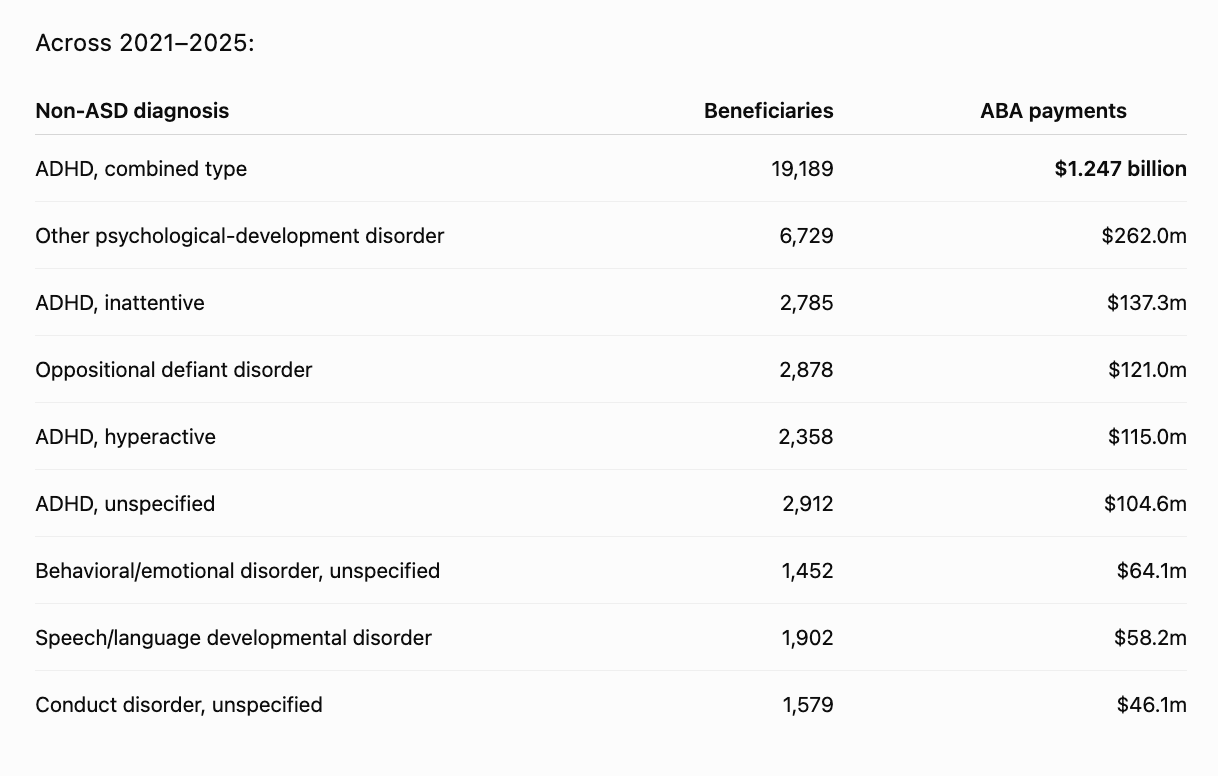
CMS actually tabulated the diagnoses attached to this non-autism ABA population. The dominant diagnosis wasn't another severe developmental disability.

It was ADHD.

CMS says that ADHD combined type alone represented 40.3% of all non-ASD ABA spending. Add the five ADHD diagnostic codes together and ADHD represents 57% of all non-autism ABA spending during 2021–25.

So this is not principally a story of ABA being used for intellectual disability or severe developmental disorders.

It is substantially an ADHD-treatment story.

3. The spending intensity is extraordinary

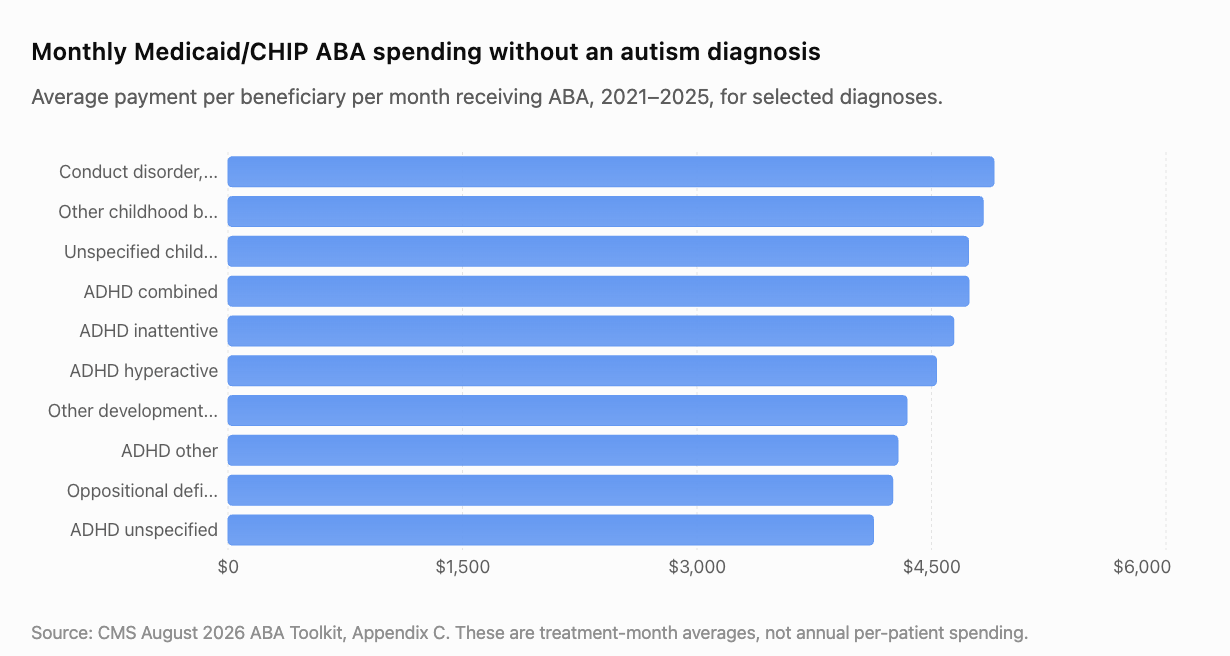
The CMS table also supplies per beneficiary per month payments.

For ADHD-combined-type patients receiving ABA:

$4,740 per beneficiary per month.

That's an annualized rate of about:

$56,880 per year.

For several other diagnoses:

  • ADHD inattentive: $4,643/month ≈ $55,716/year

  • ADHD hyperactive: $4,532/month ≈ $54,384/year

  • ADHD unspecified: $4,129/month ≈ $49,548/year

  • Oppositional defiant disorder: $4,252/month ≈ $51,024/year

  • Childhood-onset conduct disorder: $4,900/month ≈ $58,800/year

  • unspecified childhood behavioral/emotional disorder: $4,737/month ≈ $56,844/year

Those are CMS's average payments per beneficiary during months in which the service was received, so multiplying by 12 should not be interpreted as saying every recipient actually cost that amount annually. But it gives you the treatment intensity implied by the claims.

This tells us something important about the 1,789% increase. It isn't merely that Medicaid is occasionally reimbursing a behavior analyst for an ADHD consultation. Some of these patients are receiving extremely intensive—and expensive—ABA.

4. And geographically, the phenomenon is astonishingly concentrated

This may be the biggest red flag in the entire appendix.

CMS reports:

Florida alone paid more than $2.1 billion for ABA delivered to beneficiaries without an autism diagnosis during 2021–2025.

The next-highest state?

Colorado: just over $375 million.

So Florida spent more than 5½ times Colorado's total.

That is very difficult to explain as a nationwide change in medical science. ADHD obviously isn't five times more amenable to ABA in Florida than elsewhere.

It strongly suggests that state reimbursement rules, provider markets, billing practices, benefit interpretation, or some combination thereof are major explanatory variables.

Notice also what this means arithmetically. The entire United States was spending only $77.6 million annually on non-ASD ABA in 2021. Yet Florida alone accumulated more than $2.1 billion over the ensuing five-year period.

That deserves serious scrutiny.

6. The service quantities make it even more interesting

CMS gives another variable: service quantity.

ADHD combined-type beneficiaries accounted for:

98,228,671 units of ABA service during 2021–2025.

There were only 19,189 beneficiaries in that diagnostic category.

The most commonly used ABA CPT codes are generally billed in 15-minute units.

You have to be careful about dividing those numbers directly, because the CMS beneficiary count and service-quantity measures cover multiple years, people enter and exit treatment at different times, and not every CPT code represents identical direct-treatment time.

Nevertheless, the sheer scale is worth noticing:

98.2 million billed units for fewer than 20,000 ADHD-combined beneficiaries.

That's roughly 5,119 service units per unique beneficiary over the five-year observation period.

If they were all 15-minute treatment units—which they aren't necessarily—that would correspond to approximately 1,280 hours per beneficiary.

So these aren't trivial claims.

8. And we already know the broader ABA claims environment has serious integrity problems

HHS-OIG isn't merely expressing theoretical concern. It has conducted a series of state audits.

In Colorado, ABA fee-for-service payments rose from $60.1 million in 2019 to $163.5 million in 2023. OIG's sample found that all 100 sampled enrollee-months contained at least one improper or potentially improper claim line. OIG identified at least $77.8 million in improper payments and another estimated $112.5 million federal share requiring further review.

Wisconsin's audit likewise found at least $18.5 million in improper ABA payments, again with every one of its 100 sampled enrollee-months containing at least one improper or potentially improper claim line.

Indiana: at least $56 million improper. Maine autism-related services: at least $45.6 million improper. HHS-OIG now has an ongoing multi-state ABA audit program specifically because federal and state agencies have identified questionable billing and payments for unallowable services.

Again, an "improper payment" is not synonymous with fraud. It includes documentation and compliance failures. But the error environment is clearly real.

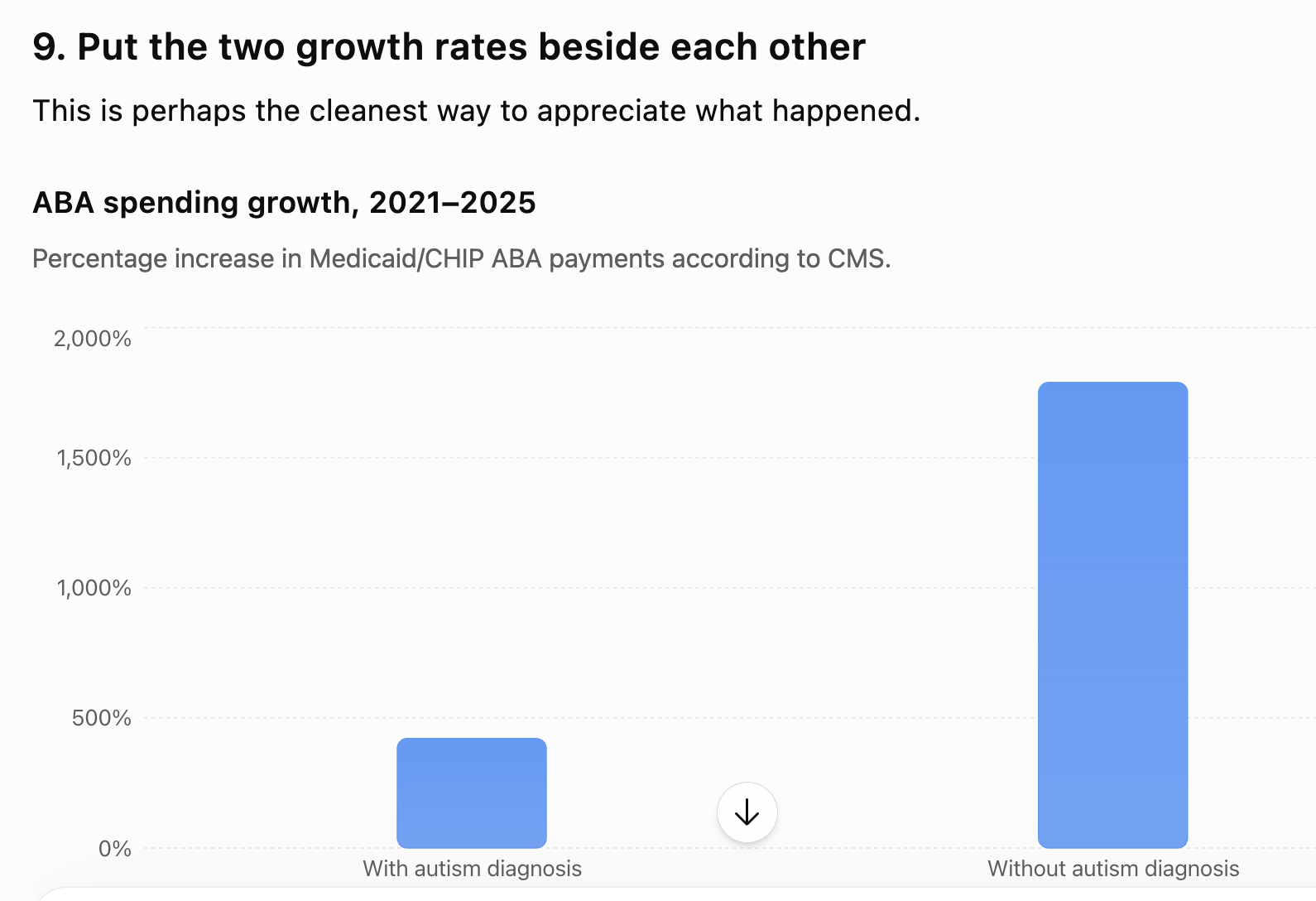
The non-ASD category grew about 4.25 times faster even than the already extraordinary growth rate of ASD ABA spending.

And because compound growth can be easier to grasp than percentages:

  • ASD ABA: 5.21× in four years.

  • Non-ASD ABA: 18.89× in four years.

An 18.9-fold increase over four years corresponds to roughly a 109% compound annual growth rate.

In other words, non-autism ABA spending was, on average, more than doubling every year.

10. What could plausibly explain it?

I think there are five hypotheses, and they're not mutually exclusive.

Legitimate expansion of ABA indications. Providers and Medicaid programs may increasingly be using behavioral analysis for ADHD, disruptive behavior, intellectual disability and developmental disorders. Some portion unquestionably belongs here.

Diagnostic sequencing/access. A child awaiting a formal autism evaluation could receive ABA under another diagnosis. CMS explicitly discusses barriers and delays in obtaining ASD diagnoses. That could cause legitimate ABA to appear temporarily in the non-ASD bucket.

State-policy arbitrage. Providers respond to reimbursement rules. Florida's >$2.1 billion versus Colorado's ~$375 million strongly suggests that state-specific policy and market structure matter enormously.

Over-servicing or weak medical-necessity controls. A legitimate patient may receive far more billable treatment than clinically warranted. That is waste or abuse rather than necessarily fraud—and the CMS toolkit spends a remarkable amount of space addressing precisely this problem.

Fraud. Phantom sessions, inflated units, unqualified providers, impossible hours, falsified documentation, kickbacks or medically unnecessary treatment can generate exactly this sort of claims growth. CMS explicitly says investigations have resulted in prosecutions and that fraud, waste and abuse have become significant fiscal concerns.

The available aggregate data cannot tell us what fraction belongs in each bucket.

Where I land after examining it

The 1,789% number alone is startling but doesn't establish much.

The combination is much harder to dismiss:

18.9× spending growth in four years + 57% of non-ASD spending associated with ADHD + ~$4,000–$4,900 per treatment-month for many leading diagnoses + extreme geographic concentration in Florida + documented high improper-payment rates in ABA audits + CMS suddenly publishing a 173-page toolkit with an entire chapter titled “Preventing Applied Behavior Analysis Fraud, Waste, and Abuse.”

That is a fairly strong signal that we're looking at something more complicated than a benign expansion of evidence-based behavioral treatment.

The most tantalizing unanswered question is Florida. More than $2.1 billion of non-autism ABA in one state is extraordinary. I'd next investigate Florida Medicaid specifically: when its coverage rules changed, which diagnoses qualify, annual non-ASD ABA spending, number of recipients, reimbursement rates, provider growth, ownership/concentration, enforcement cases, and whether a small number of providers account for a disproportionate share of claims. That could tell us whether Florida is essentially driving the national 1,789% phenomenon.

Autism: if you spend it, they will come

I read an article in HotAir this morning:

The 'Rorting' of a New Australian Entitlement

(What is "rorting" you ask? It's Australian slang for fraud or, in this case, ripping off the system.)

Back in 2012, Australia's Labor Prime Minister Julia Gillard pushed through a new entitlement called the National Disability Insurance Scheme (NDIS). The basic idea is that the Australian government would provide direct funding to individuals with disabilities. Those individuals would then choose how to spend the money to provide for their own support.

…. But the program grew much more quickly than expected and cost much more as well. Within two years of it going nationwide, there was concern that the program had been heavily infiltrated by organized crime. This story is from 2022:

According to a study by the Australian National University, there's been a 32% increase in the prevalence of autism since the NDIS was introduced. Experts, however, say the explanation for this is simple...

One of the other criticisms of the scheme has been that providers have gamed the system, offering unnecessary and expensive services.

"Where there's government money, there have been over-servicing and over-charging and shonky providers," says Shorten. "Many are good providers, but some are bad. That's the nature of a government scheme: people will hone in on it and try and slice off amounts for themselves."

Hmm: subsidize something and you get more of it. Counterintuitive, at least to a liberal mind, but I asked Chat GPT about it, asking it to compare Australia’s experience with our own. It complied, but then came up with a fascinating observation on its own: in the US, while autism diagnoses and “treatment” costs have soared, that increase is dwarfed by another branch of ABA (Applied Behavior Analysis), not classified as a “severe developmental disability”: Attention Deficit Disorder. That merits another post, which will follow. Here’s (some of) the report on autism — masochists can find the full report at the link:

Chat discussion

Yes. The rise is very large, but the cleanest data suggest two different stories: autism identification has roughly doubled in U.S. child-surveillance data over a decade, while some categories of autism-treatment spending have risen several-fold faster than diagnoses.

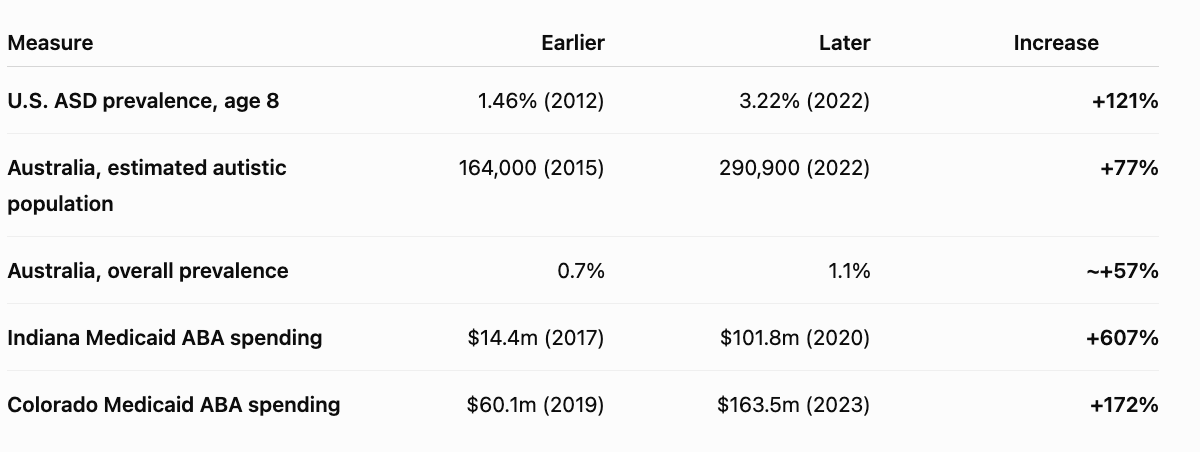
In the United States, the CDC’s comparable ADDM surveillance found autism in 14.6 per 1,000 8-year-olds in 2012 (1 in 68) and 32.2 per 1,000 in 2022 (1 in 31). That is a 121% increase in measured prevalence in ten years—about 2.2 times the 2012 rate. Importantly, this is identified prevalence, not proof that the underlying biological incidence doubled. Changes in screening, diagnostic practice, access to evaluation, diagnostic substitution and ascertainment all contribute. The CDC also reports a further 22% rise just from 2020 to 2022 among comparable surveillance sites.

Indiana Medicaid fee-for-service ABA payments went from $14.4 million in 2017 to $101.8 million in 2020—a 607% increase in three years. Colorado went from $60.1 million in 2019 to $163.5 million in 2023—up 172%. Wisconsin rose from $39.9 million in 2018 to $53.7 million in 2022, about 35%. CMS itself said in its August 2026 ABA toolkit that Medicaid and CHIP are seeing rapid growth both in ASD diagnoses and in use of ABA and other behavioral interventions.

Australia shows similarly remarkable growth in identification. The Australian Bureau of Statistics estimated 164,000 autistic Australians in 2015, or about 0.7% of the population. By 2022 it estimated 290,900, or 1.1%. Thus, in only seven years, the estimated number increased 77%, while population prevalence rose by roughly 57% (0.7% → 1.1%). The increase is especially concentrated among younger cohorts: for 10–14-year-olds, prevalence went from 2.8% in 2015 to 4.4% in 2022, an increase of about 57%. For ages 20–24 it went from 1.2% to 2.7%, a 125% increase.

So, in compact form:

The 32% comes from a 2026 peer-reviewed Journal of Health Economics paper by Maathumai Ranjan and Robert Breunig at Australian National University. Their result is that introduction of the NDIS itself caused an estimated 32% increase in reported autism prevalence and accounts for an estimated 47% of new autism diagnoses since the scheme's introduction.

…[T]here really does appear to be evidence of an incentive effect on diagnosis, independently of outright billing fraud.

…..

Now compare that with money

This is where the divergence gets striking.

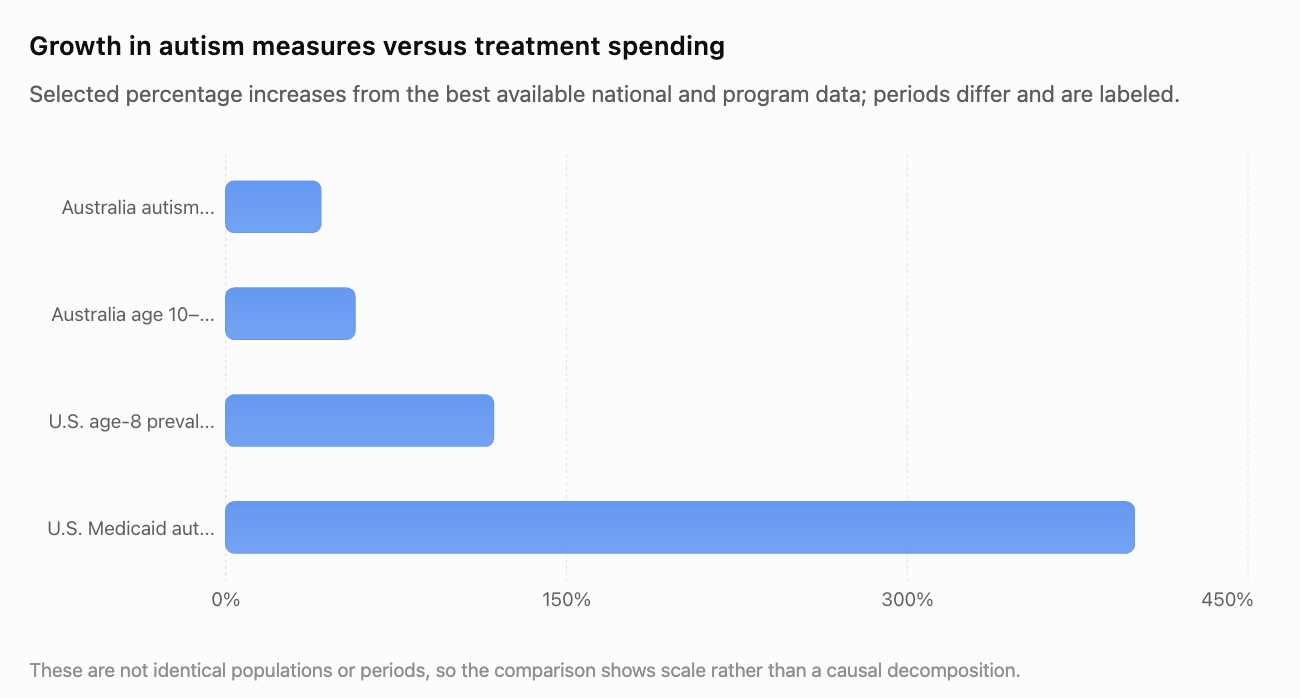
The newly released U.S. CMS figures say Medicaid/CHIP spending on autism therapy increased more than fivefold between 2021 and 2025, reaching $10.1 billion in 2025. CMS explicitly says spending grew much faster than the number of patients receiving treatment.

I've put the U.S. spending bar at +400% as a conservative floor because the source says "more than fivefold": five times the original amount corresponds to a 400% increase. The actual increase is therefore somewhat greater.

Australia gives another useful within-program comparison. In FY2022, NDIS paid A$5.27 billion to participants whose primary disability was autism. One year later that was A$6.73 billion—+28% in a single year. There were 214,880 such participants by June 2023, representing 35% of everybody in NDIS.

That doesn't prove the extra 28% was waste: increased enrollment, inflation, service intensity and changing participant composition matter too. But it illustrates why the financial incentives are worth investigating.

After reading the source behind your article, I would actually modify the framework I gave you earlier. There are three, rather than two, phenomena to keep distinct:

1. Genuine/ascertainment growth. Better recognition, changing criteria, diagnostic substitution and identification of people previously missed clearly account for some increase. ABS itself explicitly warns that awareness and diagnostic criteria contribute to its rising prevalence figures.

2. Incentive-induced diagnosis. This is not necessarily fraud. The ANU natural experiment provides evidence that making a valuable government benefit conditional on disability recognition changes diagnostic behavior. Their central estimate is +32% autism prevalence caused by NDIS, with 47% of post-introduction new diagnoses attributable to the program. Their evidence favors a lowered recognition threshold over simply finding previously missed cases.

3. Fraud, over-servicing and improper billing after diagnosis. Australia estimates 6–10% of NDIS payments are currently lost to inflated invoices, organized crime or ineligible payments; criminal-intelligence officials have suggested the problem could be substantially larger. In the U.S., CMS has now reacted to the extraordinary growth in ABA spending with recommendations specifically addressing fraudulent/abusive billing, conflicts where diagnosis and treatment are financially connected, provider ownership and very high treatment hours.

The distinction between #2 and #3 is critical. A clinician could sincerely decide that a borderline child meets today's ASD criteria because obtaining that diagnosis unlocks useful services. That can increase measured autism prevalence without anyone committing fraud. Once billions of dollars are contingent upon the label, however, the system creates incentives at both the diagnostic and treatment stages.

And the Australian study is unusually valuable because it moves this beyond speculation about incentives: the staggered NDIS rollout gives researchers something approaching a natural experiment showing that the entitlement itself changed autism diagnosis rates.

That makes the Australia/U.S. parallel considerably more interesting than merely observing that both countries have experienced more autism diagnoses.

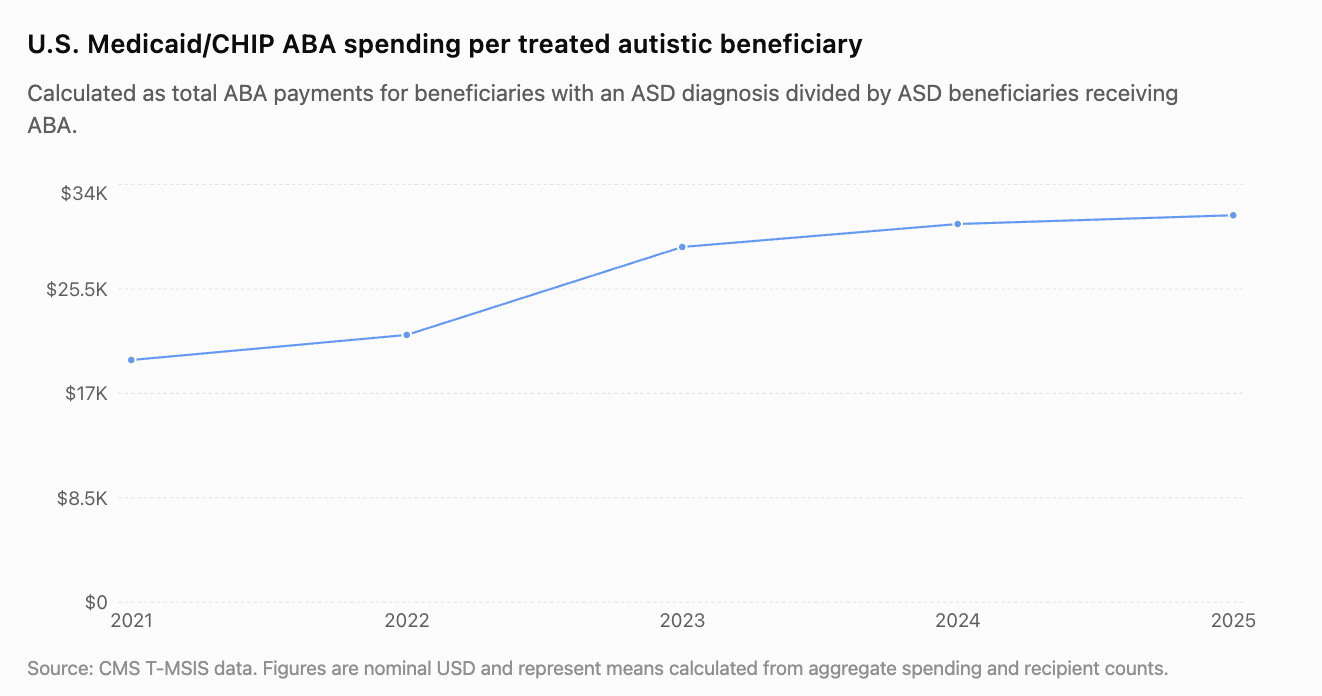
Normalizing by the number of people actually receiving services changes the picture substantially—and reveals a notable difference between the U.S. and Australia.

For the U.S., CMS now gives us exactly the ingredients we need. Medicaid/CHIP ABA spending for beneficiaries with an autism diagnosis rose from $1.86 billion in 2021 to $8.58 billion in 2025, while the number of autistic beneficiaries receiving ABA rose from 94,338 to 272,426. Dividing one by the other gives the following average expenditure per treated autistic beneficiary:

So the U.S. decomposition is:

  • ABA-treated autistic beneficiaries: +189%

  • ABA spending on autistic beneficiaries: +361% [Corrected later on by Chat to 421%]

  • Average spending per treated autistic beneficiary: +60%, from about $19,700 to $31,500

…………

1. What exactly is the $1.47 billion?

CMS examined Medicaid and CHIP claims nationwide for the eight ABA-specific CPT codes 97151–97158. It then separated beneficiaries according to whether they had an autism-spectrum diagnosis—F84.0, F84.5, F84.8 or F84.9—in the claims data.

Among people without one of those ASD diagnoses, payments went:

2021: $77.6 million → 2025: $1.47 billion

That's 18.9× as much money in four years, or +1,789%.

This isn't somebody's extrapolation or an advocacy-group estimate. It's CMS's analysis of T-MSIS claims and encounter data covering all 50 states, D.C., Puerto Rico, USVI and Guam, including both fee-for-service and managed-care encounters.

And by 2025, non-autism cases constituted 14.5% of all Medicaid/CHIP ABA spending.

That is remarkable because ABA remains overwhelmingly associated with autism treatment.

2. What were they being treated for?

Here is where it gets much more interesting.

CMS actually tabulated the diagnoses attached to this non-autism ABA population. The dominant diagnosis wasn't another severe developmental disability.

It was ADHD.

(And SO ON TO THE NEXT POST ….)

Havemeyer Park as it was in the beginning

A comment by a reader about Havemeyer Park’s Nimitz Place reminded me that some years ago, Greenwich Sentinel’s Anne Semmes published excerpts from an Oral History Project on the development; it offers a great perspective of what this particular neighborhood, but Old Greenwich and Riverside in general, were like back in the 50s, even early 60s, and what’s been lost.

Havemeyer Park – A Unique Community

…. One can trace the history of Havemeyer Park to its initial incarnation, that of a 200-acre homestead, just north of Boston Post Road, where Henry Osbourne Havemeyer built a family country retreat in 1880, named Hilltop. Havemeyer, president of the American Sugar Refining Company, enjoyed the bucolic setting of Hilltop with its mansion, barn, three greenhouses, farm animals, and extensive plantings. Havemeyer died in 1907. The home was demolished after his wife, Louisine, died in 1929.

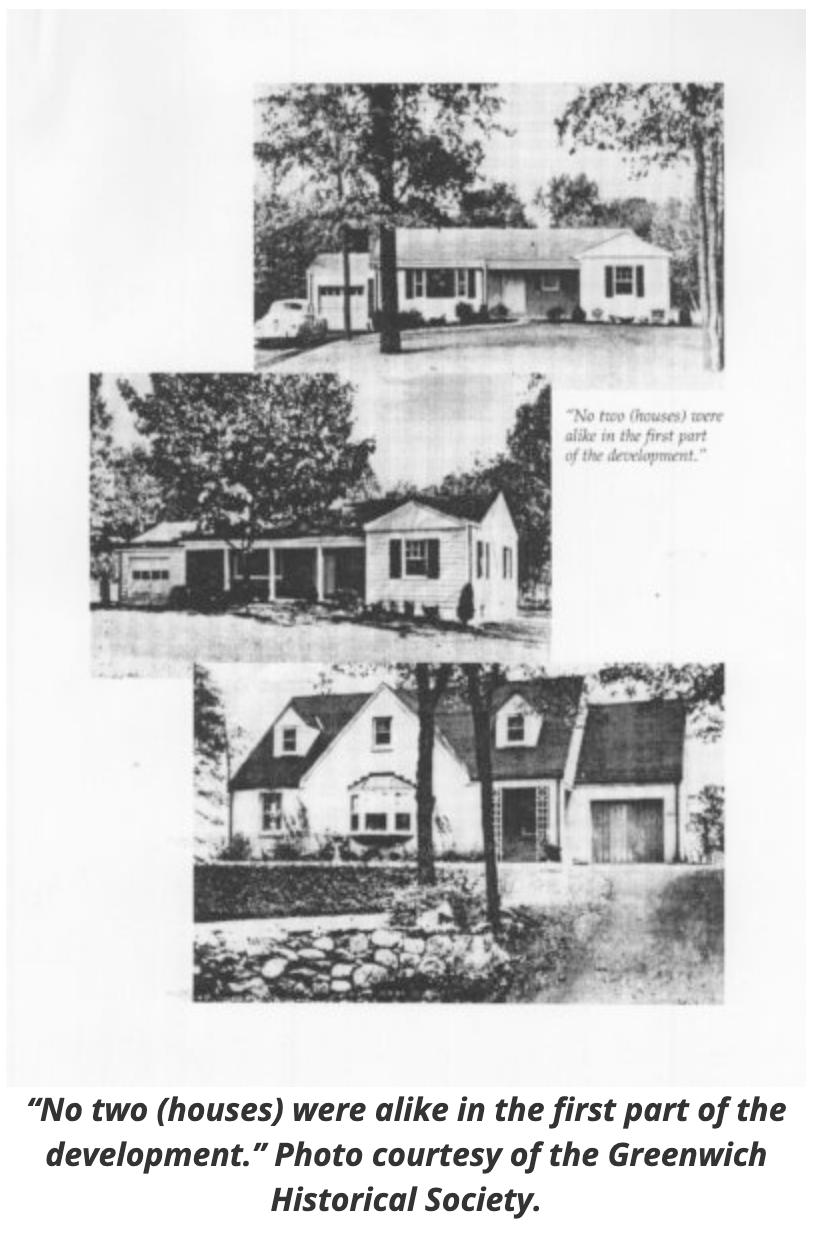
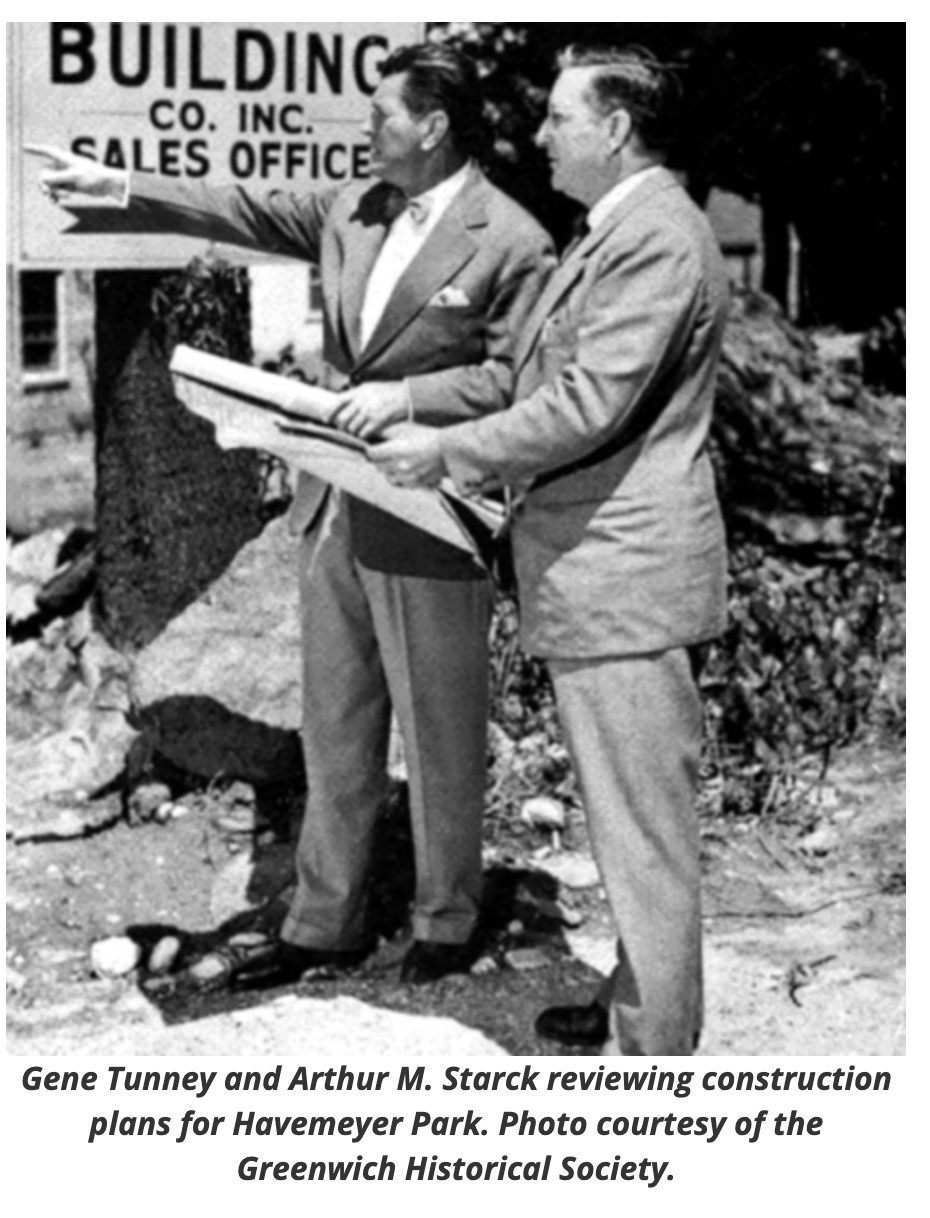
Gene Tunney, known primarily as the world heavyweight champion from 1926 to 1928, married socialite Polly Lauder of Greenwich in 1928. In 1946, he purchased the property from the Havemeyer estate for $178,000. Tunney, a former Marine, envisioned the land, now named Havemeyer Park, as a housing development for returning WWII veterans. He and Arthur M. Starck formed the Stamford Building Company. The Cape Cod-style homes were built on one-quarter acre lots. The first units were completed by 1947; eventually 360 of them were constructed. A $1,000 loan from the bank could procure a home priced at $10,000. It is no surprise that the neighborhood boasts street names like McArthur Drive, Halsey Drive, and Nimitz Place.

Ginny Ridenour, a former resident, recounted a story about Mr. Tunney. “I heard that in the early years he used to come along and check out the site; and if people would come out and say, ‘Mr. Tunney, I don’t have enough room for my garage’ or whatever, he would try to accommodate the wishes of the residents. And the builder finally told him, ‘You have to stay off the site because we can’t make all these changes.’”

Russell Vernet lived in Havemeyer Park from 1950 to 1996. When he moved in “practically everybody was a veteran…We had a Cape Cod, and it was a two-story, but the second floor was never finished; and the basement, of course, wasn’t finished. But, over a period of time I completely finished the upstairs into two bedrooms and a bath and made a playroom in the basement…Almost everybody who moved in was a hands-on handyman.” Vernet describes some of the streets as dirt roads “for a long time after we moved in…So there was a lot of roadwork that had to be done.”
Havemeyer Park’s population consisted mostly of young families. It was amusingly dubbed “Have a Baby Park” for the many children in the neighborhood. Ginny Ridenour remembered the first day she moved there in 1959. “My next door neighbor came over and she said, ‘Do you have children?’ and I said, ‘Yes, we have one.’ And she said, ‘Oh, I’m so glad because we have three.’ And from that moment on we began a beautiful experience in Havemeyer Park.”
Within the community there were many organized and impromptu social activities. From Boy Scout and Girl Scout troops to picnics, a garden club, costume parties, Valentine’s Dances and more. “We really had a whole social life right within our own area. Nobody joined the Newcomers or anything like that. They never felt they needed to,” according to Ridenour.

Russell Vernet described a Christmas tradition where a neighbor “used to put up a big screen in front of his house; and he had a projector and would project the words of the Christmas carols onto that screen. Then he’d play the accordion, and we’d all stand around and sing.”

The Havemeyer Park Owners Association, begun in 1948, grew out of concern for roads and traffic. In those days, according to Gerald Porricelli, past president of the homeowners’ association, “… we were speaking at Planning and Zoning Commission hearings, writing letters particularly about traffic, the density of traffic coming onto Havemeyer Lane and arranging for access out on Palmer Hill Road.” Over time, Porricelli commented, the population of Havemeyer Park has become more transient in nature and the number of neighborhood activities has diminished from its early days. “You see a lot of turnovers…we have working families with not a whole lot of time to give to these kinds of events.”

Ginny Ridenour reflected on her early days in Havemeyer Park saying, “It was a very positive period of our life, and I think this is what we’ve all come away thinking about it…I don’t know what the magic was, but we really did all have such fun…It was truly a unique place to start your life in Greenwich.”


I’ll add this: these were solidly-built homes: plaster walls, hardwood floors, good hardware and trim, and they stood up beautifully over the decades. Compared to what developers of what we’d now call “affordable housing” put up in Riverside in the 60s, they were truly remarkable houses. Tunney was a champ.

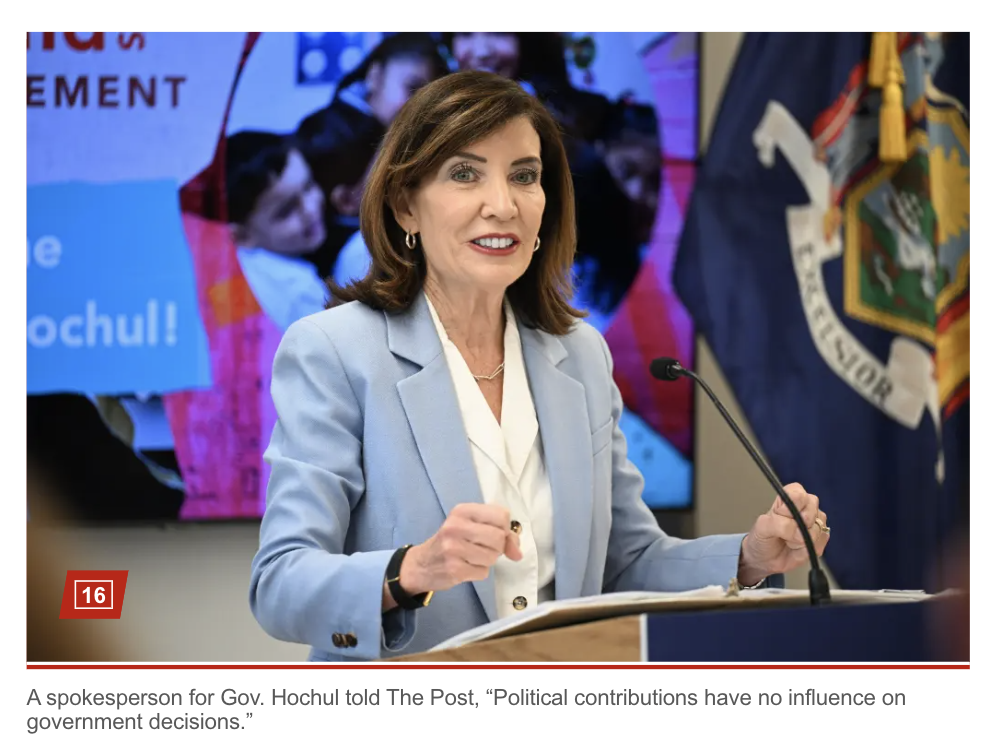
Not to worry, "these are gifts from Patriotic Americans who only want to express their love and affection for me, and their donations have absolutely no influence on me or any other Democrats”.

Owner of suspiciously vacant adult daycare billed Medicaid $32M while donating to Kathy Hochul, other Dems

Kathy Hochul received $55,000 in campaign contributions from social adult daycare centers (SADCs) in fraud-plagued Flushing, Queens, records show.

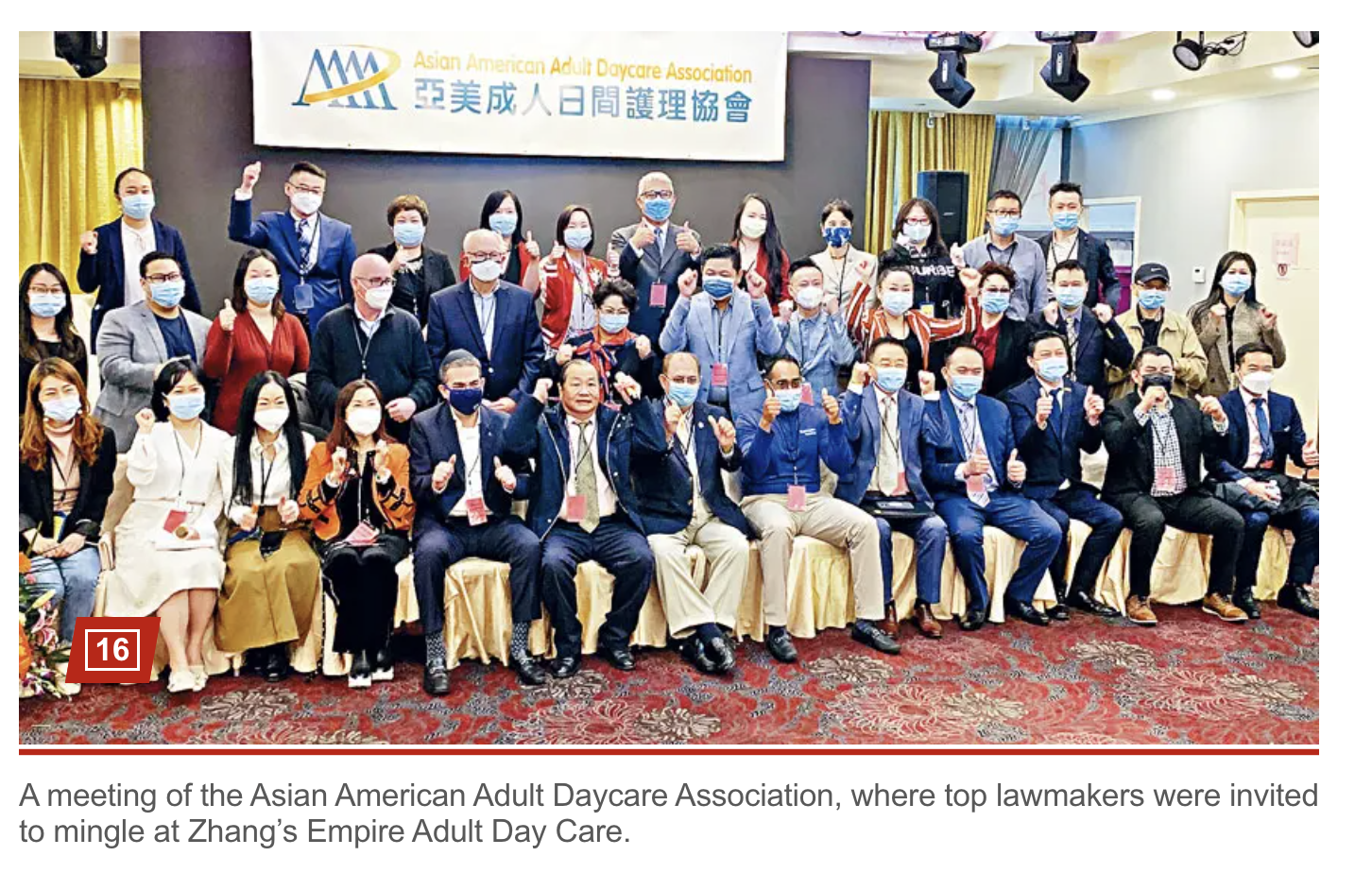
Almost half of those donations can be linked to two men: local powerbroker Baoli Zhang, and Jiemin Shang — who own two of Flushing’s biggest daycare businesses, both of which were empty of patients when visited by The Post last week.

Zhang, 69, personally donated $10,000, as well as another $5,000 through his Bao Kang Adult Day Care, financial disclosures show. Zhang’s various businesses have claimed at least $32 million from Medicaid since 2018, on behalf of tens of thousands of patients.

“In 2021, [social adult daycare centers] were dying due to COVID. Someone threw them a lifeline and must have said something like, ‘Take care of me, I’ll take care of you.’ They’re making more money than ever now,” an industry source claimed to The Post.

Federal figures back this up. Business has exploded at Livingwell, which billed $114,000 in 2018, a number that increased to $8.05 million in 2024. Bao Kang went from claiming $1.5M in 2018 to $7.22M by 2024. Monthly revenue for daycares across Flushing overall has nearly doubled compared to pre-pandemic numbers.

Only nine of the city’s nearly 400 SADCs made contributions over $5,000 to Hochul’s first gubernatorial campaign in 2022. Those same nine businesses accounted for billing Medicaid for an eyepopping $49 million in 2022, The Post’s investigation found.

….

Zhang also owns Confucius Social Daycare Center in Manhattan’s Chinatown, which billed Medicaid $15.7 million between 2018 and 2024; Silver Arch Management and AA Plus Management Inc. The latter is a “point of service” Medicaid provider that has billed taxpayers $2.65 million, according to federal data.

This is what happens when you prematurely announce that you're going to leave your children a mere billion apiece

Of course, she’ll never feel the discomfort of steel bracelets, let alone see the inside of a prison cell, but it’s interesting view of a seething, scheming daughter angered at being disinherited — well sort of disinherited; kinda, anyway.

Bill Gates’ daughter Phoebe accused of ‘cookie stuffing’ scheme that has max penalty of 20 years in prison: reports

Bill Gates’ “nepo baby” daughter Phoebe Gates, 23, has been accused of “cookie stuffing” at her multibillion-dollar startup, Phia – an illicit practice that comes with a maximum penalty of 20 years in federal prison, according to reports.

Phia – a digital personal shopping assistant co-founded by Gates with fellow Stanford alum Sophia Kianni – reacted with shock in July following reports that it was dropping more web “cookies” than it should, taking undue credit for online sales at retail partners.

[Wikipedia explains: “An investigation by Bloomberg News, as well as findings from independent consultant Ben Edelman, found that if a user shopped at an online retailer — even if they arrived at the site on their own or through another affiliate program like Wirecutter — Phia would open a new tab in the background. During the checkout process, Phia would override the referral codes from other affiliates and instead inject its own, allowing it to take credit for and potentially receive a commission on a purchase it didn’t earn. Edelman stated that statements made by the leadership of Phia, claiming it was a "bug", are misleading and concluded that "Deliberately building and deploying a feature called "auto_drop" that automatically sets affiliate tracking — cannot be dismissed as a mere bug. It's intentional, and it violates both trust and contract".

The company released a statement that it had only learned of the issue “within the last 24 hours,” pledging to fix the glitch – but according to a new Bloomberg report, the young entrepreneurs had known for at least seven months that their startup was overcounting its sales commissions.

Ariel Givner, founder and principal attorney at Givner Law, warned in a post on X Tuesday that “cookie stuffing” can come with serious consequences.

“It’s typically treated as federal wire fraud in US courts. There’s a possibility of a max penalty of up to 20 years prison + fines/restitution,” Givner wrote.

The startup – which raised a jaw-dropping $30 million in 2025 from backers including Hailey Bieber, Kris Jenner and Spanx founder Sara Blakely – operates as a browser extension, finding discount codes for customers across online retailers when they click on Phia at checkout.

When a shopper uses Phia by selecting one of its coupon codes, the software drops a “cookie” – which tracks activity across the web – to show that retailer it helped drive the sale and earn itself a commission.

But Kianni and Gates – the Microsoft princess whose dad is worth $108.4 billion, according to Forbes – were aware of features that dropped cookies into the checkout process even when customers did not use Phia, according to people familiar with the matter and internal Slack messages reviewed by Bloomberg.

The illicit cookie stuffing traced back to at least December across sales at several major retailers, including Nike, Gap and Nordstrom, and seemingly made up the bulk of Phia’s revenue, according to the news outlet.

After Phia disabled the features in July, average daily revenue at the company plummeted from around $80,000 to between $10,000 and $28,000, according to Bloomberg. 

In June, cookie stuffing accounted for about 51% of the merchandise value that Phia claimed credit for selling, the report said.

According to an internal dashboard viewed by Bloomberg, what Phia initially called a software bug in July was actually a feature called “enable coupon auto drop,” which the company was able to switch on and off.

At one point, Gates – who insisted that she wanted to succeed without her billionaire parents’ help, saying she has “such a desire to prove myself” – grew concerned that Phia wasn’t generating as much commission from Etsy as she had expected. 

She messaged developers to make sure that Phia was dropping a cookie each time its browser extension popped up, even if the shopper didn’t click a coupon, which would allow it to earn commission for the total gross merchandise value, the report said.

In a Slack channel on Dec. 18, she wrote: “worried this is an issue across the board…can u confirm auto pop for cookie drop is live on ALL sites w a coupon to confirm we are monetizing on all gmv.”

In a separate incident, Kianni suggested a feature that would drop a cookie each time a user simply tried to close out a Phia pop-up, according to Bloomberg. 

A colleague told Kianni that Google Chrome prohibits extensions from dropping affiliate cookies on “dismiss events,” or when a customer simply tries to close out a notification, and Kianni conceded.

But she added: “I guess we could say that the user is trying to open us and roll it back if they complain,” according to the report.

How impoverished is poor Phoebe that she was forced to defraud? Practically penniless, if you don’t count the millions or billions coming her way when Mother Melinda falls off the deck of their motoryacht.

AI Overview

Bill Gates plans to leave his three children less than 1% of his massive fortune, meaning over 99% will go to charity. However, because his net worth exceeds $100 billion, that "less than 1%" still amounts to more than $1 billion for each child.

The Inheritance Plan

  • The Share: Each child (Jennifer, Rory, and Phoebe) will receive a tiny fraction of the total wealth, calculated at under 1%.

  • The Value: With a net worth hovering around $100–$150 billion, 1% translates to roughly $1 billion to $1.5 billion per child.

  • Prior Support: Gates has noted that his children received an exceptional upbringing, top-tier education, and financial support for their foundational opportunities.

The Reasoning

  • Independence: Gates believes that handing children massive, multi-billion-dollar fortunes does not do them any favors or help them build their own identities.

Listed as both land and residence, this will be going as land, and probably well over ask, too

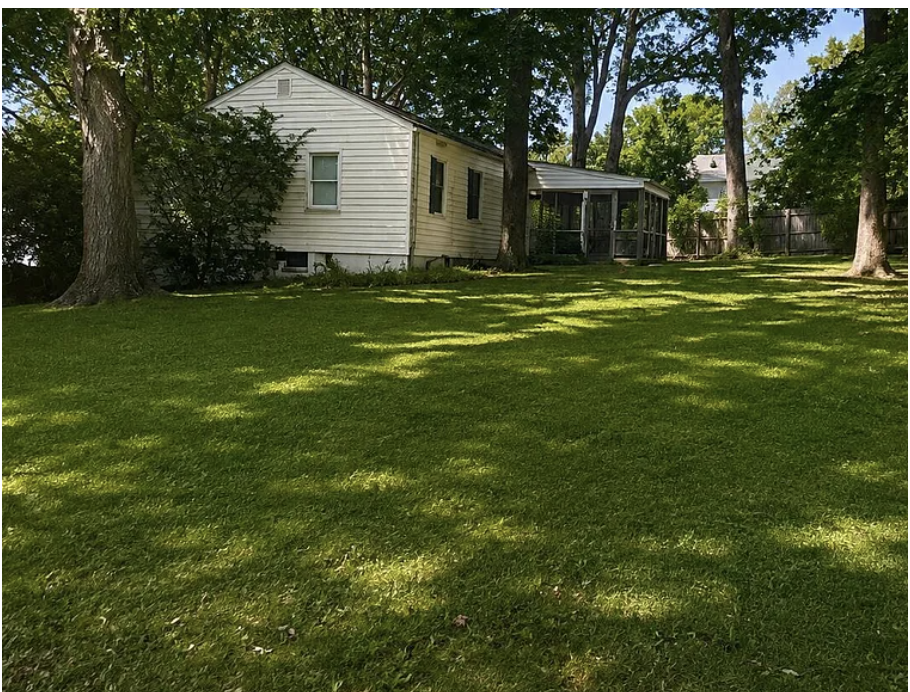
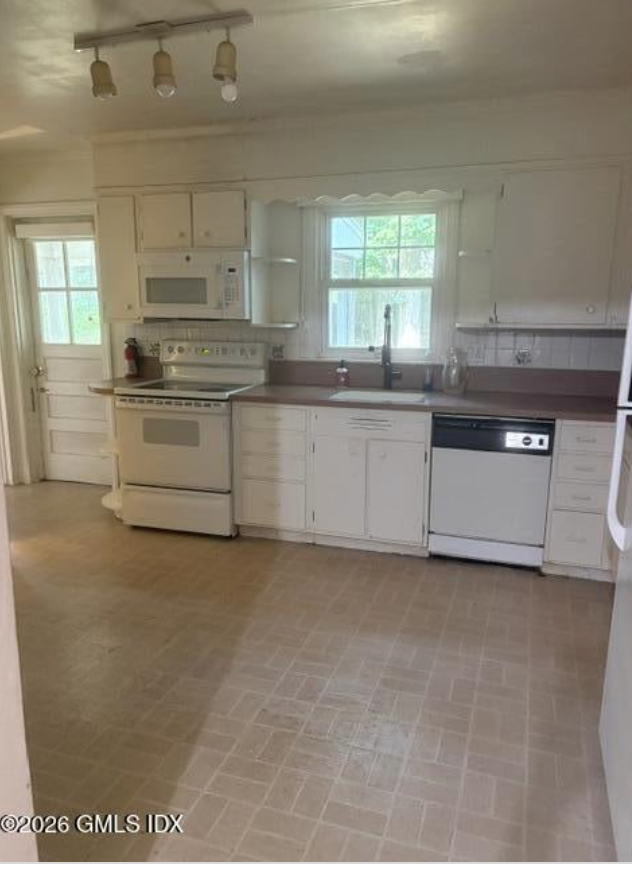
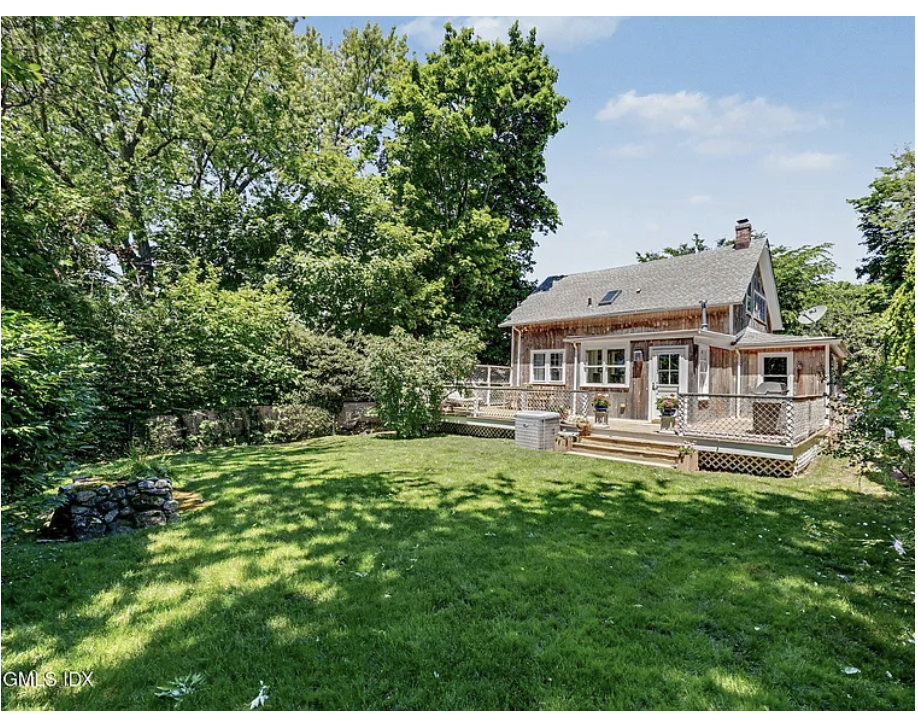
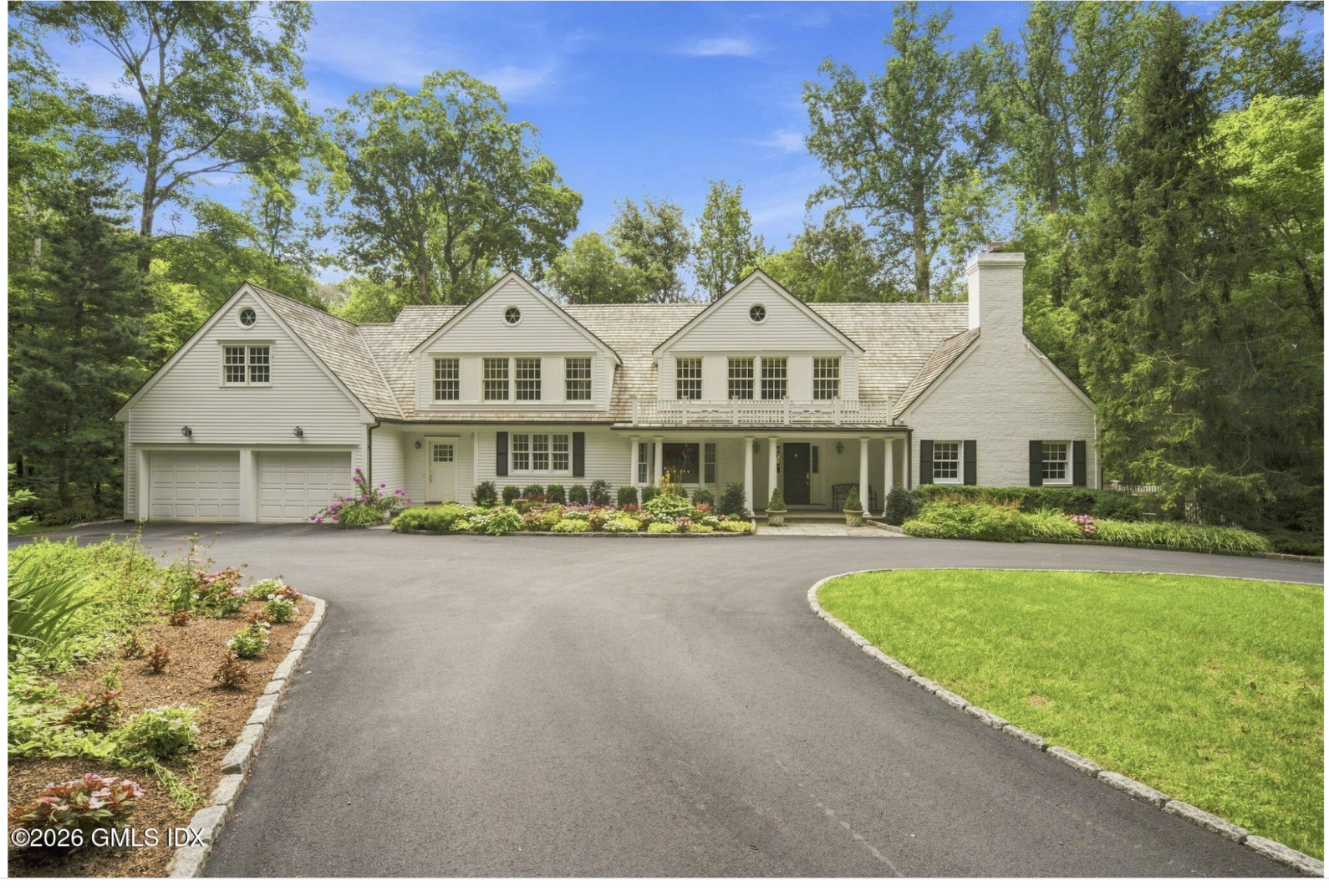
33 Nimitz Place, $1.65 million, whether one buys it for land or end use. It’s a 45-acre ;ot (19,602 sq.ft. in the R-12 — 12,000 sq. ft. minimum lot size, so something huge can be built here, and it certainly will.

It’s a shame: anyone who, by stretching, could scrape up to afford to buy this house as a starter home wouldn’t stand of chance of nabbing one of those $4.5 million subsidized luxury condos on Mason Street. What a dummy.

Luxury Housing for the few — and I’m not speaking of the rich

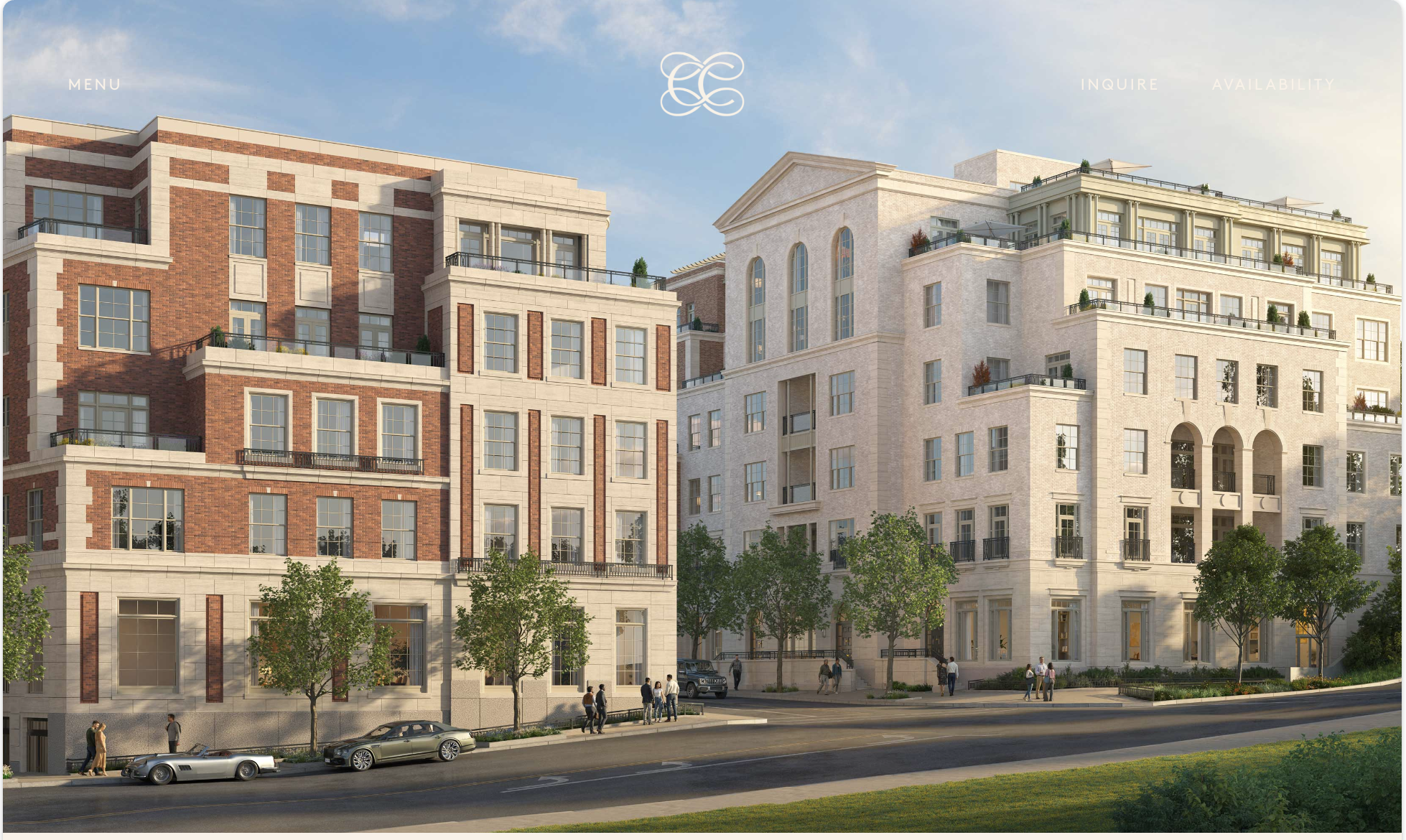
The legal wars continue, but the first initial marketing efforts for the luxury condos at the old D’Elia Honda location on Mason Street has begun.

Some of the long, tortuous journey through the P&Z and the courts is printed below, and there is plenty more at GreenwichWise, but essentially, in exchange for building far more units than zoning would otherwise allow, without setbacks, the builder must make 24 of the 75 units “affordable” and must match market-rate units in size and finish quality.

Here’s how “affordable” is defined:

Income and Affordability Limits for Greenwich (2026)

For Greenwich under CGS § 8-30g, the state median income standard applies because it is lower than the federal HUD area median metrics. The limits break down as follows:

AI Overview

Under Connecticut's § 8-30g statute, affordable housing is defined as residential units where households pay 30% or less of their annual income, and that income is 80% or less of the area median income (AMI).

  • 100% State Median Family Income: $129,500

  • 80% Adjusted Income Limit: $103,600 (overall cap)

  • 60% Adjusted Income Limit: $77,700

The units sound lovely; certainly I couldn’t afford one, nor could any of my children, and that’s the way the world goes ‘round — big deal. Except that, for 24 people, it doesn’t. For a monthly payment of, as I calculate it, $2,590 ($103,600 x 30% = $31,080 ÷ 12 = $2,950), approx. $370,000-$465,000, these lucky buyers will get to purchase a condominium unit identical to ones that less deserving people will be paying $4.5 million for, and up.

My question is, why are these two dozen buyers with incomes below $103,600 more deserving than, say, someone earning $103,700 a year? Or for that matter, $250,000? Or, let’s go wild here, $5,000,000? If, as certain Greenwich residents claim, there is a “moral obligation” to make a few units of housing available to a select few individuals who’d like to live in town, from where does that obligation arise, why does it extend only to a certain income class and then stop, and, most important, does it really stretch so far that there exists an obligation (and on whom?) to provide luxury housing worth $4.5 million for the price of a single bedroom rental apartment?

(Some background):

This Upcoming Connecticut Development Will Bring 78 Residences to Downtown Greenwich

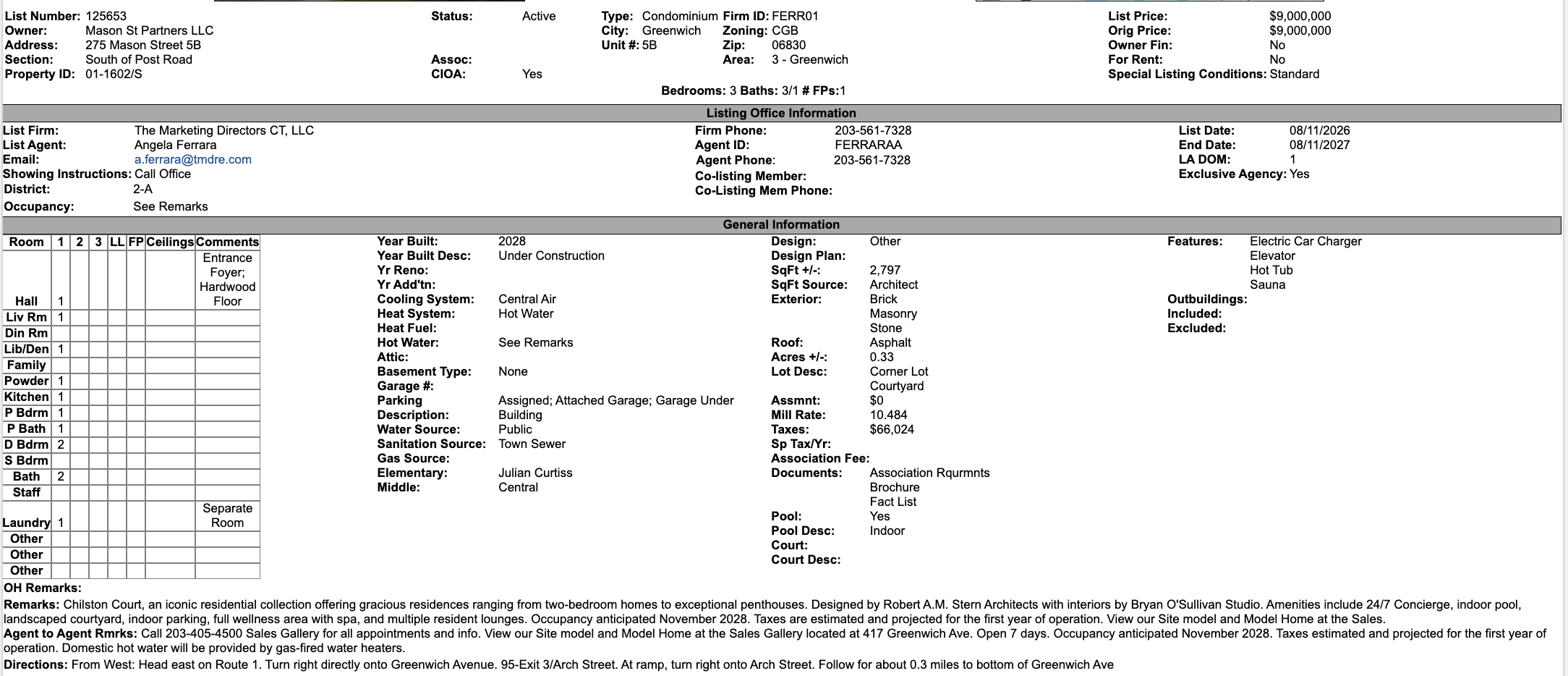
The Robert A.M. Stern Architects-designed Chilston Court will offer condos and penthouses priced from roughly $4.5 million to upward of $10 million

…. The residences range from two-bedroom homes to penthouses, with even the smallest layouts measuring more than 2,000 square feet. Caspi said the units were intentionally designed with oversized primary suites, generous closets, wide hallways and ceilings exceeding nine feet so owners accustomed to sprawling Connecticut estates wouldn’t feel as if they were sacrificing comfort simply because they were moving into a condominium.

Rather than trying to recreate a suburban estate, Chilston Court instead borrows cues from luxury hospitality. Interiors by London firm Bryan O’Sullivan Studio are complemented by roughly 10,000 square feet of shared amenities—including a lap pool, wellness facilities, a 20-person private dining room, and speakeasy—along with concierge services and dedicated delivery closets that allow packages, groceries, and laundry to be dropped off while residents are away.

Chilston Court apartments start around $4.5 million and climb past $10 million.

The developer and the town are still mired in litigation, and this will probably all drag on for years, The article below, however, was published before last week’ Superior Court decision upholding the Town’s demand that all “affordable units” units be comparable to their multi-million dollar neighbors.

Developer sues Greenwich Planning & Zoning over limits put on Mason Street affordable housing project

GREENWICH — The Planning & Zoning Commission is being sued by developers over conditions it imposed on approvals for two large residential buildings on Mason Street that were authorized by the commission in December.

The lawsuit seeks to overturn the conditions and grant approval for the project with retail space and no restrictions on the size of the affordable units.

Mason Street Partners and developer Joshua Caspi say the conditions that the commission imposed went against state law 8-30g, which is designed to provide the community with affordable housing units. The law states projects offering affordable housing units, as the Mason Street development has been proposing, can only be denied or modified on "health and public safety" issues.

The lawsuit contends that the conditions imposed on the approvals — eliminating any retail space from the project and requiring that the affordable units be nearly identical in size as the market-rate units — ran counter to the state law and should be invalidated.

The lawsuit has been filed in State Superior Court in Hartford. A message sent to the office of town attorney Barbara Schellenberg was not returned.

The long-running and controversial project was resubmitted to the Planning Commission in November, with a reduced number of total units in both buildings on Mason Street set at 75, down from 92 in an earlier draft. The 24 affordable units were evenly distributed in the two buildings. 

During review, the commission went into a lengthy discussion about "comparability," seeking to ensure that the affordable units did not carry any perception that they were of lesser value or quality. Commissioners said they wanted to avoid any perception of "a rich door, poor door," in the phrase that came up during discussions of the application. 

As part of its condition for approval, the commission required that the affordable units would have to be no less than 90% of the size of the market-rate units. The commission also said there could be no retail space in the buildings, which would have taken up around 4% of the total square footage of the new construction.

The developers in their suit took issue with the requirement for "comparability."

According to the legal complaint filed last month, "Mason Street Partners responded to this concern by pointing out that comparability is not a health or safety concern," the lawsuit stated. In addition, the developers claimed, earlier court rulings held that "comparability was 'a matter of opinion' that cannot be a basis of denial.” Further, they stated, the smallest affordable units in the Mason Street development would be larger than most of the condo units on the market in Greenwich at full price. 

Because the project is taking advantage of state law 8-30g, providing the community with affordable housing units, the town Planning & Zoning Commission has little regulatory power over the proposal. Under the state law, the developers can override local zoning codes for the goal of creating affordable housing. The project does not meet the normal setback requirements from the street in central Greenwich, and the structures are higher than what would normally would be allowed.