Paste Eaters in Pradise

I get it, I think: the average voter doesn’t know why food prices are up, his electric bill has tripled in the past decade, and his rent’s soaring out of his reach, he just knows that it’s happening, and he wants it to stop, and he blames whichever party’s in power for not ending the misery. He sees, he objects, but he never asks why things are so, never asks if, for instance blocking construction of natural gas pipelines or tacking on a “social service” charge to utility bills might have contributed to his woes. “I don’t want to know the reason, just fix it, and if you can’t, I’ll vote for the other guy.” Ant that’s why — there’s that word again — it seems likely that the country’s about to hand the reins back to the very people who created this mess in the first place.

Sad.

Trump's not on the ballot but swing state voters still cast ballots with MAGA in mind

"Republicans have showed in the past two years that they really have made things worse," Chris from Doylestown said when asked if he believes Democrats will bring down prices. "Gas is way up, the energy is way up, food's way up. There's nothing that's cheaper, so they can't argue that."

"I mean, Donald Trump's in office, how much worse can it get?" he went on. "Telling me that it can get worse than this? It's the worst it's ever been. You think that by having... Democrats in office... that somehow it's gonna make things go even higher? I don't think so."

I paid $1.67 for a gallon of gasoline on January 20, 2021, the day Biden was inaugurated. Under his rule, gas hit a peak national average of $5.01 in June 2022, and stayed lodged in the stratosphere for the rest of his term. That should have pleased his constituency — after all, Obama’s Energy Secretary called for $8 gas in 2008, and the president and fellow democrats took immediate steps to achieve that, shutting down pipelines and power plants and preventing new ones, as well as refineries, from being built. Yet somehow, the people were dissatisfied. Not enough to stop them from voting to keep him office for two terms or bringing back his Vice President in 2020, but unhappy nonetheless.

All the noble sounding goals of Democrats are met with huge public support, until the chumps discover that, despite the promises otherwise, they’ll have to pay for them themselves. “Free” solar energy, is just one example. Medicare for All is another:

Medicare for All Is Popular—Until People Find Out How It Would Work

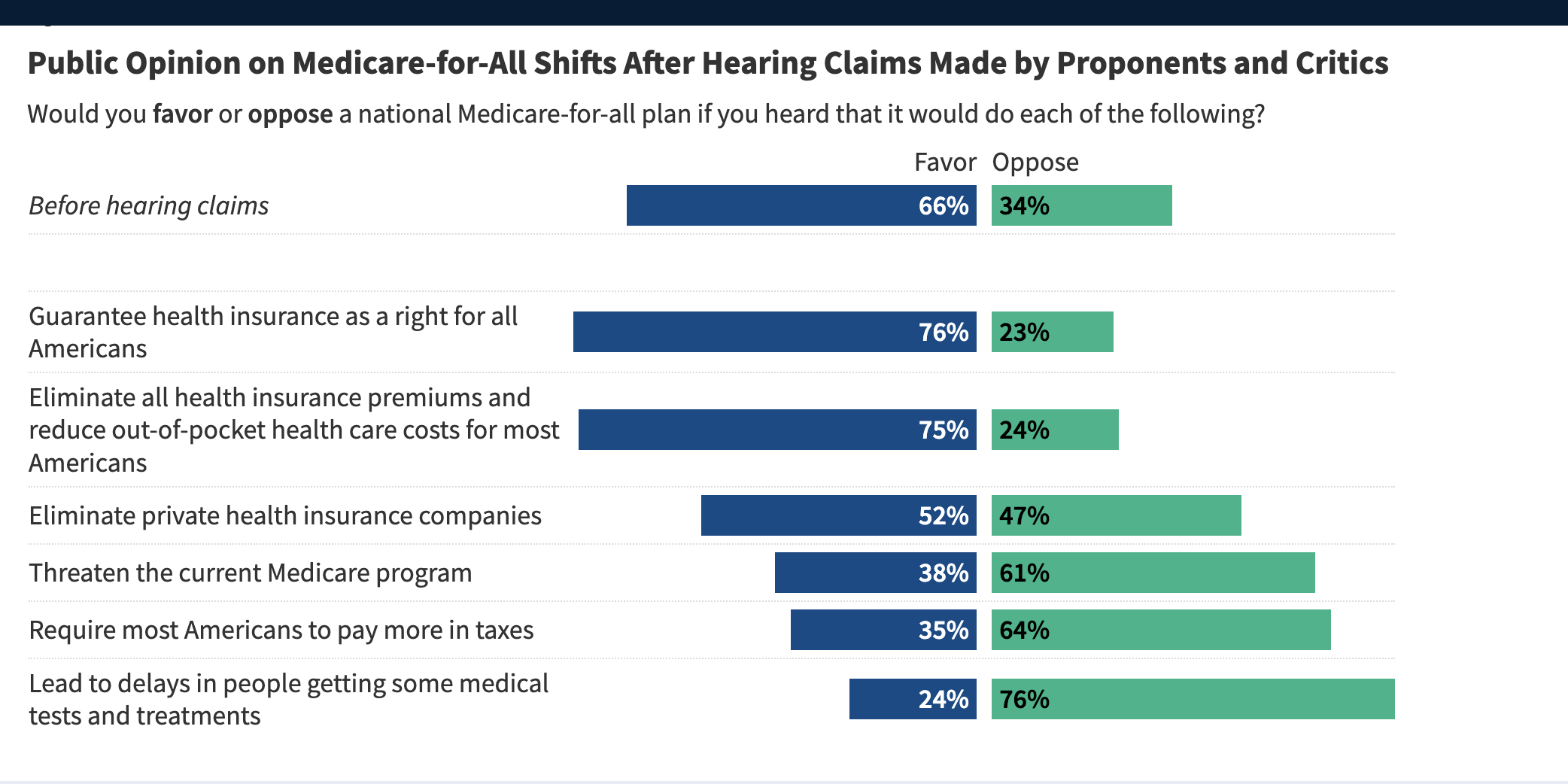
Medicare for All may be a popular slogan, but the policies that would be necessary to make it work would not be. A recent poll found that Americans approved of Medicare for All in principle by a margin of 66 percent to 34 percent—but they opposed it, 64 percent to 35 percent, if it would increase their taxes, and by 76 percent to 24 percent if it delayed access to medical tests and treatments.

Here’s that poll referred to:

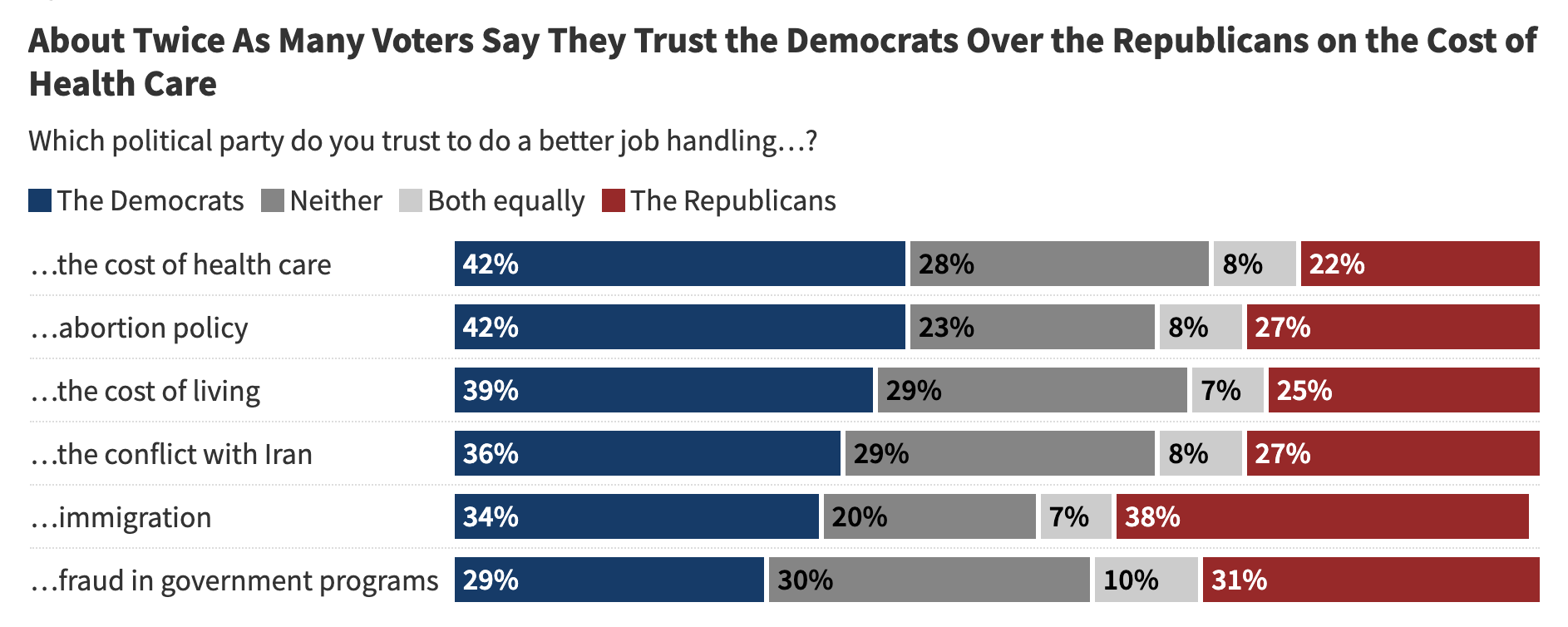
With about a month to go before Election Day, the latest KFF Health Tracking Poll finds a large enthusiasm gap between partisans, with Democratic voters much more likely than Republican voters to say they are “more motivated” to vote this year than usual (63% vs. 38%). As voters make their final assessments before they cast their ballots, the Democratic Party has a clear edge over the Republican Party on who voters trust to handle many top issues in the election, including the cost of health care (42% vs. 22%) and the cost of living (39% vs. 25%). Notably, the size of the gap between the Democratic and Republican parties on health care costs has increased since April of this year, when 37% said they trusted the Democrats and 26% said they trusted the Republicans.

  • Health costs continue to be a top affordability worry for voters, tied with concerns about gas prices as in recent months. Six in ten voters are worried about being able to afford their health care costs, and about half of voters say it is “extremely important” for candidates in the midterm elections to talk about the cost of health care—ranking alongside the cost of living as the top two issues voters want to hear candidates talk about in the closing weeks of the midterm campaigns.

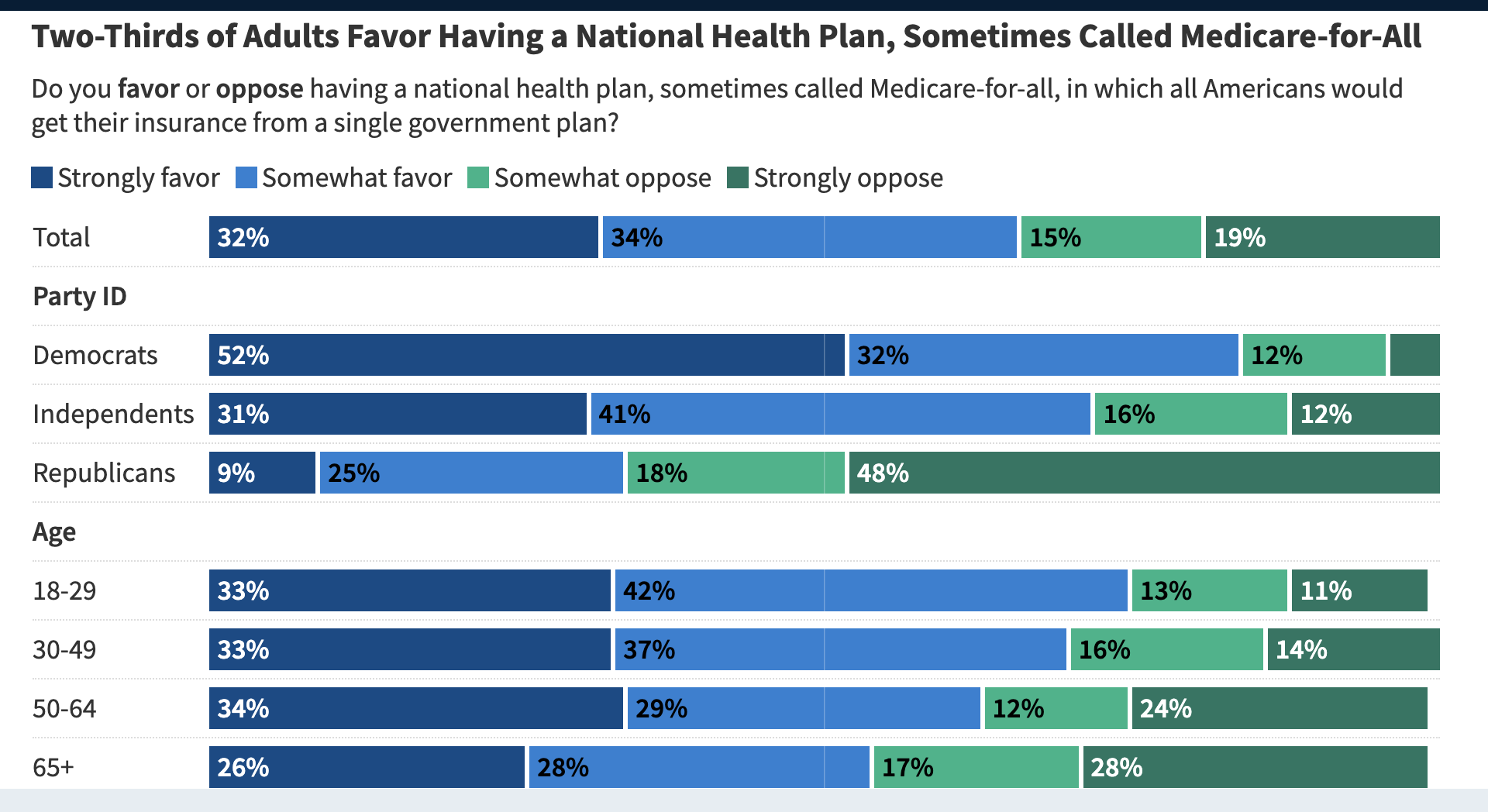
  • There is bipartisan support among the public for major changes to the country’s health care system, but partisans have vastly different views of the type of change needed. Large majorities of adults, including about nine in ten Democrats and three-quarters of Republicans, say the U.S. health care system needs either a complete overhaul or major changes. Reflecting the increased attention to Medicare-for-all in congressional races where some progressive Democrats have campaigned on it, two-thirds (66%) of U.S. adults now support Medicare-for-all, up from 53% when KFF last asked the question in October 2020. Views of a single-payer system remain highly partisan, with majorities of Democrats (84%) and independents (72%) saying they favor it, compared to 66% of Republicans who oppose such a plan.

  • Despite the public’s generally favorable view of Medicare-for-all, support drops when people hear criticisms of such a plan commonly made by opponents about the potential for higher taxes, longer wait times, or threats to the current Medicare program. On the other hand, support for Medicare-for-all increases when people hear claims made by proponents, including that such a system might guarantee health coverage as a right for everyone or eliminate insurance premiums and cost-sharing. Taken together, these findings suggest that while a majority supports Medicare-for-all in the abstract, support is likely to shift over the course of any public debate in which the public hears arguments for and against such a plan. For a summary of historical KFF polling data on opinions of Medicare-for-all, see here.
I don't want to be treated by a doctor who while training and being paid $88,662 annually "had difficulty" `figuring out how to feed himself

The claim:

1 in 5 CT medical trainees lacks reliable access to food.

That trainee doctor treating you at a teaching hospital may be struggling to afford food, a new study by Yale Medical School has found.

Yale researchers reporting in the Journal of the American Medical Association found that 45.3% of first-year medical residents in the Yale New Haven Health System reported some level of “food insecurity,” and 1 in 5 of all medical trainees reported lack of access to food. Finances were the barrier for many, the study found. 

“Lack of money was associated with food insecurity,” the researchers wrote, recommending additional support for medical trainees. 

Residents and fellows often provide front-line care in emergency rooms and other settings at teaching hospitals, as depicted in the television series “The Pitt.” [top-notch reporting, using a television show as a source – ED]. Food insecurity can add to the stress of training, alongside burnout and social isolation, the researchers said.

A first-year resident at Yale earns $88,662 in total salary, according to the Yale School of Medicine website. At the same time, medical school graduates who borrow for their education owe an average of $227,514 in student loans, according to the Education Data Initiative. [None of which need be repaid until after graduation, so this number has nothing to do with the supposed ‘food insecurity” the poor dears are suffering from now — ED].

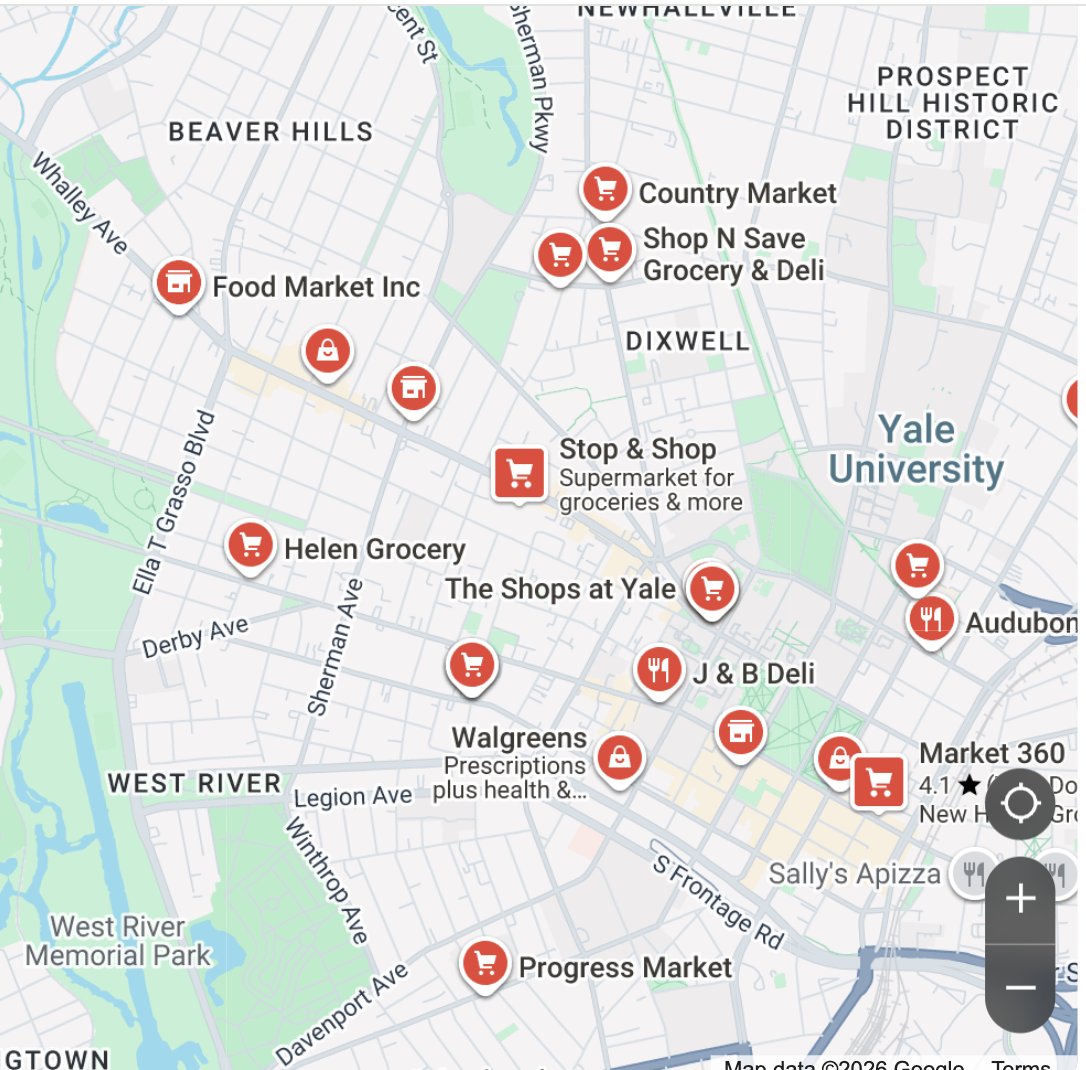
In addition to financial stress, the doctors said a “lack of accessible grocery stores” played a role in their food insecurity. 

As to that, the reporter didn’t ask, so I did:

No time to cook for themselves? No problem

Q: What dining options are available to yale new haven medical residents?

AI Answer:

Medical residents at Yale New Haven Hospital (YNHH) have access to multiple institutional dining facilities, on-campus student venues, and local street options. Because residents frequently transition between the hospital buildings and the Yale School of Medicine campus, their choices span hospital-operated cafeterias, university dining halls, and dedicated resident lounges.

Hospital Cafeterias & Cafés

The York Street Campus (YSC) serves as the primary hub for inpatient rotations, offering multiple dining options where residents can use hospital-issued meal stipends or cards: [1, 2]

  • East Pavilion Cafeteria (Main Cafeteria): Located on the first floor of the Atrium lobby, this is the main dining space. It is open 7 days a week from 6:00 AM to 8:00 PM and offers full hot entrees, a grill section, a salad bar, and rotating healthy options. [1, 2, 3]

  • Atrium Café: Located in the main lobby, serving salads, pizza, sandwiches, sushi, and coffee on weekdays from 6:00 AM to 4:00 PM. [1]

  • New Haven Pavilion Cafeteria & Café: Located on the second floor of the Clinic Building, open weekdays from 7:30 AM to 2:00 PM. It features an attached Peet’s Coffee bar open weekdays until 3:00 PM. [1, 2]

  • Smilow Cancer Hospital Cafés: Residents rotating through Smilow can stop by the Park Street Coffee Shop (1st floor, open weekdays 6:30 AM to 3:00 PM) or the Overlook Café (2nd floor, open weekdays 9:00 AM to 5:00 PM). [1, 2]

Dedicated House Staff Amenities

For quick breaks during a shift or overnight call, residents have exclusive access to specialized benefits: [1]

  • House Staff Lounge: YNHH provides a dedicated resident lounge equipped with televisions, a refrigerator, 24-hour coffee, and nightly food deliveries specifically designated for on-call staff.

  • Stipends: Programs under Yale New Haven Health include a pre-loaded food allowance or monthly stipend that can be spent directly across the various hospital cafeterias. [1, 2]

JAMA ‘s “study” admits that the authors used a different definition of food insecurity than the federal government’s. Was that so they could reach a pre-determined outcome? Oh, that woud never happen, this is science.

These findings should be situated in their broader social context. Resident physicians earn salaries well above the federal poverty level, and reported food insecurity in this population differs in severity and circumstance from that experienced by economically marginalized households; our findings are not intended to equate the two. The USDA measure assesses consistent access to adequate food given a household’s resources and competing obligations, not income alone, and food insecurity above the poverty threshold is well documented.2,3 The mechanisms underlying reported food insecurity in this relatively well-compensated population remain undetermined and warrant direct study.

That last sentence: “the mechanisms [for these results] remain undetermined” is essentially saying, we don’t know why this segment of Residents report they are unable to afford food, because we didn’t ask.” Despite a plentiful supply of food stores in the immediate area, and subsidized cafeterias on campus, nearly a third of relatively well-compensated medical trainees experience food insecurity? Really? Why? And, follow-up question, why didn't the researchers examine whether respondents actually used them, what they paid for meals, and whether their reported difficulties were financial or logistical?

This is “researching” and reporting for headlines, not facts.

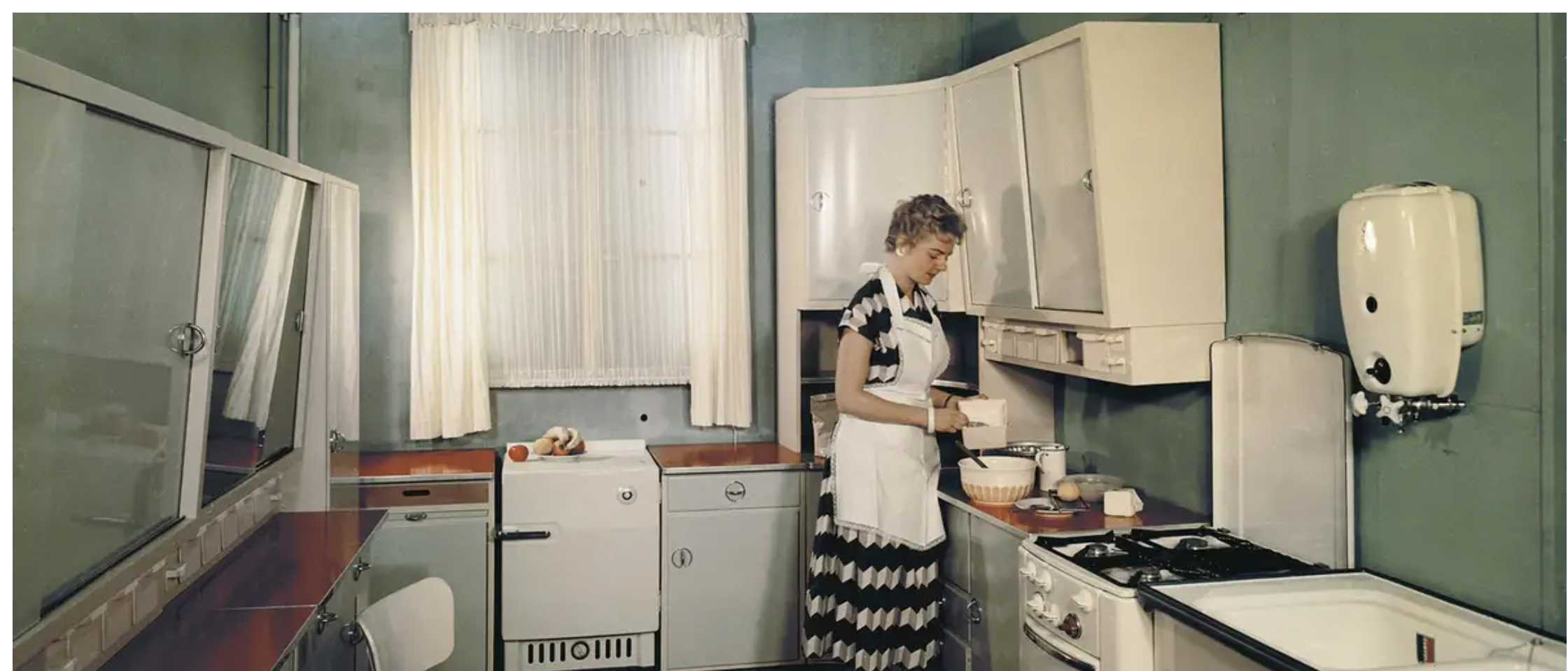
Speaking of happy home design, let's not forget the original communist model, the Frankfurt KItchen, designed by a communist and built for the 1925-1930 New Frankfurt Project

It’s architect trundled off to the Soviet Union along with the other originators of the scheme, but her influence remains; in fact, look for the resurgence of the entire package: communal housing, kitchens and right-thinking alike, come next Tuesday.

The Guardian October 7, 2021

Meg Conley:

Invisible fridges and cooling cubbies: how kitchens have been designed for the rich

The latest status symbol in kitchens is invisible appliances – but hiding behind that fridge disguised as a cabinet is a long history of people trying to engineer society

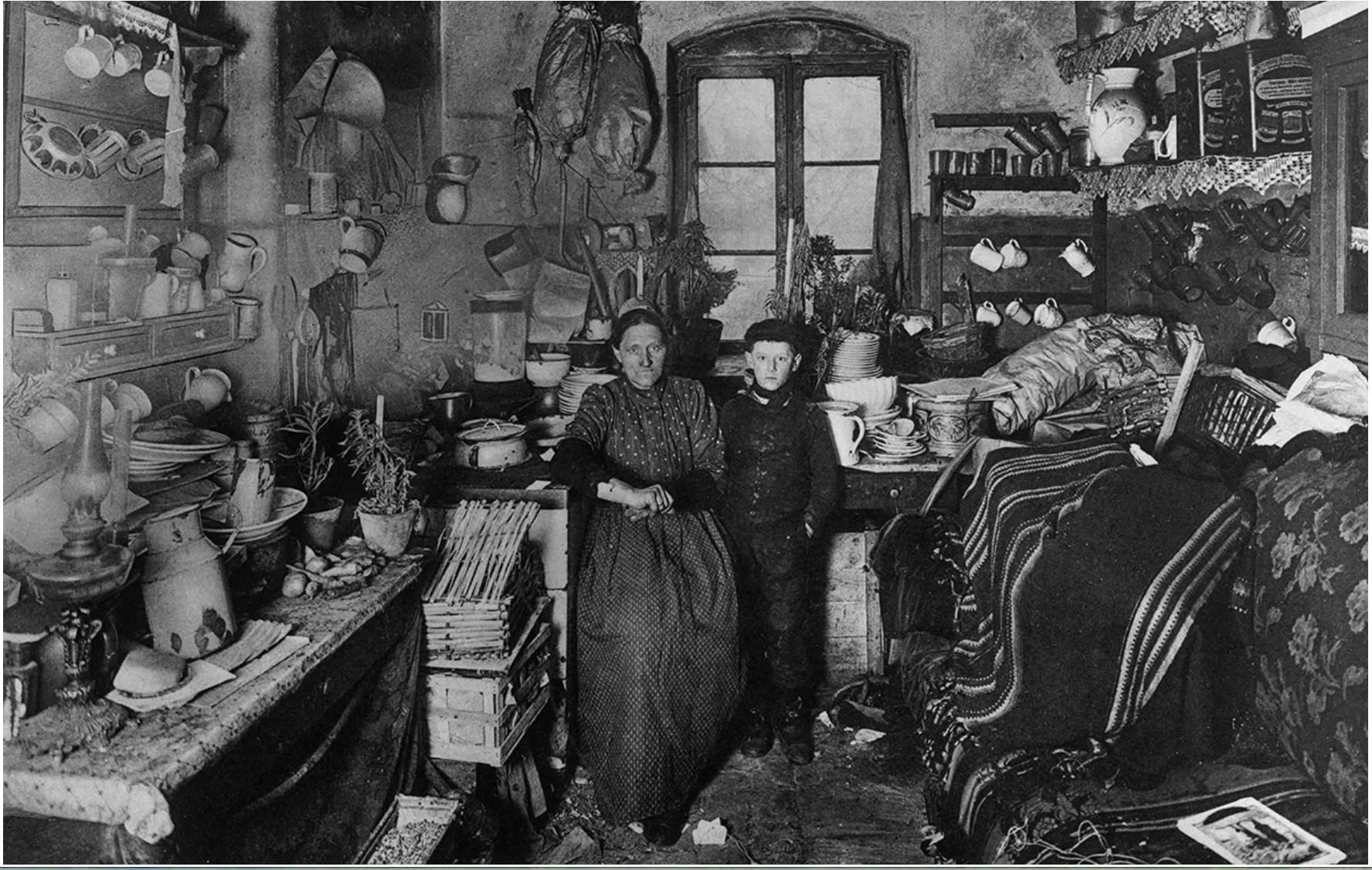
…… A practical theory of kitchen design didn’t emerge until the 20th century. Until then, kitchens were just random bits of furniture and a stove shoved in attics, basements and poorly ventilated back rooms. Architects didn’t care about kitchens because their high-end clients’ kitchens were filled with servants.

After the first world war, the architects behind New Frankfurt, in Germany, were tasked with finding a way to build affordable housing that fostered community and equality by design. This time, the architects decided to include kitchens in their world building. Grete Schüette-Lihotzky, the first female architect in Austria, was in charge of the kitchens. In a 1997 interview before her 100th birthday, she said: “Before I conceived the Frankfurt kitchen in 1926, I never cooked myself. At home in Vienna my mother cooked, in Frankfurt I went to the Wirtshaus. I designed the kitchen as an architect, not as a housewife.”

She was not a housewife, but that did not keep her from respecting the women who were. Lihotzky believed the work of the home was real work. She thought it should be treated with professional dignity.

Using the research of the home economist Christine Frederick, Lihotzky created an orderly layout of storage, appliance and work surface. Frederick was an odd silent collaborator. Lihotzky was a passionate communist dedicated to an egalitarian future, while Frederick is widely credited with disseminating the 20th-century version of the separate spheres of men and women. She was also influential in arguing that all mass-produced home goods should be made to fall apart so that industries could keep making mass-produced home goods. (This is called planned obsolescence, and tech companies still do it today.)

Still, Lihotzky took Frederick’s measurements seriously. Cabinets, shelves, appliances, work surfaces were each fixed in place, fitting precisely.

Inspired by the efficiency of research labs, Lihotzky standardized kitchen workflow and under cabinet storage. Your kitchen looks a little like a lab, standing work surfaces and cabinets lining the wall, because in 1926 a woman decided to give it the dignity and efficiency of one.

Lihotzky’s kitchen is boldly utilitarian. It’s gunmetal green because research suggested flies disliked the color [Whose “research?” Lysenko’s — ED]. Form follows doggedly after function on every surface and in every cubby. She created the first fitted, or built-in, kitchen, complete with standardized cabinets and standardized liberation. Ten thousand of Lihotzky’s Frankfurt kitchens were built in New Frankfurt.

In 1930, buoyed by the success of her kitchen, Lihotzky accepted a commission to help design cities for the first of Stalin’s five-year plan. The first plan was supposed to turn the Soviet Union into a great industrial power while creating a collective Soviet culture. She was asked to help design a world that could foster Soviet ideals. Lihotzky helped design Magnitogorsk, an industrial city built around steel production. Magnitogorsk served as a shining example of the supremacy of the Soviet Union.

Shockingly, the Guardian author actually inserted this tiny caveat into her artcle before resuming her Marxist cant:

While Lihotzky designed a new world, others were subjugated for it. People were imprisoned so they could provide the hard labor required by Soviet ideals. Agricultural land owned by the peasant class was collectivized through brutal, bloody force. People kept dying but Lihotzky remained.

Then back to her regularly scheduled program:

She finally fled the Soviet Union in 1938 during Stalin’s final Great Purge. Even the architects who helped build Stalin’s world were not safe any more. In 1940, she returned to Vienna to join the resistance against the Nazis. She was caught by the Gestapo and jailed for four years. Her liberation was designed by US troops in 1945. Despite the success of the Frankfurt kitchen, Lihotzky was not invited to help rebuild her country after the war. People were too wary of communist design. She spent the rest of her career working as a consultant for communist governments, rationalizing liberation through standardized measures.

The Frankfurt kitchen sought to help women put drudgery in its place. Twentieth-century American appliance advertisements promised to free women of the drudgery altogether. Washing machines, dryers, dishwashers, toasters, refrigerators, garbage disposals and adjustable temperature irons all made their first domestic appearances in the first half of the century.

Once appliances could be mass produced, they needed to be sold. Thanks to planned obsolescence, once they were sold, they’d always be bought again.

In the 1920s and 30s, appliance advertisements called appliances “invisible servants”. By the 1950s, the domestic help angle was dropped in favor of domestic pride. Kitchen design was overtly political once again, and the purpose of the home was remade.

Historically, homes have been a unit of consumption and production. Some homes consumed grain while producing children and textiles, for example. In cold war America’s propaganda and policy, the home became exclusively a unit of consumption. The kitchen was the consuming center of that home. It was a white woman’s patriotic duty to have a house full of capitalist produced, time-saving appliances. She was supposed to use her saved time to devote herself to the American model of womanhood – a careful, carefree housewife with pristine children and a pristine home. Her home wasn’t a work space, it was a lifestyle.

Marietta Shaginian, a Soviet journalist in the 1950s, called the American kitchen “‘ideologically inappropriate’ because it was designed not to help the working woman achieve self-realization but to compensate the middle-class ‘professional housewife’ for her lack of a place in the public arena”. American housewives were not expected, or welcome, in the public arena. And they certainly weren’t about to be paid for their work in the private arena. You could hardly pay a woman for her work in the home if you were determined to prove consumerism ended her work.

Some racist white feminist architects envisioned a life truly free of domestic work spaces. They sought to free white women, and their homes, of kitchens altogether. The oppression of Black women and women of color was often an integral part of their designs. In the early 1900s, Alice Constance Austin was commissioned to design a socialist commune of kitchenless houses. Food would be cooked in a central kitchen and sent to communal patios by a series of underground rails. Laundry would be taken care of this way too. The central kitchen would be staffed with paid labor.

Applications to become a member of the commune were open exclusively to white socialists. The commune’s founder didn’t think it was “expedient to mix the races in these communities”. There’s no way to know what their employment terms would have been, however. Austin’s vision of a home without a hearth was never built – the commune fell apart over a lack of water and leadership.

Sometimes the kitchenless house got literary support. In Women and Economics, Charlotte Perkins Gilman, author of the feminist classic The Yellow Wallpaper, opines: “Take the kitchens out of the houses, and you leave rooms which are open to any form of arrangement and extension; and the occupancy of them does not mean ‘housekeeping’. In such living, personal character and taste would flower as never before … The individual will learn to feel himself an integral part of the social structure, in close, direct, permanent connection with the needs and uses of society.”

An early precursor to today’s “No Human is Illegal, Who’s Going to Empty Our Bedpans and Rake Our Leaves?” open border crowd:

Certainly a house without a kitchen still holds people who need to eat. If the men and women of the house aren’t doing housework, who is? Who is dusting those rooms where taste flowers and the form of society itself is touched? For Gilman this was “a need for labor unmet”. In 1908, she published a paper in the American Journal of Sociology explaining how to meet that need, titled, “A Suggestion on the Negro Problem”. Gilman wrote that the mere fact of Black people in America caused “social injury”. Her “suggestion” for that “problem”? A forced labor corp, complete with uniforms and bases.

She argued that Black people “should be taken hold of by the state” and “enlisted” into forced labor. “Men, women, and children, all should belong” to her “proposed organization”. The “enlisted” would be made to labor on farms, in mills and in building roads and harbors. Gilman suggested the state build “a training school for domestic service” at each enlistment base. Once trained, “individuals could be sent … on probation … to remain out in satisfactory home service. In case of unsatisfactory service they should be re-enlisted.” In Gilman’s ideal world, Black people were “free” to clean Gilman’s house or face enslavement – a chilling and dystopic vision.

And the author’s conclusion? Exactly what the next generation of paste-eaters is being fed in our schools todaay:

None of their blueprints made room for the meaning of the work in the kitchen

White communists, white socialists, white feminists, white capitalists and white supremacists were all hoping to engineer whole societies by designing the kitchen. Each saw kitchens as permanently fitted with women – they just disagreed over what that meant. All kept the footprint of patriarchal understanding and most anchored deep into racist foundations. None of their blueprints made room for the meaning of the work in the kitchen. Forget the meaning, they could hardly be bothered with the function.

It’s time to design the kitchen for the world we’ve engineered. Women have traditionally cooked in the kitchen. But they’ve wept and screamed there too. What work surface will bear our scratches best? Is there a line of cabinets deep enough to hold our grief?

Maybe the rich have got it right with their hidden fridges. Why pretend the substance matches the surface? It never has. We could start covering everything with cabinet panels. Sinks, stoves, counters, windows. The new status symbol is an invisible kitchen. Everything is cabinet now.

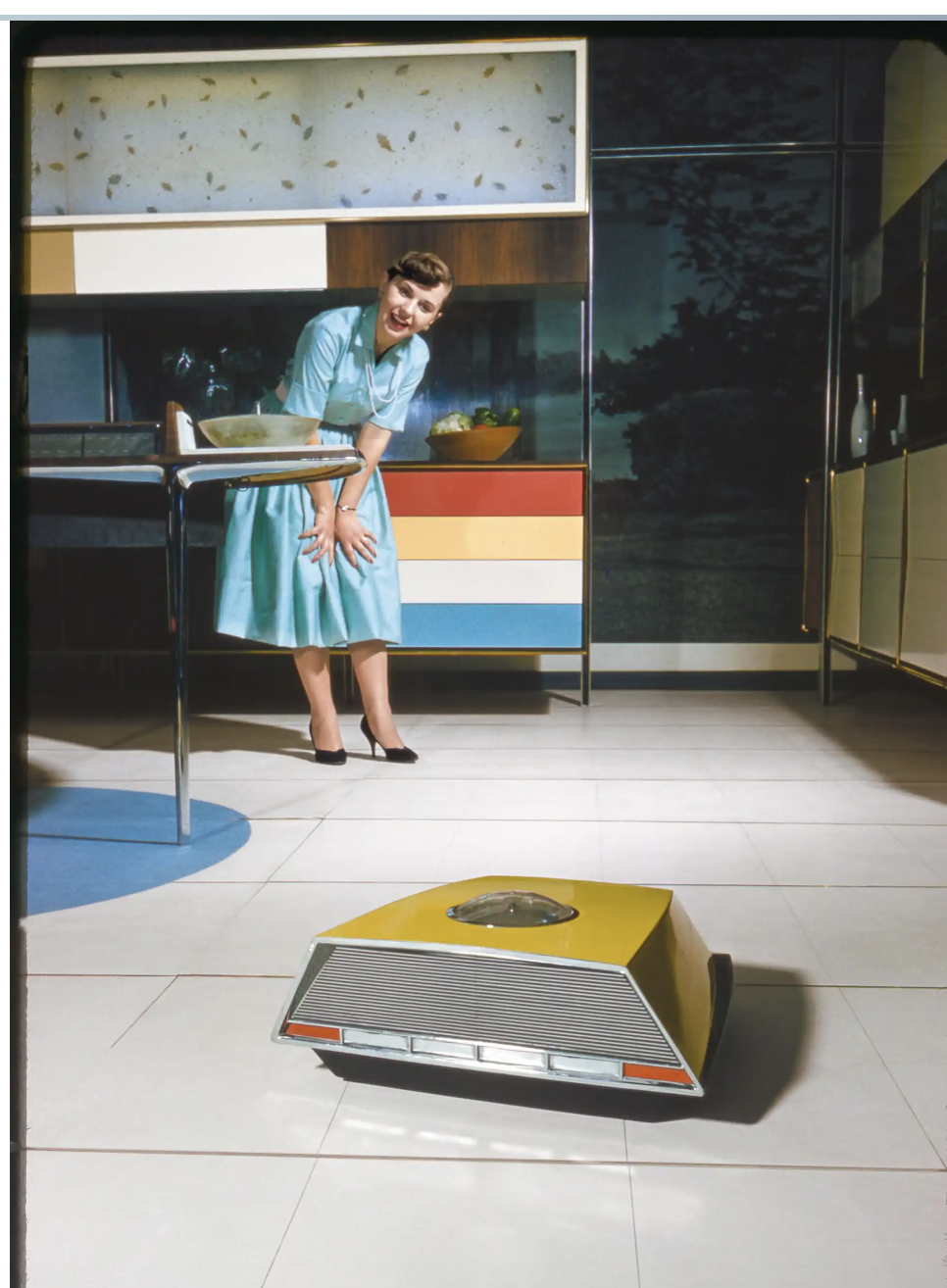
Your kitchen of the future, Soviet style:

Formica vs Corian vs granite vs quartzite vs quartz

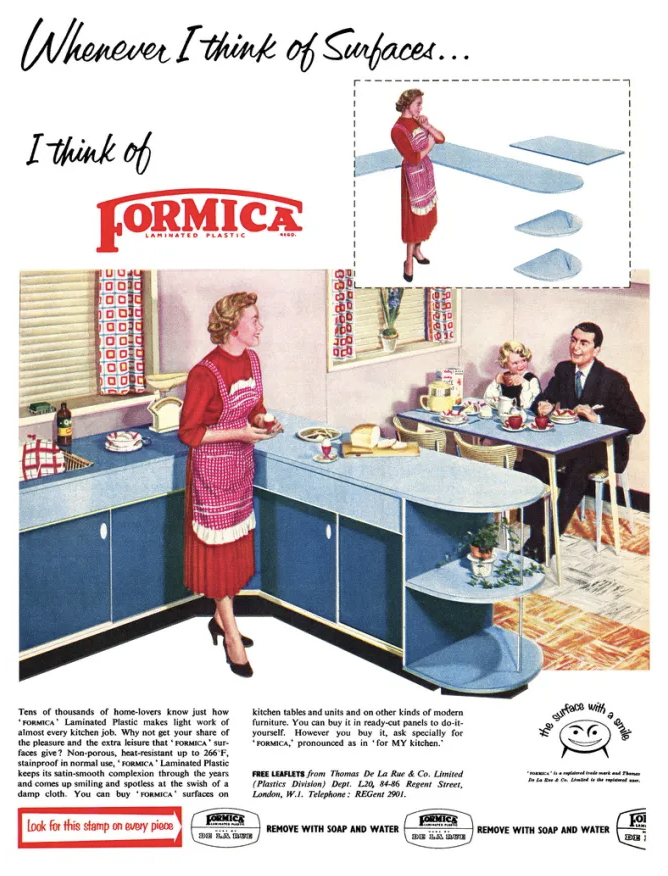
“This housewife is a ‘FORMICA’ kitchen enthusiast – but aren’t we all? Won’t you feel life is good when you own a kitchen where all the surfaces are jewel-bright-clean-at-a-wipe ‘FORMICA’ Laminated Plastic?”

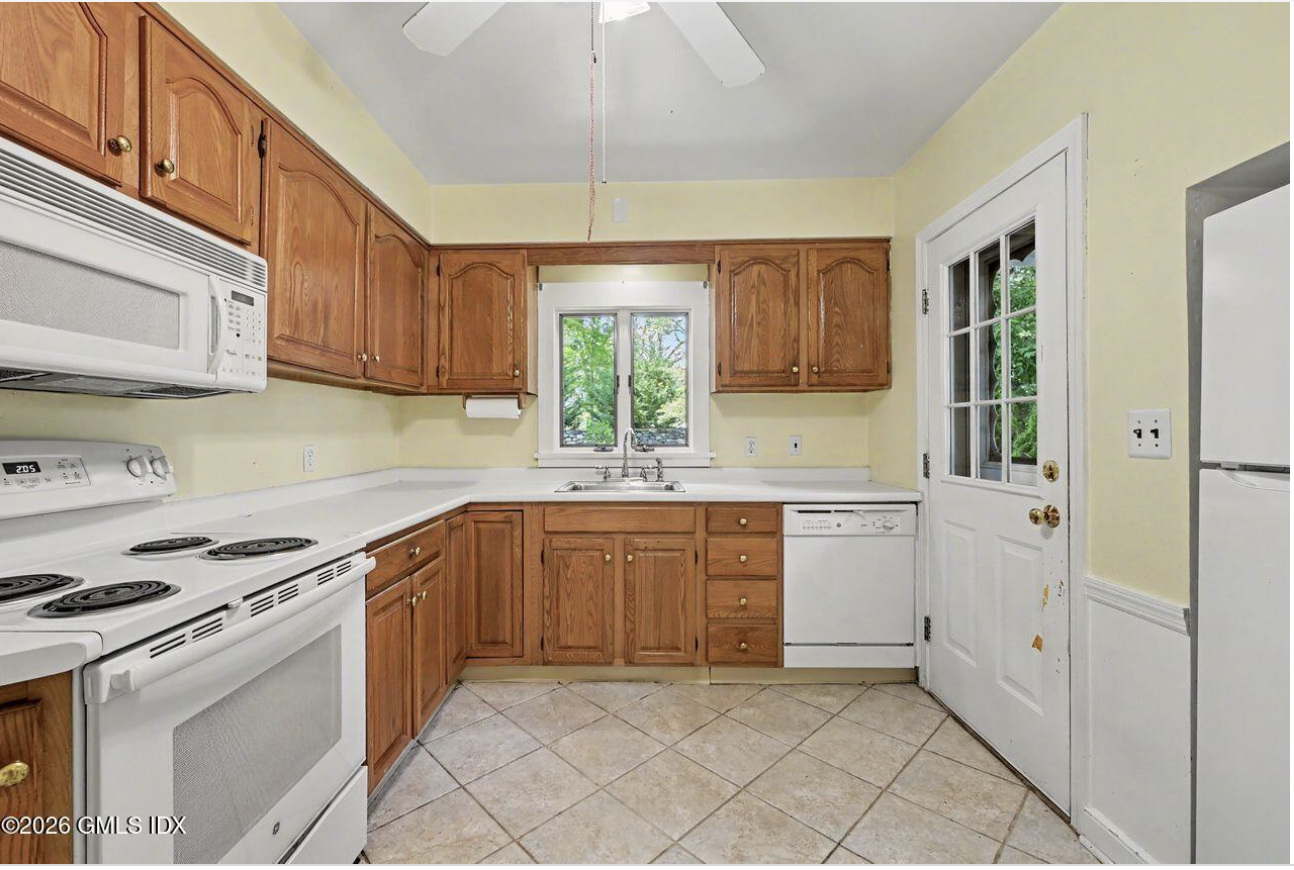
Nothing in real estate goes out of fashion faster than kitchens and bathrooms. Don’t believe me? Do you remember the ubiquitous gold-fixtures/jet pool bathrooms of the 90s? I rest my case.

But let’s not talk about bathrooms today, let’s discuss what’s happened to kitchen countertops, because, why not?

Countertops came to my attention the other day when I ran across an article that blamed granite’s falling-out-of-favor with consumers on, in part, an hysterical fear of silicosis; a lung disease that can be caused by prolonged inhalation of massive amounts of granite dust — common enough in the manufacturing process, and an absolutely non-existent risk from the installed countertops themselves. Doesn’t matter, the absurd overestimation of risk is persistent, as can be seen in the continued use of lead aprons for dental x-rays; they’re are no longer necessary – haven’t been for decades – and in fact can hamper the efficiency of the examination. Dentists and hygienists I’ve spoken with tell me that, while they know that, their patients still demand them, so they remain in use.

So granite’s going (helped along with the television home style shows, which need a continuous supply of fodder to broadcast). What’s next? Today, it’s Quartzite and Engineered Quartz; tomorrow, look for Formica to make comeback, and can Corian II be far behind?

Here’s some AI generated stuff explaining the differences:

Market Trends & Popularity

  • National Kitchen & Bath Association (NKBA) data shows that engineered quartz and quartzite have shifted market momentum, with a recent industry forecast ranking quartz and quartzite ahead of granite in designer consideration (with quartzite leading specific designer source lists at around 78%). [1, 2]

  • Granite has slipped to third place in many contemporary trend reports, though it still commands respect for its high heat resistance and unique, organic earth-tones. [1, 2]

Key Material Differences

  • Engineered Quartz: An artificial composite made of crushed quartz stone bound with resins. It is non-porous (requires no sealing), highly uniform in pattern, and easy to clean, though less heat-resistant than natural stone. [1, 2, 3]

  • Natural Quartzite: A 100% natural metamorphic rock transformed from sandstone. It offers the coveted, soft veining look of marble combined with a hardness level superior to granite, though it is porous and needs periodic sealing. [1, 2, 3]

  • Granite: A natural igneous rock known for bold, speckled, or exotic patterns and superior resistance to heat, though it requires regular sealing to prevent staining.

But wait, there’s more!

Quartz vs. Quartzite: Here's the One Experts Say Is Best for Your Home

And:

Are Granite Countertops Outdated in 2026? A Practical Answer

1. Why Granite (and Stone) Left Corian Behind

While HGTV and home improvement shows undeniably amplified the "granite craze" to the masses, the preference in ultra-luxury markets like Greenwich came down to fundamental material differences:

  • The Luxury Value of Rarity: Corian is an engineered, man-made acrylic polymer. No matter how premium the blend, it is a factory product that can be infinitely replicated. Granite, marble, and quartzite are geological art pieces formed over millions of years. Wealthy homebuyers value the exclusivity of owning a completely unique, non-replicable slice of the earth. [1, 2, 3, 4, 5]

  • The "Plastic" vs. "Cold Stone" Feel: In high-end kitchens, weight and tactile feedback matter. Corian is chemically a plastic, which means it feels warm to the touch and sounds hollow when a glass is set down. Granite is heavy, dense, and permanently cool—sensory traits that buyers instinctively associate with wealth and structural permanence. [1]

  • The Achilles' Heel of Corian (Heat): In a high-end chef's kitchen, Corian has a major functional drawback: it melts and scorches at roughly 212°F. Accidentally setting a hot cast-iron skillet directly on a Corian counter will permanently scar or discolor it. Granite is entirely impervious to direct heat from a stove or oven. [1, 2]

While Corian holds the advantage of being completely non-porous and seamlessly repairable, high-end buyers overwhelmingly chose the prestige [emphasis added] and heat resistance of stone.

2. The Safety Panic: What is Replacing Silica-Heavy Stone?

Your intuition regarding the "panicky homeowner" and fabricator safety is spot on. The industry is currently facing a massive reckoning over silicosis—a fatal lung disease caused by breathing in fine crystalline silica dust generated when cutting engineered stone and certain natural rocks. Australia completely banned engineered stone (quartz) because of this, and California has enacted strict emergency regulations to protect workers.

While the dust poses a severe danger only to the workers cutting the slabs during manufacturing and installation (it is perfectly safe and inert once installed in the home), the bad press and shifting tastes are driving luxury homeowners away from standard engineered quartz and speckled granite.

The modern replacements in top-tier homes include:

  • Natural Quartzite: Not to be confused with engineered quartz, quartzite is the current undisputed king of luxury real estate. It is a natural metamorphic rock that offers the spectacular, dramatic veining of high-end marble but is actually harder and more scratch-resistant than granite. Homes with quartzite countertops are commanding a premium at resale. [1, 2, 3, 4]

  • Porcelain Slabs: This is the massive technical leap forward. Large-format porcelain slabs are engineered from clay, but they are fired at such high temperatures that they become entirely non-porous, highly heat-resistant, and scratch-proof. High-end porcelain can beautifully mimic rare marbles, and because it contains significantly less crystalline silica than quartz, it is being embraced as a safer option for fabrication. [1, 2]

  • Sintered Stone: Brands like Lapitec and Dekton have developed "silica-free" or ultra-low silica mineral slabs made entirely of natural minerals bonded under extreme heat and pressure. They are practically indestructible—impervious to UV light, scratching, and direct flame.

All of which is far more than you ever needed or wanted to know, but here it is.

If a WNBA team runs into the forest and no one's there to see them, have they really run at all?

WNBA's bizarre national anthem controversy shows just how much the league needs Caitlin Clark

Matt Calkins:

Caitlin Clark isn't quite the women's basketball equivalent of Tiger Woods, but there's a reason she's been compared to the 15-time major champion.

She brought millions of new eyeballs to a league that had long struggled for mainstream attention. She's also a marketing juggernaut, with endorsement deals from the likes of Nike, Gatorade and State Farm. But like Tiger in his prime, perhaps the greatest measure of Clark's star power is that when she's absent — the audience is, too.

Nothing illustrates that phenomenon better than the WNBA's national anthem controversy.

All year long, players and coaches from the Atlanta Dream and Golden State Valkyries have been running off the court before the Star-Spangled Banner is played. Then, just after "the home of the brave" is sung, they return to the floor. Neither team has publicly explained why it follows this routine, nor have they said what the players and coaches do during those 90-some-odd seconds. But the wildest part of all this is that, until these WNBA Finals — nobody seemed to notice.

If an NFL or NBA team had engaged in a similar practice during the regular season, it would be one of the biggest sports stories — or even news stories — in the country. Pundits would be regularly weighing in on the matter, activists would be mobilizing, and a nationwide debate on the issue would ensue.

…. But a Caitlin-free WNBA game simply doesn't matter to the majority of American sports fans. The scheduled start time for Game 6 speaks to that.

Monday, it was announced that what could be the final WNBA game of the season will be played at 12:30 p.m. Eastern time on a Thursday. The reasoning is that the Dream wanted a venue change — moving the game from Gateway Center Arena (capacity 3,500) to State Farm Arena (17,000). The problem is that the Hawks are scheduled to play that same day, meaning Game 6 will occur when most Americans are working or in school. Again, it's hard to believe that happens if Clark and the Fever were involved.

This national anthem mystery is one of the more bizarre sports stories I've ever seen. That players and coaches have repeatedly left the court without offering an explanation is strange enough. That it's taken this long for anyone to notice might be even stranger.

But this is what happens when the league's true needle-mover isn't on the court. Caitlin Clark has made the WNBA impossible to ignore. Without her, apparently, it's still remarkably easy.

Perhaps when the Atlanta Dream’s top draft starts playing later this year, attendendance will soar to, say, 22? 23?